

The first time I pulled a refractor, I didn’t know what I was holding. It was 2002, and I’d just ripped a pack of Topps Star Wars Attack of the Clones at a Walmart checkout line.
The Anakin base card caught light as I tilted it, throwing rainbow prisms across my hand like a lightsaber blade made of chrome and starlight. I thought the card was misprinted. I kept it anyway. Fifteen years later, I learned that “misprint” was worth more than the entire box.
That’s the thing about modern Star Wars cards; they’re designed to surprise you. Where vintage cards from 1977 gave you photography and nostalgia, modern releases give you technology, artistry, and the thrill of the chase. Refractors that shimmer like holograms. One-of-one sketch cards drawn by hand. Autographs signed on-card by the actors who brought the galaxy to life. Relic cards with actual costume fabric embedded in cardboard.
This guide covers the best modern Star Wars sets from 1993 to 2025, the inserts that define them, and how to build a collection that balances nostalgia with investment potential.
What Are Modern Star Wars Trading Cards?
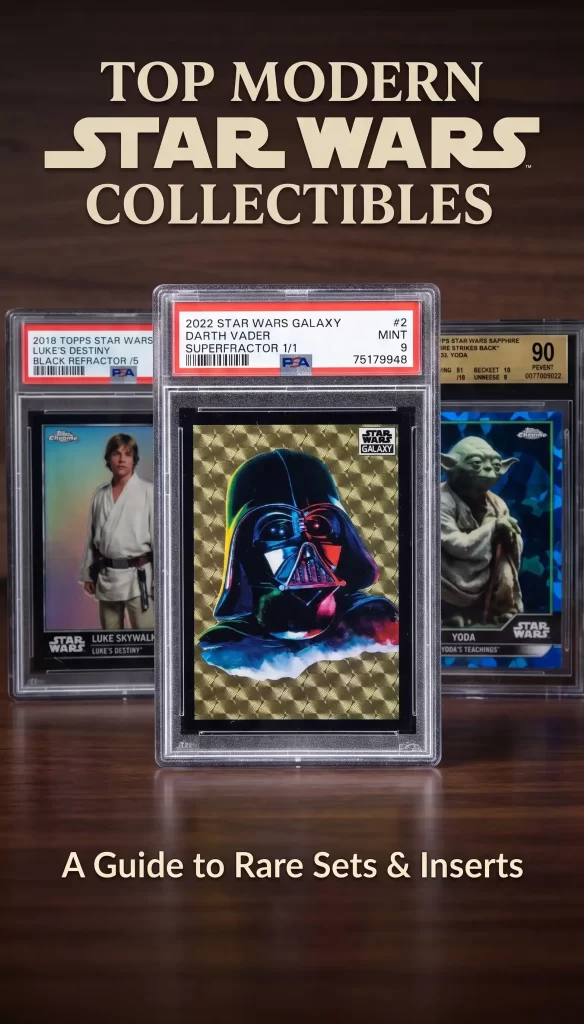
Modern Star Wars trading cards are licensed collectibles produced from 1993 onward, characterized by premium production techniques including chromium technology, serial-numbered parallels, autograph cards, sketch cards, and costume relic cards. These sets shifted the hobby from photography-driven base cards to insert-driven chase content.
The dividing line between vintage and modern isn’t arbitrary. Topps Galaxy in 1993 introduced painted artwork, premium cardstock, and limited-edition chase sets that fundamentally changed what collectors expected from a Star Wars product.
No longer were you just completing a base checklist. You were hunting foil parallels, artist-signed cards, and inserts numbered to 500 copies or fewer.
Modern releases embrace scarcity as a feature. A vintage set from 1977 might have 330 cards and everyone could theoretically complete it.
A modern Chrome set might have 100 base cards but also 15 different parallel tiers, 50 autograph signers, 200 one-of-one sketch variations, and relic cards featuring fabric from actual movie costumes. Completion is impossible. The hunt is the point.
What Was Topps Galaxy, and Why Does It Matter?
Topps Galaxy (1993-1995) was the first modern premium Star Wars card set, featuring original painted artwork by legendary fantasy and sci-fi artists instead of film stills. Galaxy introduced collectors to the concept of art-driven cards and established the blueprint for future premium releases.
Galaxy Series 1 launched in 1993 with 140 base cards showcasing paintings, illustrations, and reimagined character portraits. Artists like Joe Jusko, Dave Dorman, and the Brothers Hildebrandt contributed work that looked more like gallery pieces than trading cards. The cardstock was thicker. The finish was glossy. The imagery was bold, dramatic, and sometimes wildly interpretive.
I still remember the first Galaxy card I ever saw, a Dave Dorman painting of Boba Fett standing in Jabba’s palace, backlit by torchlight, looking like something out of a Frank Frazetta fantasy cover. It didn’t look like a Kenner action figure or a movie still. It looked like art. That shift in perception opened the door for everything that followed.
Galaxy II arrived in 1994 with 135 cards, leaning harder into surrealism and stylistic diversity. Galaxy III in 1995 scaled down to 90 base cards but introduced etched-foil chase inserts that caught light like holographic stickers. The series ended after three releases, but its legacy lives on in every art-focused insert set Topps has produced since.
What Is Topps Widevision and How Did It Change Card Design?
Topps Widevision introduced oversized cards with a 16:9 cinematic aspect ratio that matched the theatrical film frame, allowing collectors to experience Star Wars scenes as they appeared on screen rather than cropped into standard card dimensions.
The first Widevision set launched in 1995, covering A New Hope with 120 base cards pulled directly from film frames. Each card measured roughly 2.5″ x 5″, making them too large for standard binders and toploaders. Collectors had to buy specialty storage. The inconvenience didn’t matter. The cards were gorgeous.
Widevision captured shots that standard cards couldn’t: the full Death Star trench run, the complete throne room duel, wide-angle Tatooine landscapes. The format also introduced chromium parallels and embossed chase cards, foreshadowing the refractor era that was about to explode.
Widevision sets followed for The Empire Strikes Back, Return of the Jedi, the Special Editions, and eventually the prequel trilogy. Modern collectors still hunt these sets because the photography holds up better than almost any other Star Wars product from the 1990s.
How Did the Prequel Trilogy Change Modern Star Wars Cards?
The prequel trilogy (1999, 2002, 2005) introduced autograph cards, costume relic cards, and serial-numbered parallels as standard pack inserts, transforming Star Wars cards from a photography hobby into a hit-driven chase product modeled after sports card releases.
When Episode I: The Phantom Menace hit theaters in 1999, Topps launched with multiple products: base sets, Widevision, Chrome, and premium boxes with guaranteed hits. For the first time, you could pull a card with Liam Neeson’s signature or a fabric swatch from Natalie Portman’s Queen Amidala gown. These weren’t mail-in redemptions or convention exclusives.
They were pack pulls. The math changed overnight. A $3 pack might contain 7 base cards and a Jar Jar Binks common, or it might contain a Hayden Christensen autograph worth $200. The variance created gambling-style excitement that hooked a new generation of collectors and drove box prices skyward.
Key sets from the prequel era include the following:
- 1999 Topps Star Wars Episode I Series 1 & 2: first widespread autographs and relics
- 2001 Topps Star Wars Evolution: timeline-spanning set with multi-era autographs
- 2002 Topps Star Wars Attack of the Clones: Chrome refractors and sketch cards debut
- 2005 Topps Star Wars Revenge of the Sith: premium autograph checklist and dual-relic cards The prequel generation grew up ripping these packs. Now they’re adults with disposable income, and prequel-era autographs have appreciated significantly as nostalgia has rehabilitated the films culturally.
What Is Topps Chrome and Why Do Collectors Chase Refractors?
Topps Chrome is a premium card line printed on chromium stock that produces a reflective, prismatic surface. Refractors are parallel versions of base cards with rainbow-like light diffraction that makes them visually distinctive and highly collectible.
Chrome technology migrated from baseball cards to Star Wars in the early 2000s and never left. A base Chrome card is already shinier and more vibrant than standard cardstock. A Refractor parallel adds prismatic shimmer. Numbered parallels restrict print runs further, creating artificial scarcity that drives chase behavior.
The typical Chrome parallel ladder looks like this:
| Parallel Type | Appearance | Numbering | Rarity |
|---|---|---|---|
| Base Chrome | Reflective silver | Unlimited | Common |
| Refractor | Rainbow prism | Unlimited | Uncommon |
| Prism Refractor | Enhanced rainbow | Numbered /199 | Scarce |
| Gold Refractor | Gold shimmer | Numbered /50 | Rare |
| Orange Refractor | Orange shimmer | Numbered /25 | Very Rare |
| Red Refractor | Red shimmer | Numbered /5 | Extremely Rare |
| SuperFractor | Full rainbow | Numbered 1/1 | One of One |
Each tier is progressively harder to pull and exponentially more valuable. A base Chrome Darth Vader might sell for $2. A Gold Refractor /50 might sell for $100. A SuperFractor 1/1 might sell for $5,000+.
I’ve ripped hundreds of Chrome packs. I’ve pulled exactly two Red Refractors in my life. One was a background Stormtrooper. The other was a young Obi-Wan that I immediately sleeved, top-loaded, and have never once considered selling. The red shimmer is hypnotic. You tilt the card and watch light dance across Ewan McGregor’s face like you’re holding a fragment of Kyber crystal.
What Are Sketch Cards and Why Are They One-of-One?
Sketch cards are original hand-drawn artworks on blank trading card stock, created by licensed artists exclusively for insertion into modern Star Wars products. Each sketch card is unique, signed on the back, and functions as a miniature piece of commissioned art randomly inserted into packs.
Topps contracts with dozens of artists, professional illustrators, comic book artists, concept designers, and provides them with blank card stock. The artists draw original Star Wars scenes, characters, or portraits directly on the cards using pencil, ink, marker, or paint. Each finished sketch gets authenticated, numbered 1/1, and randomly inserted into retail or hobby packs.
Sketch cards represent the ultimate lottery ticket. You could rip a pack at Target and pull a museum-quality Brian Kong Ahsoka Tano ink portrait worth $2,000. Or you could pull a stick-figure Ewok by an unknown artist worth $50. The variance is enormous. The excitement is addictive.
The best artists command premiums. Collectors track which artists are in each release and hunt their work specifically. Names like Cat Staggs, Jeff Mallinson, Tyson Beck, and Randy Martinez are instant value signals. A Staggs sketch of Rey or a Mallinson Darth Vader can sell for mid-four figures if the artwork is exceptional.
I’ve pulled one sketch in my entire collecting life. It was a colored-pencil portrait of a Rebel pilot I didn’t recognize, signed by an artist whose name I had to Google. I loved it anyway. It’s framed on my office wall. Someone drew that card by hand, specifically for the set I opened, and I happened to be the person who found it. That’s magic you can’t manufacture.
What Are the Best Modern Star Wars Sets to Collect?
The best modern Star Wars sets to collect depend on your budget, preferred era, and whether you chase hits or complete base sets. Here are the tier-one releases that define the modern hobby:
- Topps Chrome Star Wars (2015-Present) Annual releases with base cards, refractor parallels, autographs, and sketch cards. Chrome is the flagship modern product. Clean design, reliable parallels, and strong resale value. Every serious modern collector owns at least one Chrome set.
- Topps Star Wars Masterwork (2018-Present) Ultra-premium product with thick card stock, on-card autographs, canvas art cards, and manufactured relic booklets. Boxes cost $200+ and contain only 10-12 cards, but every card is a hit. This is the high-end showcase product.
- Topps Star Wars Galaxy (2018 Reboot-Present) Modern continuation of the 1993 classic, featuring all-new painted artwork and sketch variants. The 2018 reboot returned to the original’s art-first philosophy while adding autographs and manufactured patches. A perfect blend of nostalgia and modern hits.
- Topps Star Wars Living Set (2019-2022) Weekly print-to-order releases featuring two cards per week available only during a limited sales window. No parallels, no inserts, just base cards with limited-run scarcity. Affordable entry point with built-in collectibility.
- Topps Star Wars Stellar Signatures (2020-Present) Autograph-focused product with massive checklists covering every film, series, and animated show. If you’re chasing a specific actor’s signature, Stellar Signatures probably has it.
Each set serves a different collecting goal. Chrome is the safe annual buy. Masterwork is the luxury splurge. Galaxy is the art collector’s choice. Living Set is the budget completionist path.
Stellar Signatures is the autograph hunter’s paradise.
How Do Modern Autograph Cards Work?
Modern autograph cards feature signatures from actors, directors, and crew members directly on the card or on a sticker affixed to the card. On-card autographs are universally preferred and command higher prices than sticker autographs due to aesthetic quality and authenticity feel.
Topps contracts with actors during production, conventions, or private signings. The actor signs a predetermined number of cards or stickers, which are then inserted into packs at fixed odds (e.g., 1:24 packs for a common signer, 1:288 for a rare signer). The scarcity varies based on the actor’s willingness to sign, their contract terms, and their perceived value to collectors.
Key autograph tiers in modern Star Wars products:
- Common Tier: Background characters, minor roles, animated voice actors. Print runs of 100+ copies. Found in most hobby boxes.
- Mid Tier: Supporting cast members, popular recurring characters. Print runs of 25-99 copies.
Requires multiple boxes to hit.
- Rare Tier: Main cast from original, prequel, and sequel trilogies. Print runs of 10-24 copies.
Found in premium products or case breaks.
- Ultra Rare Tier: Mark Hamill, Harrison Ford, Carrie Fisher (archive signatures). Print runs under 10 copies or completely unlisted. Auction-level cards.
On-card autographs show the pen touching card stock. Sticker autographs show a clear adhesive label with the signature on top. Collectors overwhelmingly prefer on-card because it feels more authentic and photographs better in hand.
A Mark Hamill on-card autograph sells for 2-3X what an equivalent sticker version sells for, even though both are official Topps products.
I own exactly three Star Wars autographs: a Hayden Christensen on-card from 2002 that I pulled myself, a Daisy Ridley sticker I bought at a card show for $60, and a John Boyega sticker I got as part of a trade.
The Christensen is my pride. I was there when the pack opened. I felt the cardboard, saw the signature, and knew I’d just pulled something I’d never sell.
What Are Relic Cards and Do They Contain Real Costumes?
Relic cards contain embedded pieces of material authenticated as coming from costumes, props, or set pieces used during Star Wars film or television production. The fabric, leather, or material is cut into small swatches and inserted into die-cut windows on the card.
Topps partners with Lucasfilm and costume departments to acquire production-used materials after filming wraps. These materials are cut, authenticated, and distributed across relic card print runs. A typical relic card might contain a 1″ x 0.5″ swatch of fabric from Kylo Ren’s cloak, Rey’s scavenger outfit, or Obi-Wan’s Jedi robes.
The authenticity is real but the romance is oversold. That fabric swatch didn’t necessarily touch Adam Driver’s skin or appear on screen for more than a few frames.
It came from a costume used during production, but production uses multiples, backups, and stunt doubles. The swatch is genuine production material, not necessarily the hero costume from the iconic scene.
Still, holding a card with actual Empire Strikes Back costume fabric embedded in it feels special. These are physical pieces of the films, preserved in cardboard, distributed to collectors worldwide. Even if the swatch came from a backup tunic or a background extra’s outfit, it’s a tangible connection to the production process.
Dual and triple relic cards combine swatches from multiple characters or actors. A Luke/Vader dual relic card might have fabric from both costumes side by side. Limited to print runs of 50 or fewer, these cards trade at significant premiums over single relics.
Which Modern Insert Sets Are Worth Chasing?
The best modern insert sets combine visual appeal, limited print runs, and thematic coherence. Here are the inserts that consistently hold value and collector interest:
- Lightsaber Duel Inserts: Thematic subsets showcasing iconic battles (Obi-Wan vs. Anakin, Luke vs. Vader, Rey vs. Kylo). Often printed on premium stock with foil stamping or etched designs.
- Character Focus Inserts: Subsets dedicated to individual characters across multiple films (Evolution of Darth Vader, Journey of Rey). Completionists chase these aggressively.
- Artist Autograph Inserts: Cards featuring original artwork signed by the artist who created it.
These bridge sketch cards and traditional autographs, combining visual appeal with signature scarcity.
- Film Cel Inserts: Cards containing actual 35mm film frames from theatrical releases.
Controversial because film preservation purists hate seeing prints cut up, but collectors love the tangible film connection.
- Manufactured Patches: Embroidered patches featuring character logos, faction symbols, or ship silhouettes. Not production-used, but visually striking and popular for display.
The key to valuable inserts is intersection: visual appeal + scarcity + thematic demand. A generic “Background Aliens” insert set numbered to 500 won’t move. A “Iconic Lightsaber Duels” etched-foil set numbered to 99 will sell out immediately.
How Has the Disney+ Era Changed Modern Star Wars Cards?
The Disney+ era introduced serialized television content (The Mandalorian, Andor, Ahsoka, The Bad Batch) that generates year-round card releases tied to streaming debuts rather than waiting for theatrical films. This shift created sustained collector engagement and expanded the autograph pool beyond film actors.
Before Disney+, Star Wars card releases clustered around film premieres every few years. Between films, the hobby cooled. Disney+ changed the rhythm. The Mandalorian Season 1 launched in 2019, and Topps had cards in production before the season finale aired. Grogu (Baby Yoda) became the most-chased character in modern Star Wars cards within six months.
The streaming model allows Topps to release themed products for individual series. We now get Mandalorian-specific sets, Ahsoka-specific autographs, and Andor-focused inserts. Actors like Pedro Pascal, Rosario Dawson, and Diego Luna sign cards tied to their characters in ways that wouldn’t have been feasible during the film-only era.
This also democratized autograph access. Where Mark Hamill and Harrison Ford autographs are vanishingly rare, Pedro Pascal and Katee Sackhoff autographs appear in nearly every Stellar Signatures release. The volume makes them affordable, and the affordability makes them attainable for casual collectors.
What Should New Collectors Buy First?
New collectors should start with a recent Topps Chrome base set in raw condition, then add one or two low-tier autographs of characters they personally love. This combination teaches you modern card structure, parallel tiers, and hit distribution without breaking the bank.
A complete Topps Chrome base set from 2023 or 2024 costs $30-$50 on eBay. Buy one. Hold the cards. See the refractor shimmer in person. Learn which characters command premiums and which are bulk commons. Understand the product structure before you start chasing numbered parallels or autographs.
Then buy an autograph. Not an investment-grade Mark Hamill. Not a low-population 1/1. Buy a character you actually like. A Grogu autograph from an artist who illustrated him. A Moff Gideon signature from Giancarlo Esposito. A Hera Syndulla from Vanessa Marshall. Spend $20-$75 and own a card that makes you smile.
Once you’ve handled base cards and autographs, you understand the modern hobby. From there, decide your path: complete sets, chase refractors, hunt sketches, or build a PC (personal collection) of one character across every set. All paths are valid. The best path is the one you’ll actually finish.
What’s the Future of Modern Star Wars Cards?
The future of modern Star Wars cards looks bright because Lucasfilm continues producing content at scale, Topps (now Fanatics) remains the exclusive licensee, and collector demand spans three generations of fans from the original trilogy through the Disney+ era.
New films are in development. New Disney+ series launch annually. The Ahsoka fanbase is growing. The Bad Batch concluded and left collectors chasing autographs. Skeleton Crew introduced new characters. The Acolyte expanded the High Republic era. Every release feeds the card pipeline.
Fanatics acquired Topps in 2022 and has signaled continued investment in premium Star Wars products. Digital collecting via apps like Topps Digital is growing but hasn’t cannibalized physical cards. NFTs briefly threatened the hobby in 2021-2022 but collapsed spectacularly, vindicating collectors who stuck with cardboard.
The biggest risk is oversaturation. Too many products, too many autographs, too many parallels can dilute scarcity and exhaust collector budgets. Topps has flirted with this line before. Fanatics will need to balance volume with quality to keep the market healthy.
But as long as Star Wars exists, Star Wars cards will exist. And as long as kids rip packs at Target and adults chase SuperFractors on eBay, the modern hobby will thrive.
The Modern Hobby Is Whatever You Make It
The beautiful thing about modern Star Wars cards is that you can collect however you want. Chase refractors. Hunt autographs. Complete base sets. Build a Darth Vader PC across every product. Focus on sketch cards. Stick to one era. Mix everything.
There’s no wrong way to do it. The hobby is big enough, diverse enough, and accessible enough to accommodate every budget and every interest.
I started with that 2002 refractor I thought was a misprint. Twenty-three years later, I own Chrome sets, Galaxy art cards, a handful of autographs, and one sketch I’ll never sell. My collection isn’t the most valuable. It isn’t the most complete. But it’s mine, and every card in it tells a story.
That’s what modern Star Wars cards are really about. Stories you can hold.
Continue Your Star Wars Card Journey
This article is part of our complete Star Wars trading cards knowledge cluster. Explore more:
- The Ultimate Star Wars Trading Card Guide — The full pillar covering all eras from 1977 to modern Chrome
- 1977 Topps Star Wars Cards: History and Key Cards — Deep dive into the vintage foundation
- Top 10 Most Valuable Star Wars Cards and Why Collectors Love Them — The hobby’s crown jewels explained