
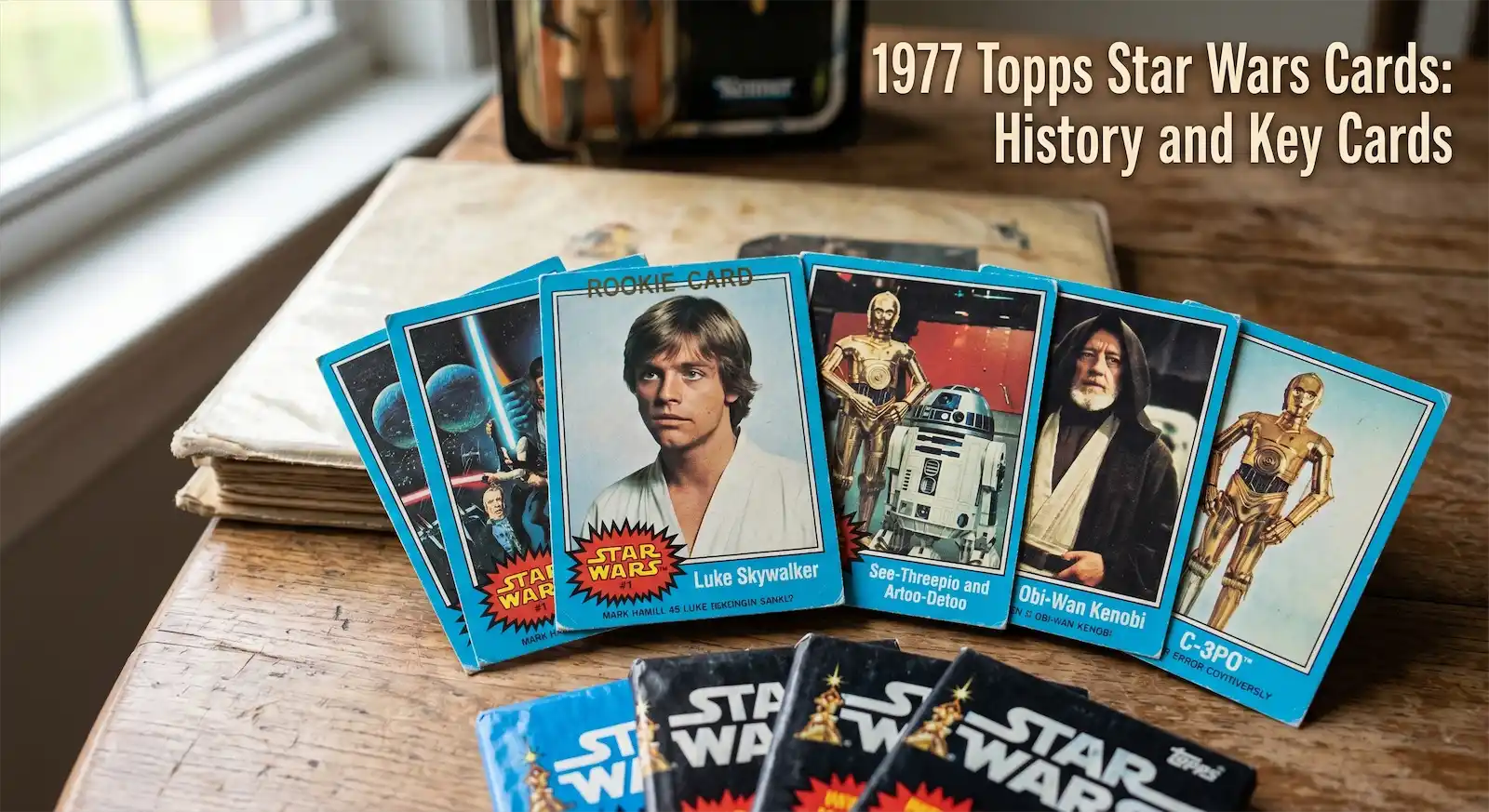

The corner drugstore smelled like floor wax and old magazines. It was July 1977, and I wasn’t even born yet, but my uncle was twelve, clutching two quarters, staring at a spinner rack that had just been restocked with something he’d never seen before. Blue-bordered cards with a logo that read “STAR WARS” in yellow block letters. He bought four packs. Three had doubles. One had card #1.
That Luke Skywalker rookie is still in his collection, raw and ungraded, with a small crease on the bottom-left corner from the day he tried to trade it for a complete set of Wacky Packages. The trade fell through. Forty-seven years later, even with that crease, the card is worth more than the bicycle he rode to that drugstore.
The 1977 Topps Star Wars cards are the foundation of the entire non-sports trading card hobby. They proved that kids would collect characters and stories just as passionately as they collected baseball players.
They introduced design concepts, colored borders, sticker subsets, numbered series, that still define how modern sets are structured. And they created a market that has never stopped growing.
This is the deep history of that set, all five series, all 330 cards, all 55 stickers, and every story worth knowing.
Why Did Topps Release Star Wars Cards in 1977?
Topps released Star Wars cards in 1977 because the film became an unexpected box-office phenomenon, creating instant demand for licensed merchandise that didn’t yet exist. The company scrambled to secure a license from 20th Century Fox and rushed the first series into production while Star Wars: A New Hope was still playing in theaters.
The timing was pure chaos. According to interviews with former Topps executives, the company initially passed on Star Wars during early licensing discussions. Science fiction films had a terrible track record in the mid-1970s, and Topps wasn’t convinced kids would care about space opera the way they cared about superheroes or TV westerns. Then May 25, 1977 happened. Star Wars opened and never stopped selling tickets.
By June, kids were lining up at toy stores demanding action figures that wouldn’t ship until Christmas. Topps saw the gap and moved fast. The first series hit retail shelves in mid-July, less than two months after the film’s release, and sold out almost immediately. Regional distribution was spotty. Some stores got cases. Others got nothing. The scarcity was accidental, but it locked in the set’s future collectibility from day one.
How Many Cards Are in the 1977 Topps Star Wars Set?
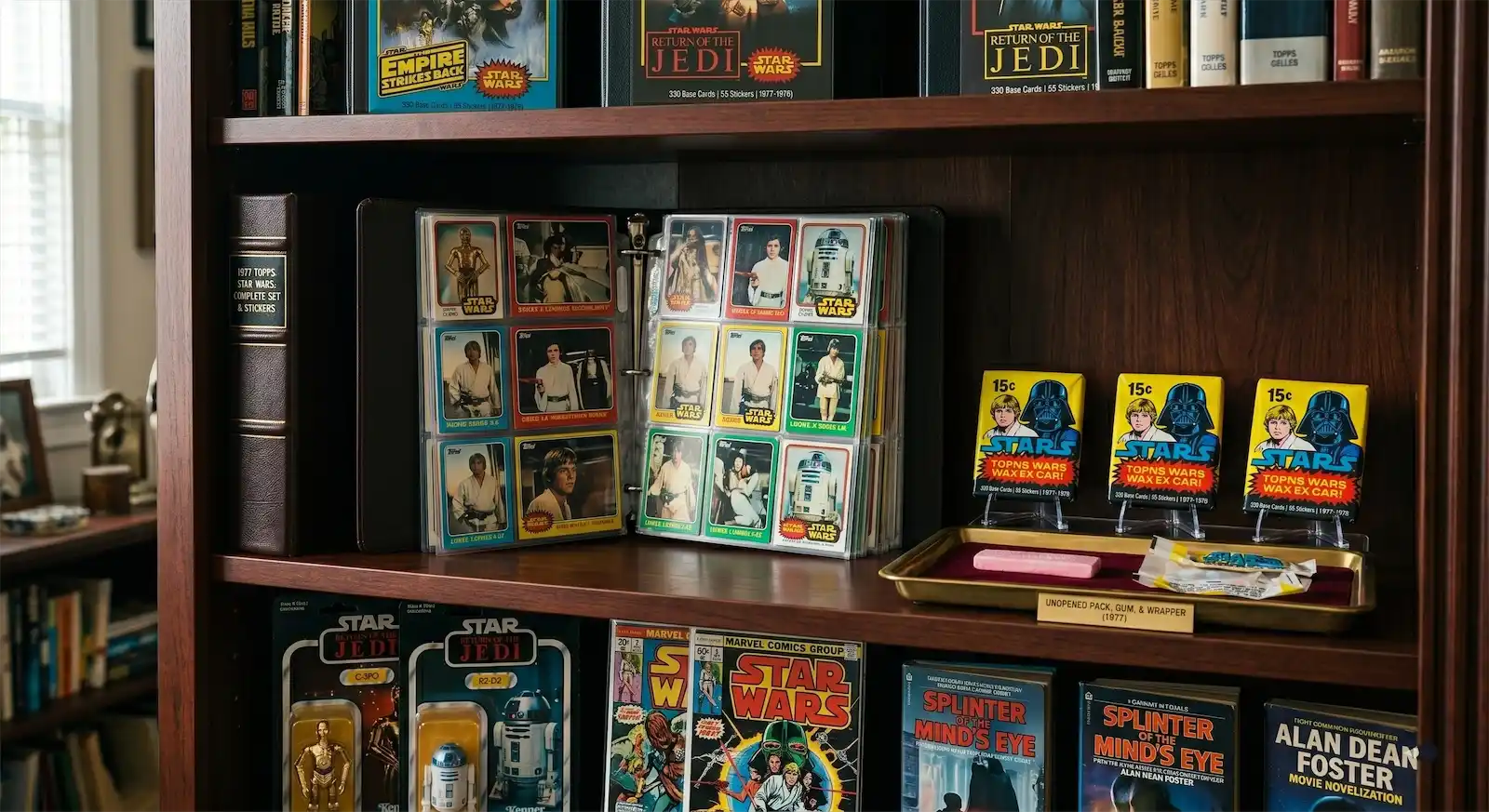
The 1977 Topps Star Wars set contains 330 base cards across five series, plus 55 stickers distributed across the same five series. Each series was released sequentially over the course of 1977 and early 1978, with distinct colored borders so collectors could tell them apart instantly.
Here’s the complete breakdown:
| Series | Border Color | Card Numbers | Sticker Numbers | Release Window |
|---|---|---|---|---|
| Series 1 | Blue | #1-66 | #1-11 | July 1977 |
| Series 2 | Red | #67-132 | #12-22 | September 1977 |
| Series 3 | Yellow | #133-198 | #23-33 | November 1977 |
| Series 4 | Green | #199-264 | #34-44 | January 1978 |
| Series 5 | Orange | #265-330 | #45-55 | March 1978 |
The release cadence matched the film’s theatrical run. As long as Star Wars stayed in theaters, which it did for over a year in some markets, Topps kept printing new series. By the time Series 5 shipped, the film had grossed over $200 million domestically, and the cards were embedded in pop culture alongside the movie itself.
Each wax pack cost 15 cents and contained 7 cards, 1 sticker, and 1 stick of pink Topps bubble gum that tasted vaguely like sweetened cardboard. The gum stained cards.
The wax wrappers tore easily. Kids didn’t care. They ripped packs in parking lots, traded duplicates on school buses, and taped their favorites to bedroom walls. Preservation was not the goal. Living inside the universe was the goal.
What Makes the 1977 Topps Star Wars Photography Special?
The 1977 Topps Star Wars cards featured photography pulled directly from film stills, behind-the-scenes production shots, and promotional materials provided by Lucasfilm, giving each card an authentic cinematic quality that made collectors feel like they were holding pieces of the movie itself.
The images weren’t cropped or staged for cards. They were raw frames from the film, lightsaber duels frozen mid-swing, cockpit close-ups, starfield backgrounds, Tatooine sunsets.
Topps designers added minimal overlays: a thin colored border, a small Topps logo in one corner, and the Star Wars logo across the top. The back of each card included a short caption describing the scene, a card number, and a puzzle piece that, when collected across a full series, formed a larger image.
What makes the photography hold up fifty years later is the grain. Film stock from 1977 had texture. The cards inherited that texture. You can see it in the shadow detail on Vader’s helmet, the dust on Luke’s moisture-farm tunic, the scratches on the Millennium Falcon’s hull. Digital cards today are clinically sharp. The 1977 set looks lived in, which is exactly how the original film looked and felt.
I’ve stared at card #57, the Death Star trench run, more times than I can count. Every time I notice something new. The reflection in Luke’s visor. The scuff marks on his helmet. The way the starfield isn’t perfectly black but has faint noise and color shifts. It’s not nostalgia goggles. The photography is genuinely excellent.
What Are the Key Cards from Series 1 (Blue Borders)?
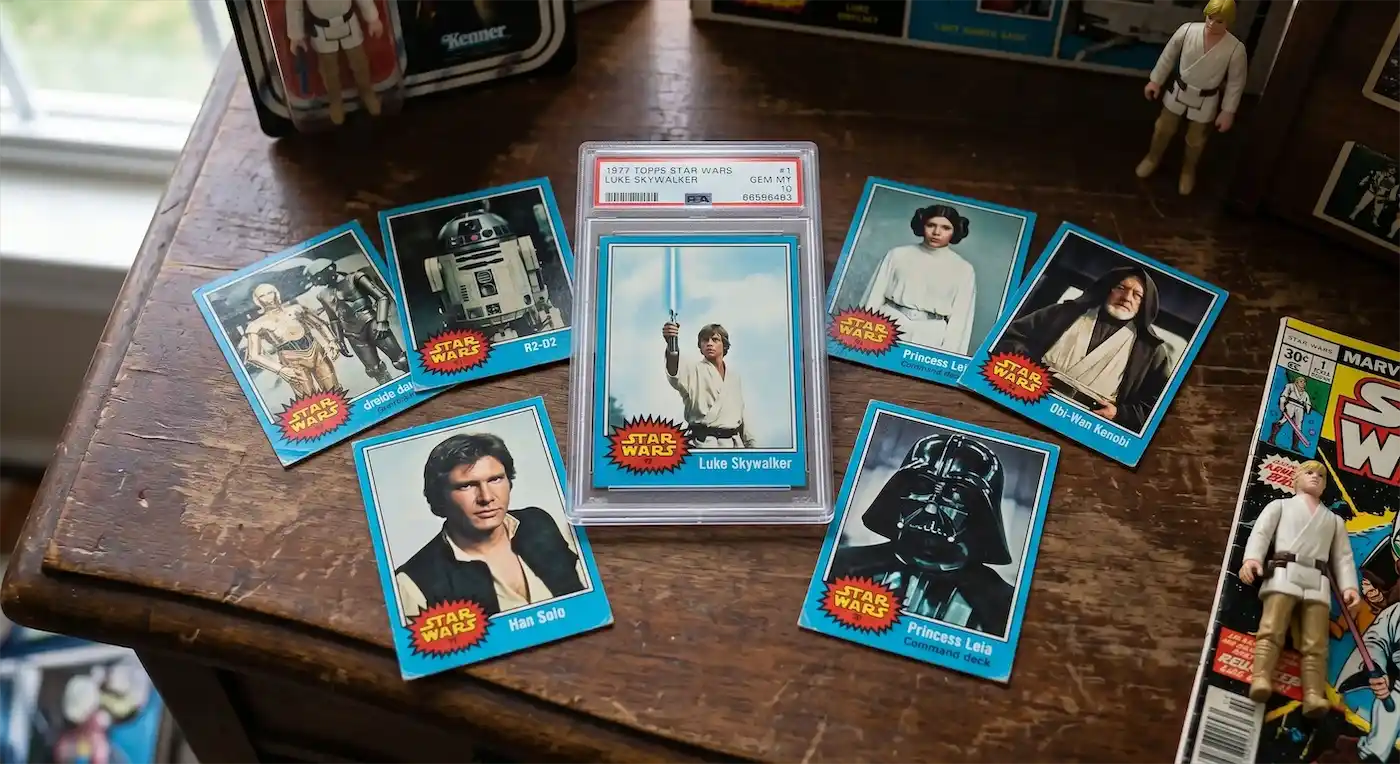
The key cards from Series 1 of the 1977 Topps Star Wars set are cards #1 through #8, which introduce the main cast and are treated by collectors as the “rookie cards” of the Star Wars universe. These cards command the highest prices in high grades because they were the first-ever depictions of these characters in trading card form.
Here’s the complete Series 1 key card list:
- Card 1: Luke Skywalker (the franchise’s de facto rookie card)
- Card 2: See-Threepio and Artoo-Detoo (C3PO and R2-D2 duo shot)
- Card 3: The Little Droid, Artoo-Detoo (R2-D2 solo close-up)
- Card 4: Space Pirate Han Solo (Harrison Ford’s iconic smirk)
- Card 5: Princess Leia Organa (Carrie Fisher in the white gown)
- Card 6: Ben (Obi-Wan) Kenobi (Alec Guinness in Tatooine robes)
- Card 7: Menacing Darth Vader (the helmet, the breathing, the nightmare fuel)
- Card 8: Rebel Leader Princess Leia (second Leia card, command-deck shot) Card #1 is the crown jewel. In PSA 10 condition, it routinely sells for five figures at major auctions.
The image shows Luke holding his lightsaber toward the sky in the classic hero pose, the same shot that appeared on posters, lunchboxes, and bedsheets across 1977. If you could only own one card from the vintage Star Wars era, this is the one.
But here’s the thing collectors don’t talk about enough: even cards #9 through #66 from Series 1 carry premiums over later series because they were first to market. A blue-border Stormtrooper (#20) or Cantina scene (#34) will always trade higher than equivalent shots from red, yellow, or green series, even when the photography is nearly identical. First is first.
Why Are Series 1 Blue Borders So Hard to Find in High Grade?
Series 1 blue border cards are difficult to find in high grades because they were printed first, distributed regionally with inconsistent quality control, and handled heavily by children who had no concept of preservation or future value.
The printing process in 1977 was analog and imperfect. Sheets were cut by mechanical blades that sometimes slipped, creating off-center cards. The blue ink on the borders was prone to chipping during the cutting process, leaving white edges visible on otherwise clean copies. The cardstock itself absorbed moisture from the gum stick included in every pack, which caused subtle warping over time that shows up under modern grading scrutiny as surface issues.
Then there’s the human factor. Kids in 1977 didn’t use penny sleeves. They didn’t know what a toploader was. They traded cards hand-to-hand in cafeterias. They carried stacks in pockets.
They rubber-banded their favorites together and tossed the rest in shoeboxes or, worse, threw them away when they outgrew the hobby. Survival rates for Gem Mint copies are brutally low.
PSA’s population reports reflect this. As of early 2025, fewer than 100 PSA 10 examples exist of card #1 across all submissions in the company’s history. Compare that to modern releases where PSA 10 populations for key rookies can hit four or five figures within the first year. Scarcity drives value. Scarcity plus iconic imagery drives lasting value.
What Is the C3PO #207 Error Card?
The C3PO #207 error card is a printing anomaly from Series 4 of the 1977 Topps Star Wars set, where C3PO’s lower body appears to have an anatomically suggestive feature caused by a misaligned airbrush or printing plate error. It is the most famous mistake in non-sports card history.
The card shows C3PO standing in his full golden armor against a neutral background, a standard publicity still from Lucasfilm. But during the printing or plate-making process, something went wrong. A shadow, a color-registration error, or an overzealous airbrush stroke created what looks like, to put it delicately, male anatomy where C3PO’s lower waist plating should be.
Topps caught the error quickly and corrected the print run, but thousands of error copies had already been distributed. The corrected version removed the offending feature, but by then the damage, or the legend, was done. Collectors immediately began hunting for the error variant, and it became the single most talked-about card in the set.
High-grade examples of the error are absurdly rare. Raw copies in clean condition sell for hundreds. Graded PSA 9 or PSA 10 examples sell for thousands. The corrected version, by comparison, is worth normal Series 4 pricing. The error elevated an otherwise unremarkable character card into a hobby icon.
I’ve only seen one in person — a raw copy at a card show in the late 2000s, sitting in a dollar bin because the dealer didn’t know what he had. A kid who couldn’t have been older than sixteen picked it up, flipped it over to check the number, then looked at the front again and started laughing. He bought it on the spot. I should have bought it first.
How Do the Other Four Series Compare?
The remaining four series, red, yellow, green, and orange borders, expanded the card checklist to cover more scenes, secondary characters, vehicles, and alien creatures, but they lack the first-to-market premium and rookie-card psychology of Series 1.
Series 2 (Red Borders) introduced more action-heavy shots: lightsaber duels, Millennium Falcon escapes, Death Star interiors. Key cards include #95 (Han and Chewie in the cockpit) and #109 (the iconic trash compactor scene). Print quality improved slightly, and distribution widened, which means these cards survive in higher quantities and lower average prices than Series 1.
Series 3 (Yellow Borders) leaned into the alien cantina characters and expanded the droid roster. Collectors love #145 (Greedo) and #147 (the Cantina Band), which have aged into meme-tier cultural relevance. The yellow borders show condition issues more visibly than darker-colored series, so high-grade copies still command premiums despite larger print runs.
Series 4 (Green Borders) is home to the C3PO #207 error, which overshadows nearly every other card in the series. Beyond the error, this series features the most vehicle-heavy photography, TIE fighters, X-wings, the Death Star exterior. Card #213 (the Death Star plans) and #233 (the medal ceremony) are quietly underrated.
Series 5 (Orange Borders) closed out the set with a mix of action climax shots and behind-the-scenes production photos. The orange borders are the most visually polarizing, some collectors love the warmth, others find it garish. Card #265 (the final battle) and #330 (the closing shot) function as narrative bookends and trade slightly higher than mid-series commons.
Here’s a quick value comparison across all five series for mid-grade (PSA 7-8) commons:
| Series | Border | Avg PSA 7 Common | Avg PSA 8 Common |
|---|---|---|---|
| Series 1 | Blue | $15-$25 | $30-$50 |
| Series 2 | Red | $8-$12 | $15-$25 |
| Series 3 | Yellow | $8-$12 | $15-$25 |
| Series 4 | Green | $8-$12 | $15-$25 |
| Series 5 | Orange | $8-$12 | $15-$25 |
Series 1’s premium is undeniable. The other four trade relatively flat unless you’re chasing specific character or error cards.
What Role Do the Stickers Play?
The 1977 Topps Star Wars stickers served as parallel chase content, with 11 stickers released per series for a total of 55 across the entire run. Each sticker featured die-cut character artwork or scene photography and was designed to be peeled and applied to notebooks, lunchboxes, or bedroom walls, which is exactly why high-grade stickers are rarer than the cards themselves.
Stickers were functional. Kids used them. A mint, unpeeled sticker with perfect glue adhesion and sharp die-cut edges surviving into 2025 is the exception, not the rule. Grading companies treat stickers as their own category, and PSA 10 stickers from Series 1 can rival the prices of key cards.
The sticker backs also included puzzle pieces, similar to the card backs, which encouraged completionists to chase both the card puzzle and the sticker puzzle. The dual-puzzle mechanic was brilliant from a sales perspective, it doubled the engagement and kept kids buying packs long after they’d completed one subset.
My favorite sticker remains #23 from Series 3, the yellow-bordered Darth Vader die-cut. The artwork shows Vader’s helmet in three-quarter profile with sharp black shadows and metallic highlights. It’s perfect. I’ve never seen a raw copy that wasn’t creased, corner-lifted, or missing chunks of the backing paper.
How Do You Spot Counterfeits and Reprints?
You spot counterfeits and reprints of 1977 Topps Star Wars cards by examining the cardstock texture, border print quality, back design details, and copyright line. Authentic 1977 Topps cards use a specific gray cardstock with a visible rough texture, while reprints typically use smoother, whiter modern cardstock.
The easiest tell is the back. Original 1977 cards have a copyright line that reads “© 1977 20th Century-Fox Film Corp.” along with “Printed in U.S.A.” in small serif type at the bottom. The text is crisp but shows slight ink spread characteristic of 1970s offset printing. Reprints often use sans-serif fonts, slightly different copyright wording (“TM & © Lucasfilm Ltd.” appears on later reprints), or glossier ink finishes.
The front borders also give it away. Original borders have subtle color variation and occasional print registration drift, the blue isn’t perfectly uniform across every card in a series. Reprints tend to have digitally flat, overly saturated color that looks too clean. Hold an original and a reprint side by side under natural light. The original looks printed. The reprint looks scanned and reprinted.
Third-party grading solves this problem for expensive purchases. PSA, BGS, and CGC authenticate cards before grading them, and their slabs eliminate counterfeit risk. For raw purchases, always ask for clear scans of the front and back, check the seller’s feedback history, and walk away if the price seems too good to be true on a high-grade Series 1 key card.
I got burned once on a fake #1. Bought it on eBay in 2006 for what felt like a steal. The blue was too blue. The card felt too stiff. I sent it to PSA, and it came back “Counterfeit, Not Authentic” in the slab. Expensive lesson. Never again.
What Are the Best Ways to Collect the 1977 Set Today?
The best ways to collect the 1977 Topps Star Wars set today depend on your budget, condition standards, and completion goals. Most collectors choose one of three paths: complete raw sets, graded master sets, or cherry-picked high-grade keys.
- Path 1: Complete Raw Set (Budget: $800-$1,500) Buy a complete 330-card base set in mid-grade raw condition from a reputable dealer or collector. Focus on clean copies without creases, stains, or major edge wear. Skip the stickers unless you find a good bundle deal. This is the nostalgia path, you get to hold every card, feel the cardboard, and build binders without breaking the bank.
- Path 2: Graded Master Set (Budget: $5,000-$15,000+) Build a PSA 7-8 graded master set including all 330 cards plus all 55 stickers. This takes time. You’ll buy individual graded cards, hunt auctions, trade with other collectors, and slowly fill the gaps. The payoff is a museum-quality complete set with third-party authentication and preservation.
- Path 3: Focus exclusively on Series 1 cards #1-8 in PSA 9 or PSA 10, plus the C3PO #207 error in high grade. Ignore the rest. This is the investment path, you’re buying the cards most likely to appreciate and most liquid when it’s time to sell. For a deeper look at key cards collectors chase, check out this guide to the most valuable Star Wars cards.
I’m a Path 1 guy with Path 3 aspirations. My raw set sits in a binder. My graded keys sit in a safe. The binder gets flipped through during late-night nostalgia spirals. The graded slabs get checked on eBay comps every six months.
How Has the 1977 Set Performed as an Investment?
The 1977 Topps Star Wars set has performed exceptionally well as a long-term investment, with key cards appreciating at double-digit annual rates over the past two decades and complete graded sets increasing in value as surviving high-grade examples become scarcer.
Let’s look at real numbers. A PSA 10 card #1 sold for approximately $1,200 in 2005. By 2015, that same card sold for $5,000. In 2020, $12,000. In early 2025, recent sales cleared $25,000. That’s a 20X return over twenty years, far outpacing traditional equities, real estate, and most alternative collectibles.
Complete PSA 8 master sets (all 330 cards graded PSA 8) sold for around $8,000 in 2010. Today, they trade for $18,000-$25,000 depending on whether stickers are included. Partial sets and mixed-grade collections have appreciated more modestly but still beat inflation handily.
The C3PO #207 error in PSA 10, if you can even find one, has sold for as much as $15,000 at auction. A card that originally cost 15 cents in a wax pack.
That said, investing in cards is not a guaranteed path to wealth. Condition is everything. A raw creased #1 might be worth $50. A PSA 10 #1 is worth 500 times that. Timing matters. Liquidity matters. Transaction costs (grading fees, auction premiums, shipping) eat into margins. And the market is cyclical, prices spike during Star Wars movie releases and cool during quieter years.
If you’re collecting because you love Star Wars and you love the cards, appreciation is a bonus. If you’re collecting purely for ROI, you’d better know exactly what you’re doing.
Why Do These Cards Still Matter in 2025?
The 1977 Topps Star Wars cards still matter in 2026 because they represent the birth of modern non-sports card collecting, they connect multiple generations of fans to the original cultural phenomenon, and they continue to appreciate as preserved high-grade examples become rarer every year.
They also matter because they’re real. In an era of digital NFTs, virtual collectibles, and app-based card simulators, a 1977 Topps card is a physical artifact you can hold. It was printed on cardboard in 1977. It traveled through time. It survived. That tangibility has value beyond dollars.
Every card show I attend, I see the same thing: parents in their fifties buying blue-border cards to show their kids what they collected as children. Teenagers discovering the original trilogy through Disney+ and asking where they can find the vintage cards. Investors treating PSA 10 keys like they treat rare coins or stamps. The hobby is multigenerational now, and the 1977 set sits at the center of it all.
And the cards themselves are just beautiful. The photography, the borders, the back designs, the puzzle pieces — every element was crafted with care by people who had no idea they were creating something that would outlive them. Topps didn’t set out to make investment-grade collectibles. They set out to make cool cards kids would love. They succeeded beyond anyone’s wildest projections.
That’s why I still open the binder some nights and flip through the blue borders. Not to check values. Not to plan sales. Just to remember what it felt like to believe a moisture farmer from Tatooine could save the galaxy with a lightsaber and hope.
Final Thoughts: Holding History in Your Hands
If you’ve never held a 1977 Topps Star Wars card, find one. Doesn’t matter which number. Doesn’t matter the condition. Just hold it. Feel the cardboard texture. Look at the border. Read the back.
Let yourself imagine the kid who opened that pack in 1977, walked out of the drugstore into summer sunlight, and saw the whole galaxy spread out in his hand.
That’s what these cards are. They’re time machines printed on cardboard.
Continue Your Star Wars Card Journey
This article is part of our complete Star Wars trading cards knowledge cluster. Explore more:
- The Ultimate Star Wars Trading Card Guide – The full pillar covering all eras from 1977 to modern Chrome
- The C3PO #207 Error Card: Mystery, Myth, and Market – Deep dive into the hobby’s most famous error
- How to Grade Vintage Star Wars Cards: A Step-by-Step Guide – Everything you need to know about PSA, BGS, and CGC grading
- Star Wars Card Investment Guide: What’s Hot, What’s Not, and Why – Market analysis and buying strategies