
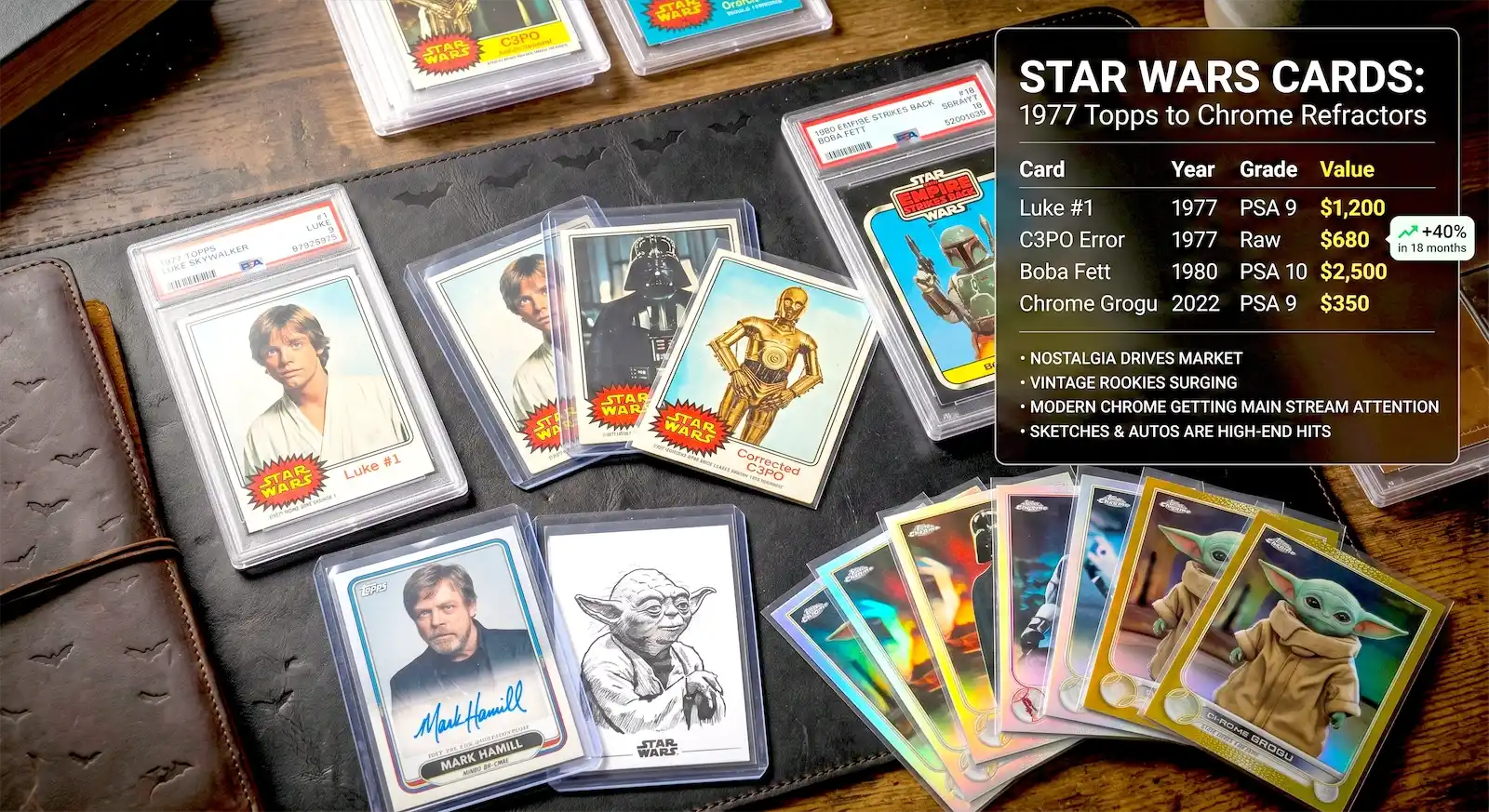

I still remember the smell. Dusty cardboard, that faintly sweet Topps gum, and a sliver of waxed paper that had clearly seen better days. My uncle handed me a shoebox in the summer of 1994 and said, “Don’t lose these.”
Inside were a few dozen 1977 Topps Star Wars cards he’d bought as a kid, blue borders, red borders, a creased Darth Vader, and a single C3PO that looked, well… anatomically unusual. I had no idea what I was holding. I just knew it felt important.
That shoebox is what started me down the rabbit hole. And this Star Wars trading cards guide is the resource I wish someone had handed me back then.
We’ll cover the entire history of the hobby, from those legendary 1977 Topps wax packs to today’s Topps Chrome refractors and one-of-one sketch cards.
We’ll talk values, variants, grading, storage, and the stories behind the rarest cards in the galaxy. By the end, you’ll know exactly where to start, what to chase, and what to avoid.
Let’s open the pack.
What Are Star Wars Trading Cards?
Star Wars trading cards are licensed collectible cards depicting characters, scenes, vehicles, and artwork from the Star Wars franchise, produced primarily by Topps from 1977 onward. Each card is part of a numbered set, often with parallels, inserts, autographs, and sketch variants that drive collector demand.
Think of them as small windows into a galaxy far, far away, except some of those windows are now worth more than a used car. The hobby spans nearly five decades, hundreds of sets, and millions of individual cards.
And unlike sports cards, where stats and rookies dominate, Star Wars cards are valued for nostalgia, scarcity, character demand, and the sheer artistry of the photography and illustration.
When Did Star Wars Trading Cards Begin?
Star Wars trading cards began in 1977, when Topps released the first series of cards based on the original Star Wars: A New Hope film. The set was rushed into production after the movie’s surprise box-office success and ultimately spanned five series totaling 330 cards plus 55 stickers.
Here’s the wild part, Topps didn’t really believe in the movie. According to long-running collector lore, the company hesitated to license what looked like a risky sci-fi flop.
By the time Star Wars exploded in theaters, kids were already lining up at corner stores demanding cards that didn’t yet exist. Topps scrambled. The first series hit shelves mid-1977 and never stopped selling.
The 1977 Topps Star Wars Set: Series 1 Through 5
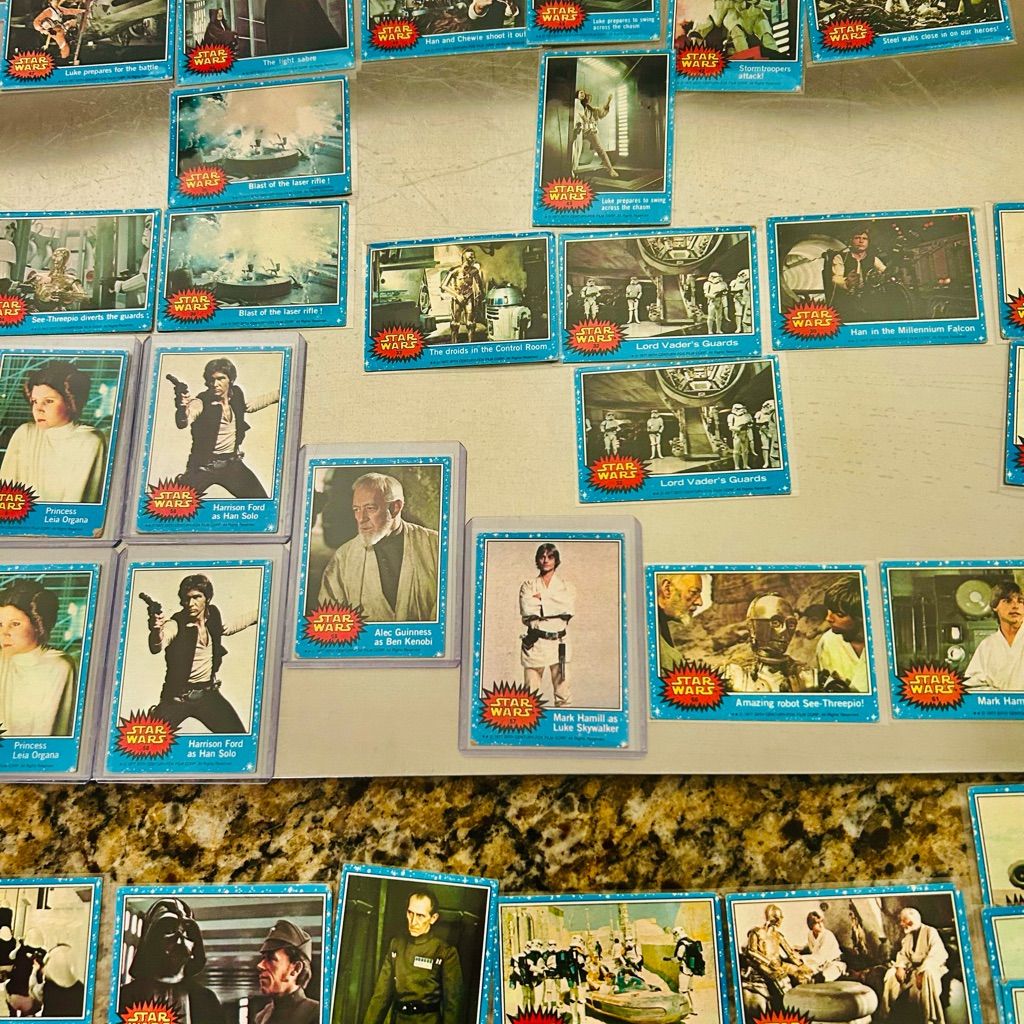
The 1977 Topps Star Wars set is a masterclass in vintage non-sports card design. Each series used a different colored border so collectors could tell them apart at a glance, and each came with a matching subset of stickers.
Here’s the breakdown:
- Series 1: Blue borders, cards #1–66, released summer 1977
- Series 2: Red borders, cards #67–132
- Series 3: Yellow borders, cards #133–198
- Series 4: Green borders, cards #199–264
- Series 5: Orange borders, cards #265–330
Each series also included 11 stickers, bringing the sticker total to 55 across the entire run. The 1977 Topps Star Wars set contains 330 cards across five series, and finishing the master set, base plus stickers, all five colors, is still considered a rite of passage for vintage collectors.
The photography is gorgeous in a way modern digital cards just can’t replicate. Slight color shifts, that hand-cut feel, the distinctive Topps cardboard stock, every card looks like it was pulled from a movie projector and stamped onto cardboard the same afternoon.
Why Are the First Series Cards So Valuable?
Series 1 cards from the 1977 Topps Star Wars set are the most valuable because they were printed first, distributed regionally, and treated like the “rookie cards” of the franchise. Cards #1–8 in particular function as the visual introduction to each main character Luke, Vader, Han, Leia, C3PO, R2-D2, Chewbacca, and Obi-Wan, and serious collectors chase them in PSA 9 and PSA 10 condition.
I remember the first time I saw a PSA 10 of card #1, the iconic shot of Luke holding his lightsaber aloft. The colors looked almost painted. The corners were so sharp they could have cut paper. Cards in that condition are extraordinarily rare because kids in 1977 didn’t store cards in penny sleeves and toploaders.
They jammed them in pockets, traded them in lunchrooms, and clipped them to bicycle spokes. Survival rates for Gem Mint copies are tiny, which is exactly why prices keep climbing.
What Is the C3PO #207 Error Card and Why Is It Famous?
The C3PO #207 error card is the most legendary mistake in non-sports trading card history. It appears in Series 4 of the 1977 Topps Star Wars set and shows C3PO standing in his classic golden armor, except a printing anomaly made it look like the droid had, let’s say, an unexpected feature where his lower waist plating should be.
The notorious C3PO #207 error card has only a handful of PSA 10 examples in existence, and even raw copies in clean condition routinely sell for hundreds to low thousands of dollars depending on the market. Topps reportedly corrected the print run quickly, which is why the error variant is considered scarcer than the corrected version.
Was it a printing accident? An airbrush mistake? A bored printer playing a joke during a long night shift? Nobody knows for sure, and that’s part of the charm. Every hobby needs its mythology, and #207 is ours.
What Star Wars Card Sets Followed the Original 1977 Release?
The 1977 success guaranteed that Topps would chase the next two films, and they did so quickly. The vintage Star Wars era runs from 1977 through 1983 and includes all three original-trilogy theatrical releases.
Empire Strikes Back Cards (1980)
The 1980 Topps Empire Strikes Back set spans three series and 352 base cards plus 88 stickers. Borders shift from gray (Series 1) to blue (Series 2) to green (Series 3). The photography here is moodier, snowier, and more painterly than the 1977 set — fitting, since Empire itself is the moodiest film in the saga.
Key cards include the introduction of Yoda, Boba Fett’s first major card appearance, and the iconic “I am your father” duel imagery. Boba Fett cards from this set have aged spectacularly well in value because Boba Fett has aged spectacularly well in pop culture. Funny how that works.
Return of the Jedi Cards (1983)
The 1983 Topps Return of the Jedi set is smaller and tighter, 220 base cards across two series, plus 55 stickers. Series 1 uses red borders, Series 2 uses blue. By 1983, kids and Topps both knew what they were doing. Distribution was wider, print runs were larger, and surviving cards in clean condition are noticeably more common than 1977 equivalents.
That doesn’t make them worthless. A graded PSA 10 set of Jedi base cards still commands real money, especially the Jabba’s Palace and final-duel cards.
How Did Star Wars Cards Evolve in the Modern Era?
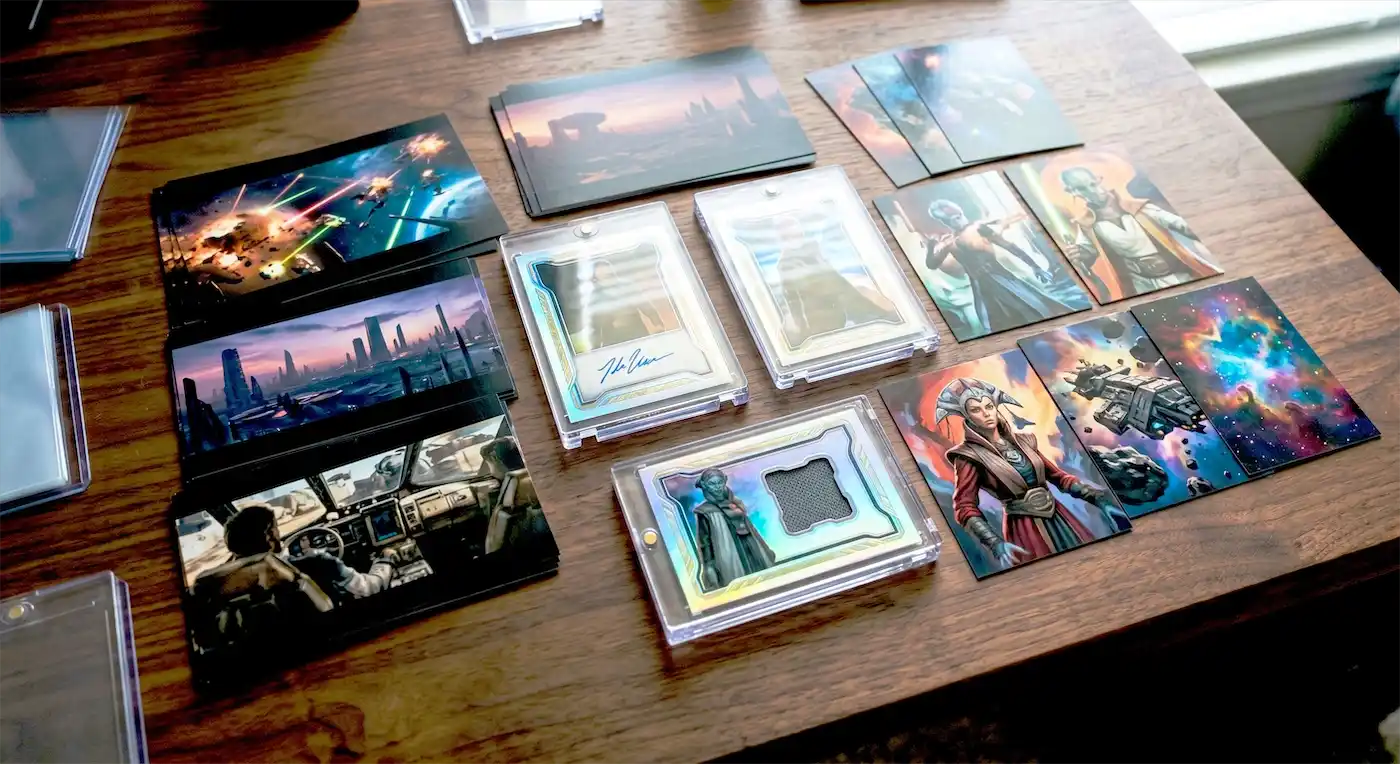
The modern Star Wars trading card era began in 1993 with Topps Galaxy and never really stopped. Where the vintage era was about photography and kid-friendly distribution, the modern era is about artistry, parallels, hits, and one-of-one chase cards.
Topps Galaxy Series (1993-1995)
The 1993 Topps Galaxy set is, in my opinion, the most beautiful Star Wars card set ever printed. It featured 140 base cards showcasing original artwork by industry legends, painters and illustrators reimagining characters, ships, and scenes in styles ranging from Art Deco to surrealist. Galaxy II followed in 1994 (135 cards), Galaxy III in 1995 (90 cards plus etched-foil chase inserts).
I sold a complete Galaxy I set at a card show in 2008 for what felt like a fortune at the time. I still regret it. Watching a kid flip through those cards and recognize the artists by name was like seeing someone discover jazz for the first time.
What Are Topps Widevision Star Wars Cards?
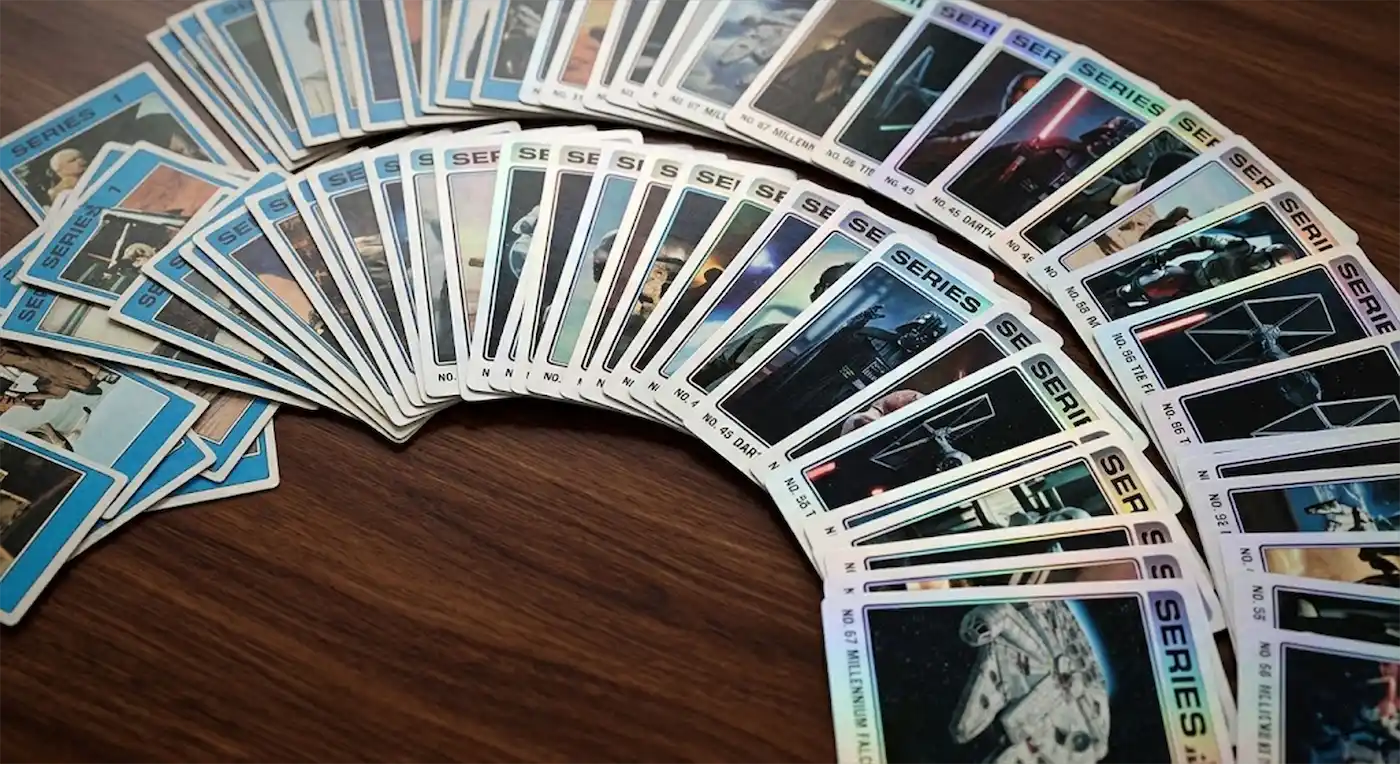
Topps Widevision Star Wars cards are oversized cards with a 16:9 cinematic aspect ratio designed to mirror the widescreen film frame. The 1995 Topps Star Wars Widevision set used scenes directly from A New Hope and was followed by Widevision releases for Empire and Jedi, plus the special-edition films and prequels.
These cards changed how Star Wars photography was presented in the hobby. Instead of cropping iconic shots into a portrait rectangle, Widevision let the original cinematography breathe. They also introduced the modern collector to chromium and foil-board parallels.
How Did the Prequel Trilogy Change Star Wars Cards?
The prequel trilogy (1999, 2002, 2005) pulled Star Wars cards firmly into the modern hit-driven era. Topps introduced widespread use of autograph cards, costume relic cards (with embedded fabric swatches from production wardrobes), and serial-numbered parallels.
Sets to know from this era include 1999 Topps Star Wars Episode I, 2001 Topps Star Wars Evolution, and 2005 Topps Star Wars Revenge of the Sith.
Hayden Christensen, Ewan McGregor, and Natalie Portman autographs from these sets are legitimately tough pulls and have appreciated significantly as the prequel-generation collectors aged into disposable income.
What Are the Different Types of Star Wars Trading Cards?
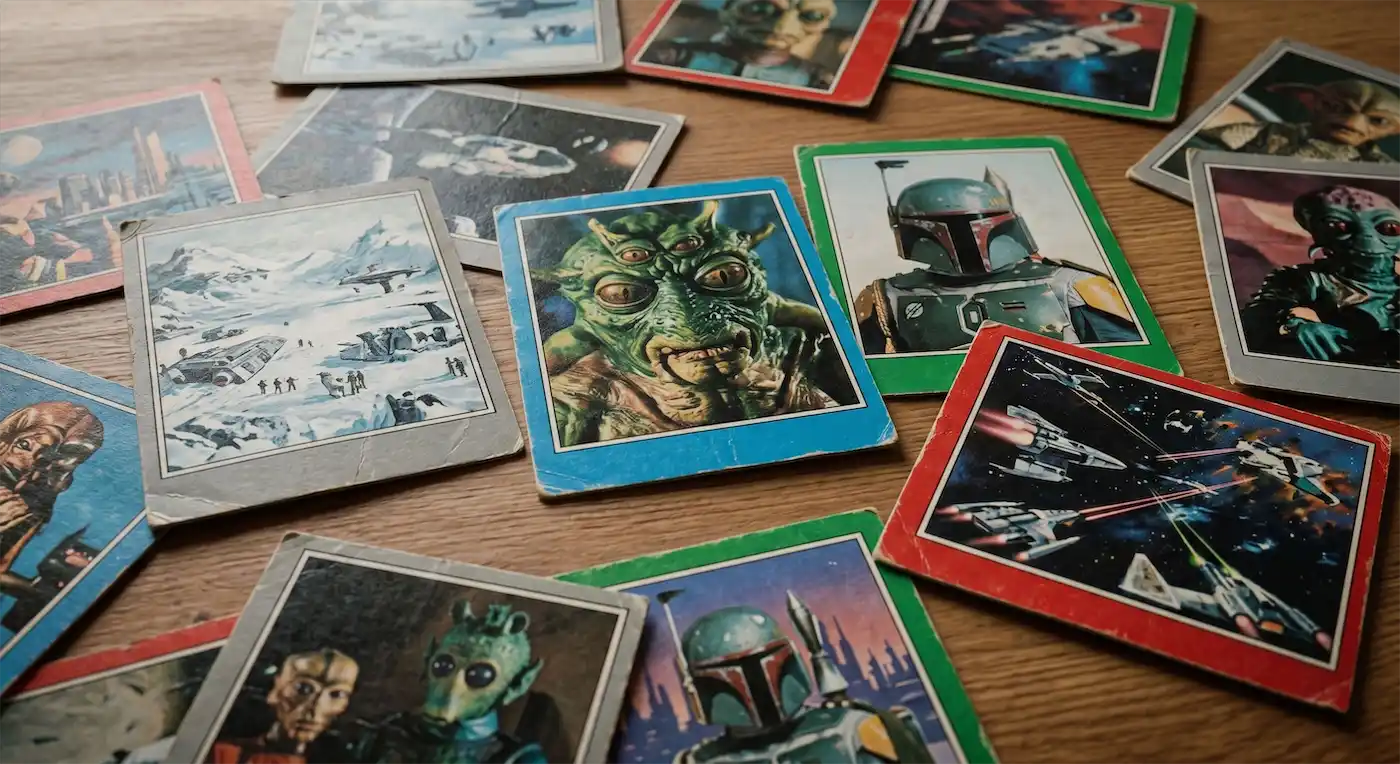
Modern Star Wars products feature a layered card structure: base, parallels, inserts, hits. Understanding this hierarchy is essential for any Star Wars trading cards guide worth its salt.
Base Cards
Base cards are the standard cards that make up the main checklist of a set. They typically feature a character, scene, or vehicle on the front and a description or stat block on the back. Base cards are the most common pulls and the cheapest individually, but completing a base set still takes meaningful effort and remains the foundation of the hobby.
Insert Cards and Parallels
Insert cards are themed subsets within a release, galaxies of characters, ship blueprints, lightsaber duels, etc. Parallels are alternate-color or alternate-finish versions of base cards, often serial-numbered. Topps Chrome Star Wars releases use a familiar parallel ladder: Refractor, Prism Refractor, Atomic Refractor, Gold Refractor (numbered to 50), Red Refractor (numbered to 5), and one-of-one SuperFractors.
The parallel chase is what makes ripping modern packs addictive. You can see a base Luke Skywalker in your stack, but the moment you tilt the card and catch a rainbow shimmer, your heart kicks. That’s a refractor. That’s the dopamine hit Topps engineered into the hobby starting in the mid-1990s.
What Are Star Wars Sketch Cards?
Star Wars sketch cards are one-of-one trading cards featuring original hand-drawn artwork by licensed artists, randomly inserted into modern Topps Star Wars products. Each sketch card is unique, signed by the artist on the back, and considered one of the rarest pulls in non-sports cards.
I pulled a sketch card exactly once, a small ink portrait of Ahsoka Tano by an artist whose name I had to look up. I held it for ten minutes before sleeving it. There is genuinely nothing else like it in the hobby.
A sketch card is a piece of original art the size of a playing card, produced specifically for the set you just opened. Top-tier artist sketches (Brian Kong, Cat Staggs, and others) trade for thousands.
What Are Star Wars Autograph Cards?
Star Wars autograph cards feature on-card or sticker-applied signatures from actors who appeared in the films and series. Topps has released autographs from nearly every named cast member over the years, Mark Hamill, Carrie Fisher, Harrison Ford, Adam Driver, Daisy Ridley, Pedro Pascal, and many supporting players.
On-card autographs are signed directly on the card surface and are universally preferred over sticker autographs (where the signature is signed onto a clear adhesive, then placed on the card). Mark Hamill autographs in particular are tightly produced because Hamill rarely signs cards in volume; expect to pay a premium even for non-numbered copies.
How Do You Grade Star Wars Trading Cards?
You grade Star Wars trading cards by submitting them to a third-party grading service, primarily PSA (Professional Sports Authenticator), BGS (Beckett Grading Services), or CGC (Certified Guaranty Company).
These companies authenticate the card, evaluate centering, corners, edges, and surface, then encapsulate it in a tamper-evident slab with a numerical grade.
Grades typically run from 1 to 10. PSA 10 (“Gem Mint”) is the gold standard for vintage Star Wars cards and dramatically multiplies value. A raw 1977 Topps Star Wars #1 might sell for one figure; a PSA 10 of the same card sells for several multiples higher.
The gap between PSA 9 and PSA 10 on key vintage cards is often the difference between a normal sale and a major auction event.
Three quick tips before you submit anything:
- Pre-grade ruthlessly. Look at corners under bright light. If you see whitening, it’s not a 10.
- Check centering. Vintage Topps cards often have off-center cuts, which caps the maximum grade.
- Don’t grade cheap cards. Grading fees can exceed the post-grade value of common base cards.
What Are the Most Valuable Star Wars Trading Cards?
The most valuable Star Wars trading cards are the ones that combine scarcity, condition, and iconic imagery. Here’s a working list of the perennial heavyweights:
- 1977 Topps Star Wars #1 (Luke Skywalker), PSA 10 – the franchise’s de facto rookie card
- 1977 Topps Star Wars C3PO #207 error variant, high grade – the legendary printing anomaly
- 1977 Topps Star Wars Series 1 cards #2–8, PSA 10 – Vader, Han, Leia, etc., as character introductions
- 1980 Topps Empire Strikes Back Boba Fett cards, high grade – riding decades of character demand
- 1993 Topps Galaxy artist-signed cards, low population – niche but devoted collector base
- Modern Topps Chrome SuperFractors (1/1) – chase pieces from any current release
- High-tier sketch cards by name artists – original art pricing applies
- Mark Hamill on-card autographs – limited supply, eternal demand
Prices shift with the market, so always check recent comparable sales on platforms like eBay completed listings, Heritage Auctions, and Goldin before buying or selling.
How Do You Start Collecting Star Wars Trading Cards?
You start collecting Star Wars trading cards by picking a focused goal, setting a budget, and learning the major sets before you spend serious money. The biggest mistake new collectors make is buying randomly across every era and ending up with a pile of expensive base cards and no real collection.
Here’s the path I recommend to friends just getting in:
- Pick a lane. Vintage (1977–1983), prequel era, sequel/Disney era, or modern Chrome. Each has a different price floor and learning curve.
- Buy a complete set first. A graded or near-mint complete 1983 Return of the Jedi set, for example, gives you instant context for what good copies look like.
- Read checklists before opening packs. Know what parallels and inserts exist in a product before you rip it.
- Join the community. Reddit’s r/StarWarsCards, dedicated Discord servers, and Facebook collector groups are full of people who’ll happily teach you.
- Track your collection. Use a spreadsheet, a collection app, or even just a notebook. Future you will thank current you.
The single best tip I can give: buy the card you actually love. The collection that survives the long haul is the one built around personal connection, not market speculation.
Where Can You Buy Star Wars Trading Cards?
You can buy Star Wars trading cards through major online marketplaces, hobby retailers, dedicated card shops, and live auctions. Each channel has tradeoffs.
- eBay: biggest selection; check seller history and ask for clear scans
- COMC (Check Out My Cards): good for picking up specific singles; reasonable shipping consolidation
- Heritage Auctions and Goldin: premium vintage and high-grade modern cards
- Local card shops: irreplaceable for the in-person experience and community
- Card shows and conventions: where deals and discoveries still happen
- Direct from Topps/Fanatics: newest releases, hobby boxes, and sealed product
Avoid sketchy marketplaces with no return policies. Avoid social media DMs offering “deals.” If a price feels too good to be true on a high-end vintage card, it almost always is.
How Do You Protect and Store Star Wars Cards?
You protect Star Wars cards by sleeving them in penny sleeves, placing them in toploaders or one-touch magnetic holders, and storing them in a cool, dry, climate-stable environment away from direct sunlight. Vintage cards in particular are vulnerable to humidity, UV light, and temperature swings.
For valuable cards, the workflow looks like this:
- Penny sleeve – soft inner sleeve that prevents micro-scratches
- Toploader or semi-rigid – rigid outer protection
- One-touch magnetic – premium display option for high-value singles
- Graded slab – long-term protection plus authentication for serious cards
- Storage box – acid-free, ideally in a closet or interior room
- Climate – aim for stable 65–72°F, 40–50% humidity
Never tape a card. Never write on the back. Never store cards in an attic, garage, or basement that floods. I’ve watched a friend lose half a vintage collection to a single burst pipe. Don’t be that friend.
What Is the Future of Star Wars Trading Cards?
The future of Star Wars trading cards looks bright because the franchise keeps producing new content, Disney+ series, animated shows, theatrical releases, that feeds new card sets every year.
Modern Topps Star Wars Chrome, Galaxy reboots, and themed releases tied to specific shows continue to drive collector engagement, and a new generation of fans is now buying their first packs.
The hobby has also globalized. Collectors in Asia, Europe, and Latin America are growing fast, expanding demand and pushing prices up on rare vintage cards. At the same time, digital platforms have made authentication, grading, and price discovery dramatically easier than they were even a decade ago.
If you’re entering the hobby today, you’re walking into a more mature and more connected market than I had access to in my shoebox days. That’s a good thing. It means better information, fairer prices on average, and a real community ready to welcome you.
Final Thoughts From One Collector to Another
Star Wars trading cards are the rare hobby that crosses generations. My uncle bought his 1977 cards as a teenager. He passed them to me as a kid. I’ll pass them to my niece when she’s ready. Each transfer carries a little piece of the galaxy with it, and a little piece of the people who held the cards before.
That, more than the prices and the parallels and the PSA grades, is what this hobby is really about. The cards are stories. The stories outlive us. And as long as kids keep watching Star Wars, somebody, somewhere, will keep ripping packs.
May the Force be with your collection.