
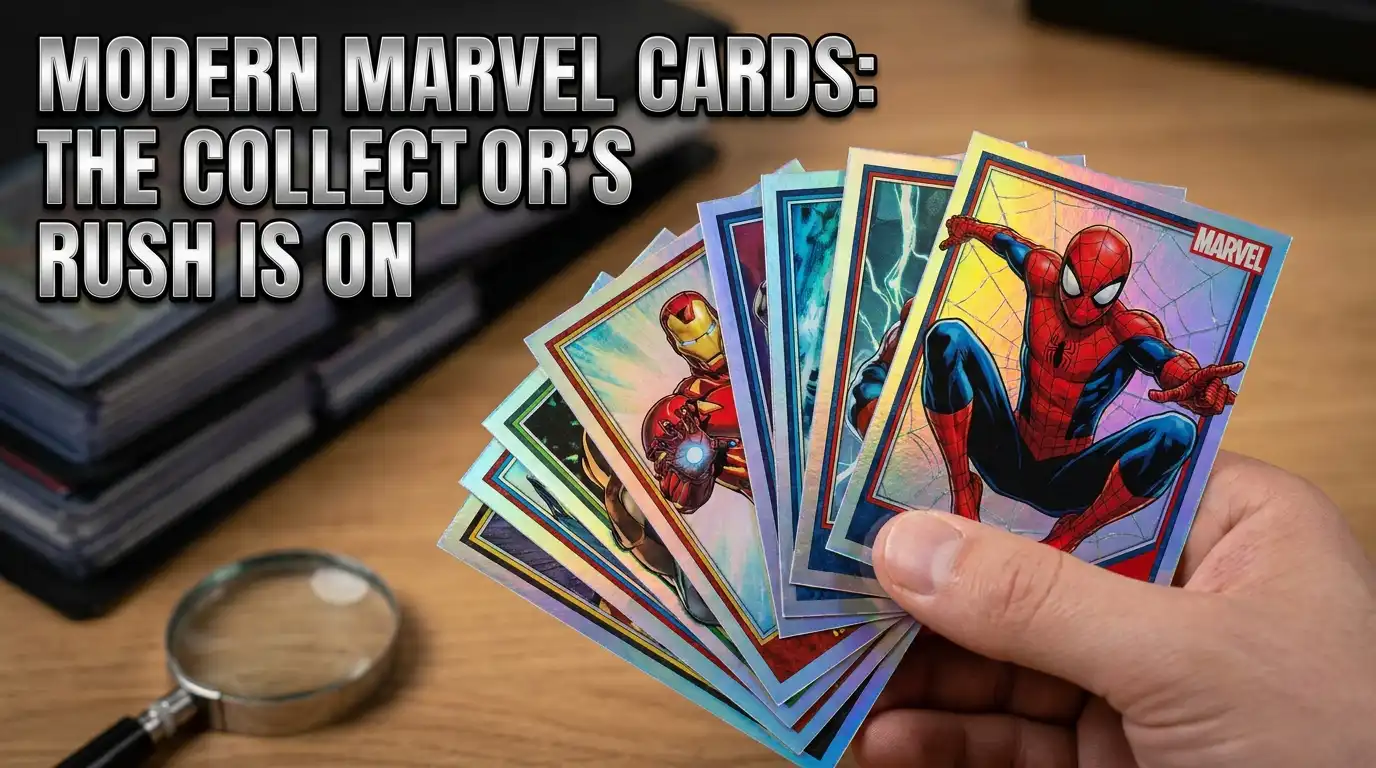

The pack felt heavier than usual. I’d grabbed it from the new release wall at my local card shop, 2019 Topps Marvel Collect, a product I’d never heard of until that morning. The wrapper peeled back with that familiar crinkle, and the first card I saw made me stop breathing for a second.
Holographic Chrome refractor. Spider-Man. Serial-numbered 15/25.
I didn’t know what I was holding was worth $400. I just knew it looked like nothing I’d ever pulled from a pack before. The chrome surface caught every light in the shop, throwing rainbows across my hands like someone had compressed an entire galaxy into a 2.5″ x 3.5″ piece of cardboard.
That card is what got me into modern Marvel collecting. Not the 1990 Impel sets I grew up with.
Not vintage. Just one pack, one pull, one moment of pure cardboard lottery luck.
Modern Marvel cards, produced from the early 2000s through today, represent the evolution of superhero trading cards from nostalgic collectibles into premium, hit-driven products with autographs, relics, sketch cards, and numbered parallels that rival anything the sports card market produces.
What Defines Modern Marvel Trading Cards?
Modern Marvel trading cards are licensed collectibles produced from approximately 2000 onward, characterized by premium materials, insert-driven products, autograph and relic content, sketch cards, and serial-numbered parallels that create chase value beyond simple base-card completion.
The shift from vintage to modern happened gradually. The 1990 Marvel Universe set established Marvel cards as a category. The mid-1990s brought oversaturation and market collapse. The early 2000s brought rebirth through premium products with better materials and real hits.
Modern Marvel cards borrow heavily from sports card strategies: numbered parallels, autographs, relics, and limited-edition chase content. A base set might have 100 cards, but the product also includes 15 parallel tiers, 50 autograph signers, 200 sketch artists, and relic cards containing fabric from movie costumes.
This creates a fundamentally different collecting experience than vintage. You’re not completing sets. You’re hunting hits.
What Are the Top Modern Marvel Card Sets?
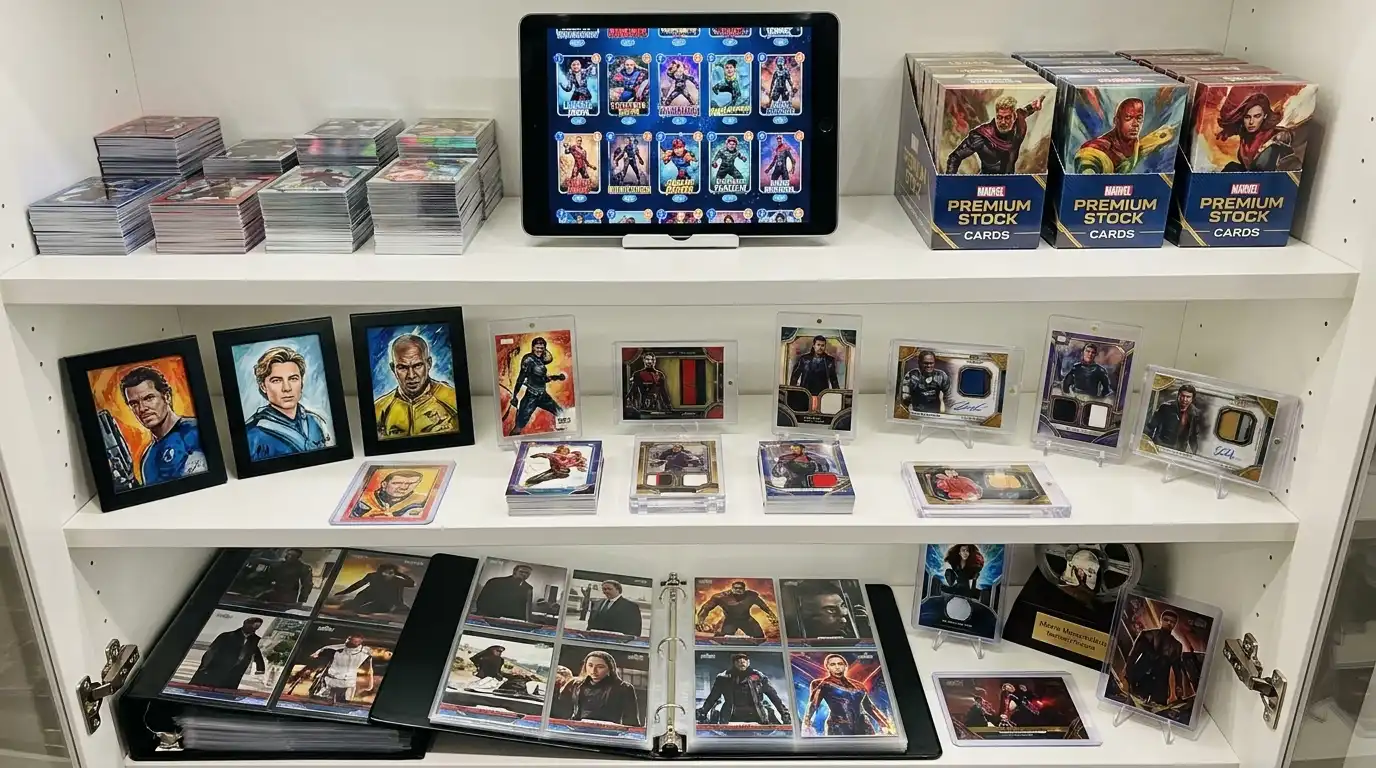
The top modern Marvel card sets include Topps Chrome Marvel, Upper Deck Marvel Masterpieces, Topps Marvel Collect, Fleer Ultra Spider-Man, and Rittenhouse Marvel Archives for premium autographs and sketch content. Each serves different collecting goals from affordable base sets to high-end hit chasing.
Here’s the tier breakdown:
- Tier 1: Flagship Annual Releases Topps Chrome Marvel (2015-present): Refractor parallels, on-card autographs, sketch cards Topps Marvel Collect (2019-present): Digital-first product with physical redemptions Upper Deck Marvel Annual (when available): Premium stock, painted artwork
- Tier 2: Premium/High-End Upper Deck Marvel Masterpieces (various years): Hand-painted art cards, sketch variants Rittenhouse Marvel Archives (various years): Deep autograph checklists, premium relics Topps Marvel Inception (various years): On-card autographs, thick card stock
- Tier 3: Licensed Movie/Show Products Topps Marvel Studios (MCU film releases): Movie-specific sets with film stills Upper Deck Marvel Cinematic Universe (various films): Premium film card products Topps Spider-Man / X-Men (character-specific): Deep-dive single-character sets
Each tier serves different budgets and collecting strategies. Chrome is the accessible entry point. Masterpieces is the art collector’s choice. Rittenhouse is the autograph hunter’s paradise.
How Do Chrome Refractors Work in Marvel Products?
Chrome refractors in Marvel products are parallel versions of base cards printed on chromium stock with prismatic light diffraction, creating rainbow shimmer effects when tilted. Refractors are serial-numbered in ascending rarity tiers from unlimited base refractors to one-of-one SuperFractors worth thousands.
The Chrome parallel ladder typically looks like this:
| Parallel Type | Visual Effect | Serial Number | Rarity Tier |
|---|---|---|---|
| Base Chrome | Silver reflective | Unlimited | Common |
| Refractor | Rainbow prism | Unlimited | Uncommon |
| Prism Refractor | Enhanced rainbow | /199 | Scarce |
| Gold Refractor | Gold shimmer | /50 | Rare |
| Orange Refractor | Orange shimmer | /25 | Very Rare |
| Red Refractor | Red shimmer | /5 | Extremely Rare |
| SuperFractor | Full spectrum | 1/1 | Unique |
Character demand drives value. A SuperFractor of a background Avenger might sell for $200. A SuperFractor of Spider-Man, Wolverine, or Iron Man can hit four figures. A SuperFractor of a major MCU actor’s likeness can clear five figures at auction.
I’ve ripped hundreds of Chrome packs across multiple years. I’ve pulled Gold Refractors twice.
I’ve never seen a SuperFractor in person outside of a graded slab at a card show. The math is brutal, one SuperFractor per card number across potentially millions of packs. When someone hits one, it’s an event.
What Are Marvel Sketch Cards and Why Are They Valuable?
Marvel sketch cards are one-of-one original artworks hand-drawn on blank trading card stock by licensed artists, randomly inserted into modern products. Each sketch is unique, signed by the artist, and represents miniature commissioned art discovered through pack-opening rather than direct purchase.
Topps and Upper Deck contract with dozens of professional artists, comic illustrators, concept designers, fan artists, and provide them with blank card stock. Artists create original Marvel character art using pencil, ink, marker, watercolor, or digital techniques printed on card stock.
Each finished sketch gets authenticated, numbered 1/1, and randomly inserted into retail or hobby packs.
The quality variance is enormous. A rough sketch by an unknown artist might sell for $30-$50. A museum-quality piece by a top-tier artist like Brian Kong, Cat Staggs, Randy Martinez, or Jeff Mallinson can sell for $2,000-$5,000+. The most exceptional sketches from legendary artists at major shows have sold for low five figures.
Artist reputation drives everything. Collectors track which artists are in each product release and specifically hunt their work. A Kong Spider-Man or a Staggs Black Widow is instantly recognizable and commands premiums.
For those exploring how sketch cards fit into the broader Star Wars collecting landscape, the Marvel sketch market operates similarly, artist-driven, lottery-style pulls, and enormous value variance based on subject and execution quality.
What Role Do Autographs Play in Modern Marvel Sets?
Autographs are the primary hit content in modern Marvel products, featuring on-card or sticker signatures from comic artists, MCU actors, voice actors, and writers. On-card autographs command 2-3X premiums over sticker autographs due to aesthetic quality and perceived authenticity.
Modern Marvel autograph structure breaks into three categories: Comic Creator Autographs Stan Lee (archive signatures), current Marvel writers and artists, legendary creators like Todd McFarlane and Jim Lee. These are affordable relative to actor autographs but carry artistic prestige.
MCU Actor Autographs Robert Downey Jr., Chris Evans, Scarlett Johansson, Tom Holland, and the entire Avengers roster. Print runs vary wildly, RDJ might be numbered to 5 copies, while supporting cast members appear at higher print runs of 50-100.
Animated/Voice Actor Autographs Voice actors from X-Men animated series, Spider-Man shows, and Marvel video games. More affordable than live-action actors but deeply beloved by specific collector segments.
On-card versus sticker matters. An on-card autograph shows the pen touching card stock. A sticker autograph shows a clear adhesive label. Both are officially licensed, but on-card photographs better, feels more authentic, and sells for significant premiums.
The most valuable modern Marvel autograph ever sold? A dual on-card autograph of Stan Lee and Robert Downey Jr., numbered 1/1, which sold at auction for over $60,000 in 2022.
How Do Relic Cards Work in Marvel Products?
Marvel relic cards contain embedded material swatches authenticated as coming from costumes, props, or production materials used in MCU films or Marvel shows. The fabric, leather, or material is cut into small pieces and inserted into die-cut windows on the card.
Topps and Upper Deck partner with Marvel Studios to acquire production-used materials after filming. These materials get authentication, then cutting and distribution across relic card print runs. A typical relic might contain a 0.5″ x 0.5″ swatch from a Captain America suit, Black Widow’s tactical gear, or Thor’s cape.
The authenticity is real but context matters. That fabric swatch came from production-used materials, but not necessarily the hero costume from the key scene. It might be from a stunt double, a backup costume, or a reshoot outfit. It’s genuine MCU material, not necessarily the specific iconic piece you imagine.
Still, holding a card with actual fabric from Avengers: Endgame embedded in cardboard feels special. These are physical pieces of billion-dollar films, distributed to collectors worldwide through random pack insertion.
Dual and triple relics combine swatches from multiple characters. An Iron Man/Captain America dual relic might have fabric from both costumes side by side. These cards typically print to runs of 25 or fewer and command significant premiums.
What Are the Best Marvel Insert Sets to Chase?
The best Marvel insert sets combine visual appeal, character focus, limited print runs, and thematic coherence. Top-performing inserts include Character Spotlight subsets, Artist Series, Die-Cut Golds, and Villain Showcases that balance scarcity with collector demand.
Inserts worth chasing: Character Evolution Inserts Multi-card subsets showing characters across different eras (Spider-Man from 1962 to MCU, X-Men through decades). Completionists chase these aggressively.
Artist Showcase Inserts Cards featuring work by specific comic artists like Alex Ross, Jim Lee, Todd McFarlane. Often include artist signatures on special parallels.
Movie Moment Inserts Key scenes from MCU films frozen in card form, Avengers assemble, Thanos snap, Tony’s sacrifice. High emotional value drives demand.
Die-Cut/Shaped Cards Cards cut into character silhouettes (Spider-Man mask, Captain America shield). Visually distinctive, production-limited.
Foil-Stamped Premium Cards with gold foil, holographic effects, or embossed elements. 1990s nostalgia aesthetic with modern production quality.
The golden rule: inserts are only valuable if they intersect scarcity with desirability. A generic “Marvel Universe Characters” insert set numbered to 500 won’t move. An “Infinity Saga Key Moments” etched-foil set numbered to 99 will sell out immediately.
How Has the MCU Changed Marvel Card Collecting?
The MCU transformed Marvel card collecting by shifting focus from comic book characters to film actors, creating sustained annual demand tied to movie releases, and expanding the autograph pool to include A-list Hollywood talent rather than primarily comic creators.
Before the MCU, Marvel cards featured comic artwork and occasionally comic artist autographs.
The market was small, cyclical, and driven by comic fandom. Iron Man (2008) changed everything.
Suddenly Marvel characters had faces. Robert Downey Jr. was Tony Stark. Chris Evans was Captain America. Card products could feature film stills, actor autographs, and costume relics that connected directly to billion-dollar cultural phenomena.
The economics shifted dramatically. A comic artist autograph might cost $20-$50. An RDJ autograph costs thousands. The MCU brought mainstream money into Marvel cards.
It also brought year-round content. Between 2008 and 2026, Marvel Studios released 30+ films and dozens of Disney+ shows. Every release generates card products. The pipeline never stops.
For collectors who grew up with vintage Star Wars cards from the original trilogy era, the MCU card boom feels familiar, a massive cinematic universe generating sustained collecting interest across multiple generations.
What Should New Marvel Card Collectors Buy First?
New Marvel card collectors should start with a recent Topps Chrome base set to learn product structure, then add 2-3 low-tier autographs of personally meaningful characters. This teaches modern parallels, hit distribution, and value scaling without requiring four-figure investments.
Starting path:
- Step 1: Base Set ($30-$60) Buy a complete Topps Chrome Marvel base set from the most recent year. Hold the cards. Learn which characters carry premiums. Understand the refractor parallel system.
- Step 2: Autographs ($50-$150 each) Buy 2-3 autographs of characters you actually love. Not investment plays. Not speculation. Cards that make you smile. A Tom Holland Spider-Man. A Sebastian Stan Winter Soldier. A Clark Gregg Agent Coulson. Characters that matter to you.
- Step 3: Sealed Product ($30-$100) Buy 3-5 retail packs or one hobby pack of a current release. Rip them. Feel the randomness. Pull commons, hit an insert, experience the variance. Understand why people chase sealed product.
- Step 4: Education Join Reddit’s r/MarvelCards, Facebook groups, and Discord servers. Ask questions. Share pulls. Learn from people who’ve been collecting longer. The community teaches things price guides never will.
The mistake new collectors make: buying everything, completing nothing, and ending up with boxes of unsorted commons. Focus beats accumulation. Pick one product per year and finish it, or chase one character across all products, or build a personal collection of one actor’s autographs.
Specific goals create sustainable collections. Vague goals create expensive piles.
How Do Modern Marvel Cards Compare to Vintage Sets?
Modern Marvel cards emphasize hit-driven content with autographs, relics, and numbered parallels, while vintage sets focused on base-card completion and painted artwork. Modern products cost more per pack but offer potential high-value pulls that vintage products never included.
The fundamental difference: vintage was about photography and artwork. Modern is about scarcity and randomness.
The 1990 Marvel Universe set gave you 162 base cards and 5 holograms for 75 cents per pack. You could complete the set through trades and accumulation. Modern Chrome gives you 7 base cards and maybe a refractor for $10 per pack, with completion virtually impossible due to parallel variance.
But modern products offer upside vintage never had. A 1990 pack maxed out at $10-$15 in pulls.
A modern Chrome hobby pack can contain a $500 autograph or a $2,000 sketch. The ceiling is exponentially higher.
Collectors who love comic-accurate character art prefer vintage. Collectors who love MCU actors and premium hits chase modern. Both are valid. The hobby contains multitudes.
What’s the Future of Modern Marvel Card Collecting?
Modern Marvel card collecting will remain strong as long as the MCU produces content, Topps/Upper Deck maintain licenses, and nostalgia-driven demand from multiple generations sustains the market. Risks include oversaturation, actor autograph fatigue, and potential market corrections during economic downturns.
The pipeline is full. Marvel Studios has films and shows planned through 2028. Every release generates card products. Disney+ series create year-round autograph opportunities that didn’t exist during the film-only era.
The biggest threat is oversaturation. Too many products per year dilutes collector budgets and creates exhaustion. If Topps releases 15 different Marvel products annually, collectors can’t buy everything. Demand spreads thin. Products sit unsold.
But as long as Spider-Man swings, Wolverine claws, and new Avengers assemble, Marvel cards will exist. The characters are too iconic. The fan base is too large. The nostalgia is too powerful.
And somewhere, a kid will rip a pack at Target, pull a Chrome refractor of their favorite hero, and feel the exact rush I felt in 2019 when I pulled that Spider-Man /25.
That’s the magic of modern Marvel cards. Every pack is a lottery ticket. Every pull could be the one.
Modern Marvel Cards Are What You Make Them
Modern Marvel card collecting offers something for everyone: affordable base sets, premium autographs, original sketch art, MCU relics, and numbered parallels spanning every budget from $10 to $10,000.
You can collect however you want. Chase Chrome refractors. Hunt autographs. Build a character PC. Focus on one film. Mix everything.
The hobby is big enough, diverse enough, and accessible enough to accommodate every interest.
There’s no wrong way to collect modern Marvel cards. The best collection is the one you’ll actually build and enjoy.
I started with one pack and one pull. Fifteen packs later, I own Chrome sets, a handful of autographs, two sketch cards, and more refractors than I can count. My collection isn’t the most valuable. It’s not the most complete. But it’s mine.
And that Spider-Man /25 that started everything? Still in a magnetic one-touch on my desk. Not graded. Not for sale. Just there, catching light, reminding me why I collect.
For a comprehensive overview of Marvel trading cards across all eras, explore Marvel Cinematic Universe Cards: A Complete Collection Guide to understand how modern products connect to the hobby’s broader history.