

The comic shop smelled like ink and plastic. I was nine years old with three dollars from my grandmother, staring at a display box of 1990 Marvel Universe Cards. Spider-Man, Wolverine, and the Hulk blazed across the box art in colors that made every comic book I owned look faded.
I bought three packs, seventy-five cents each, twelve cards plus a hologram. I ripped them open right there on the counter. The first card I pulled was #98: Jim Lee’s Wolverine in yellow and blue, claws extended, eyes locked in berserker rage.
I didn’t know who Jim Lee was. I didn’t know Marvel Universe Cards would become the most important non-sports set ever released. I just knew I’d never seen anything that cool printed on cardboard.
Thirty-five years later, that Jim Lee Wolverine sits in a one-touch case on my desk. It’s not graded. It’s not worth much money. But it’s the card that made me a collector and proved superheroes could sell like baseball stars.
The 1990 Marvel Universe Series 1 changed non-sports card collecting forever. Here’s why it still matters.
What Was the 1990 Marvel Universe Trading Card Set?
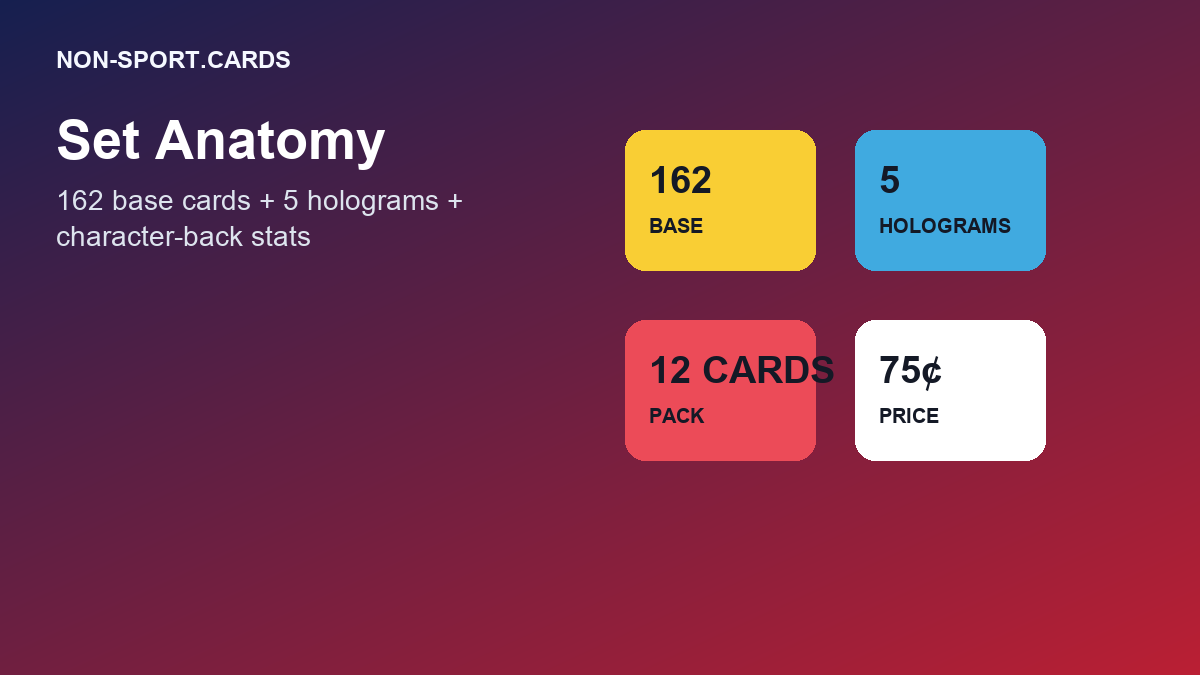
The 1990 Marvel Universe Series 1 was a 162-card base set produced by Impel Marketing featuring Marvel Comics superheroes and villains, released in July 1990 with artwork from Jim Lee, Marc Silvestri, and other top Marvel artists. It was the first complete Marvel character card set and became an instant phenomenon.
Before 1990, Marvel characters appeared occasionally in miscellaneous trading card releases, but no company had ever produced a comprehensive Marvel Universe set with consistent design, professional artwork, and widespread retail distribution.
Impel secured the license, recruited Marvel’s best artists, and created what would become the blueprint for every superhero card set that followed.
The set included:
- 162 base cards: heroes, villains, teams, and key characters
- 5 hologram chase cards: Spider-Man, Captain America, Hulk, Punisher, Wolverine
- Checklist and promotional cards
- Full-color artwork by Marvel’s top talent
- Character biographies on card backs with stats and histories
Distribution was massive. Wax boxes hit toy stores, comic shops, convenience stores, and pharmacy chains nationwide. Kids bought packs everywhere. The hobby exploded.
This set proved that superhero cards could sell like sports cards, paving the way for DC releases, Image Comics sets, and eventually the modern Marvel Cinematic Universe card boom that collectors chase today.
Why Did the 1990 Marvel Universe Set Matter?
The 1990 Marvel Universe set mattered because it legitimized superhero trading cards as a serious collecting category, introduced millions of kids to organized card collecting, and established character-driven chase cards and hologram technology that defined 1990s non-sports products.
Before Marvel Universe, trading cards meant baseball, football, and basketball. Non-sports cards existed but occupied a niche. The success of 1990 Marvel Universe changed the economics.
When a superhero set sells millions of packs and generates sustained collector demand, every publisher and license holder takes notice.
Within two years, DC launched similar sets. Image Comics licensed cards for Spawn and WildC.A.T.s. Movie studios started treating trading cards as essential merchandise. The 1990 Marvel set was the proof of concept that superheroes could drive the hobby.
The hologram chase cards were revolutionary. Holograms existed before 1990, but Marvel Universe made them standard insert content. Kids hunted those five holograms, Spider-Man, Cap, Hulk, Punisher, Wolverine, like modern collectors hunt autographs and one-of-one parallels. The chase mechanic was born.
For anyone studying the evolution of non-sports trading cards, the 1990 Marvel Universe set is the inflection point where superhero cards became a permanent collecting category alongside vintage Star Wars and movie cards.
Who Was Jim Lee and Why Did His Artwork Define the Set?
Jim Lee was a rising Marvel Comics artist in 1990 who had recently taken over Uncanny X-Men and whose dynamic, detailed, hyper-muscular art style became the visual signature of the 1990 Marvel Universe set. His cards are the most iconic and valuable from the entire 162-card checklist.
Lee contributed artwork for dozens of cards, including the following:
- Card #98: Wolverine (the set’s visual anchor and most recognizable card)
- Card #11: Cyclops
- Card #50: Psylocke
- Card #66: Gambit
Multiple X-Men team cards His Wolverine (#98) became the face of the set. The composition, Wolvie in mid-action, claws out, costume bright and bold, captured everything that made X-Men the hottest comics of the early 1990s. That single card sold packs. Kids bought boxes hunting for the Lee Wolverine.
Lee’s style influenced an entire generation of comic artists and card collectors. His clean lines, exaggerated anatomy, and kinetic energy made static trading cards feel alive. You could almost see Wolverine moving.
Two years after this set released, Jim Lee co-founded Image Comics and created WildC.A.T.s. His departure from Marvel was seismic, which retroactively increased the collectibility of his 1990 Marvel Universe cards. These were the last major Marvel cards Lee illustrated before leaving the company.
In 2024, a PSA 10 Jim Lee Wolverine #98 from this set sells for $50-$100. Not expensive by modern standards, but significant for a mass-produced 1990 base card. The Lee premium is real.
What Were the Hologram Chase Cards?

The 1990 Marvel Universe hologram chase cards were five special insert cards featuring 3D holographic images of Spider-Man, Captain America, Hulk, Punisher, and Wolverine, randomly inserted at approximately 1:6 packs. They were the first widely distributed hologram inserts in non-sports cards and created the modern chase-card market.
The holograms were technological marvels for 1990. Tilt the card and watch Spider-Man’s web shimmer. Shift the angle and see Captain America’s shield gleam. The effect was hypnotic for kids used to flat printed cards.
Insertion ratios meant you needed to buy multiple packs to complete the five-card hologram set. Topps and Impel knew exactly what they were doing, create scarcity, drive demand, sell more packs. The model worked. Kids bought boxes chasing holograms and completed base sets as a side effect.
Market values for holograms today:
| Hologram Card | Character | Condition | Estimated Value |
|---|---|---|---|
| H-1 | Spider-Man | Raw NM | $10-$15 |
| H-2 | Captain America | Raw NM | $8-$12 |
| H-3 | Hulk | Raw NM | $8-$12 |
| H-4 | Punisher | Raw NM | $6-$10 |
| H-5 | Wolverine | Raw NM | $12-$18 |
Graded PSA 10 holograms sell for 3-5X raw prices. The Spider-Man and Wolverine holograms lead in value because character demand has sustained across three decades.
I owned all five holograms as a kid. I taped them to my bedroom wall. The adhesive destroyed them. I learned about preservation the hard way.
What Are the Key Cards from the 162-Card Base Set?
The key cards from the 1990 Marvel Universe base set are #1 Spider-Man, #98 Wolverine (Jim Lee art), #11 Cyclops, #66 Gambit, #50 Psylocke, and #151 Punisher due to character popularity, artist recognition, and sustained collector demand over thirty-five years.
Full key card breakdown:
- Card #1: Spider-Man (set anchor, first card, iconic character)
- Card #11: Cyclops (Jim Lee artwork, X-Men leader)
- Card #50: Psylocke (Jim Lee art, fan-favorite character)
- Card #66: Gambit (Jim Lee art, peak 1990s X-Men popularity)
- Card #98: Wolverine (Jim Lee art, the set’s flagship card)
- Card #151: Punisher (height of Punisher’s comic popularity)
Secondary keys include popular X-Men characters (Storm, Rogue, Nightcrawler), classic Avengers (Iron Man, Thor, Captain America base cards), and major villains (Magneto, Doctor Doom, Green Goblin).
The Jim Lee cards carry premiums because Lee’s art defined the era and because he left Marvel shortly after, making these his last major Marvel card contributions for years. A PSA 10 Lee card sells for 2-3X what a non-Lee card of equal character popularity sells for.
For collectors building nostalgia-driven collections, these cards connect directly to the peak X-Men era of the early 1990s when Uncanny X-Men and X-Men #1 (also illustrated by Lee) were the best-selling comics in the industry.
How Was the Set Distributed and What Did Packs Cost?
The 1990 Marvel Universe set was distributed in wax packs containing 12 cards per pack selling for 75 cents, wax boxes containing 36 packs selling for $20-$25, and factory-sealed cases containing 20 boxes. Distribution reached toy stores, comic shops, convenience stores, and mass-market retailers nationwide.
This was mass-market distribution on a scale non-sports cards hadn’t seen since the vintage Topps Star Wars era. You could buy Marvel Universe packs at 7-Eleven, Walmart, Toys “R” Us, Walgreens, anywhere that sold candy and magazines. Accessibility drove volume.
The 75-cent price point was strategic. Kids could afford three packs with leftover lunch money. Parents bought boxes for birthdays and holidays. The low barrier to entry built the collector base.
Sealed wax boxes from 1990 still exist in the market today. A factory-sealed 1990 Marvel Universe Series 1 box sells for $200-$400 depending on condition and whether the cellophane wrapper is intact. Some collectors crack vintage boxes and rip packs for nostalgia. Others keep them sealed as time capsules.
I’ve watched YouTube videos of collectors opening sealed 1990 boxes in 2024. The smell of the wax, the texture of the pack wrappers, the anticipation of the hologram pull, it’s the same rush thirty-five years later.
What Happened After Series 1 Success?
After the success of 1990 Marvel Universe Series 1, Impel released Series 2 in 1991 with 162 more cards, followed by annual releases through 1994 before Fleer took over the Marvel license and continued producing Marvel Universe sets through the 2000s. The original 1990 Series 1 remains the most collectible.
Series 2 expanded the character roster and introduced new hologram chase cards (including a Ghost Rider hologram that became highly sought-after). Series 3, 4, and 5 followed, but by the mid-1990s, market saturation had diminished collector interest. Too many sets, too many products, too much supply.
Fleer’s Marvel Universe sets in the 2000s introduced autographs, sketch cards, and modern insert structures that mirror today’s Marvel card products. But the magic of 1990 Series 1, the first, the surprise, the cultural moment — never quite repeated.
The lesson: first is different. The 1990 Marvel Universe Series 1 will always be the Marvel Universe set because it was first. Later series are addendums. The original is history.
How Do You Collect the 1990 Marvel Universe Set Today?
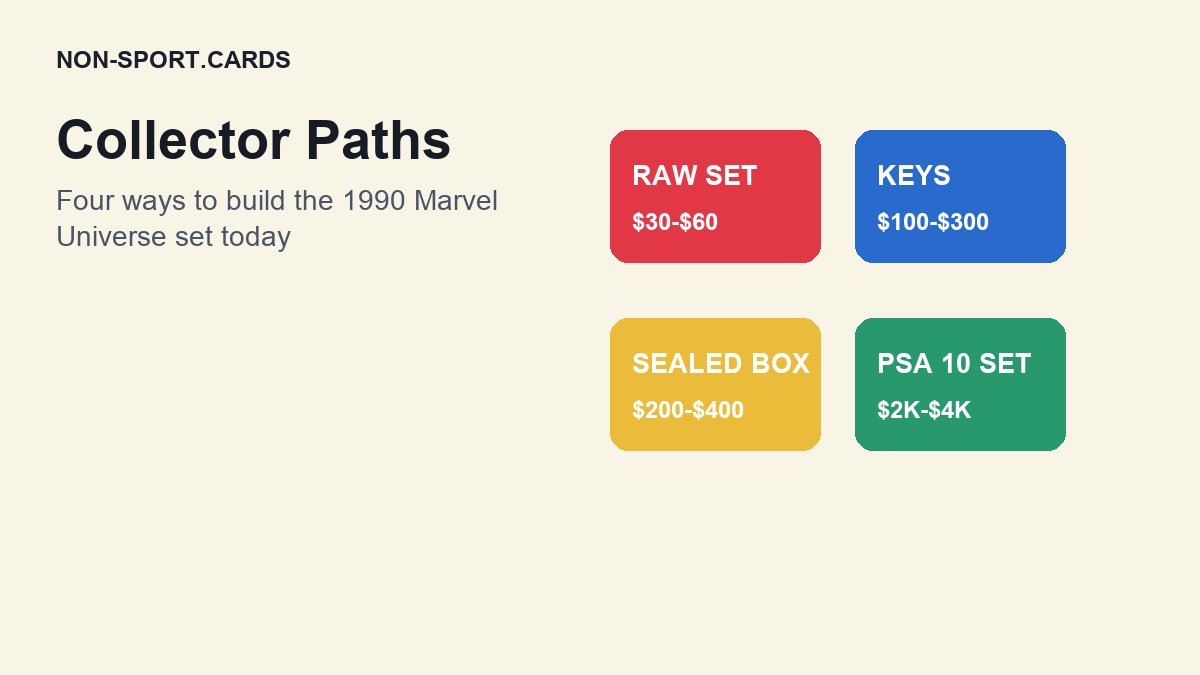
The 1990 Marvel Universe set is affordable and widely available. Complete base sets cost $30-$60, key cards run $20-$100 graded, and sealed wax boxes sell for $200-$400. Choose your path:
Four Collection Strategies:
Strategy 1: Complete Base Set ($30-$60) Buy all 162 cards in near-mint raw condition. You own every card, flip through them anytime, and spend less than a single sealed box. The nostalgia path.
Strategy 2: Key Cards Only ($100-$300) Focus on PSA 9-10 graded #1 Spider-Man, #98 Wolverine, #66 Gambit, #50 Psylocke, and the five holograms. Curated highlights without bulk commons.
Strategy 3: Sealed Wax Box ($200-$400) Buy a factory-sealed box and rip it yourself. Complete most of the base set, pull all five holograms, and relive the 1990 pack-ripping experience.
Strategy 4: PSA 10 Master Set ($2,000-$4,000) Build a complete graded PSA 10 master set, all 162 base cards plus five holograms. The completionist endgame for serious collectors.
Investment Potential: Modest but Real
The set appreciates slowly due to massive print runs, but Jim Lee cards and holograms show consistent 3-5% annual growth.
Price Appreciation (2010 vs 2024):
- PSA 10 Wolverine #98: $20 → $75 (3.75X over 14 years)
- Complete Raw Base Set: $25 → $50 (2X over 14 years)
- Sealed Wax Box: $80-$100 → $200-$400 (2-4X over 14 years)
Appreciation is real but modest. This isn’t vintage Star Wars where PSA 10s multiply 10-20X. Supply is high. Scarcity is limited.
Best long-term bet: Sealed boxes. As boxes get opened, sealed supply shrinks. Nostalgia-driven demand from 1990s kids entering peak earning years could push prices higher in the next 5-10 years.
Bottom line: Don’t buy expecting to retire on returns. Buy because you love Marvel, remember 1990, or want a piece of non-sports card history at an affordable price.
How Does This Set Compare to Modern Marvel Cards?
The 1990 Marvel Universe set differs from modern Marvel cards by featuring hand-painted comic artwork instead of film stills, lacking autographs and relic content, and emphasizing character breadth over hit-driven chase content. Modern sets focus on MCU actors, on-card autographs, and numbered parallels that didn’t exist in 1990.
The fundamental shift: 1990 was about characters. Modern sets are about actors and scarcity. 1990 gave you Spider-Man, Wolverine, and the X-Men as they appeared in comics, painted by the artists who drew them monthly. Modern Marvel sets give you Tom Holland, Hugh Jackman, and Robert Downey Jr. in costume, with autographs and film-used costume relics embedded in cards.
1990 distributed broadly at 75 cents per pack with no guaranteed hits. Modern premium Marvel products cost $200+ per box with guaranteed autographs and numbered parallels. The economics changed completely.
But the 1990 set retains charm modern products lack. The artwork is timeless. The characters are iconic in their comic forms, untethered from actor likenesses and film continuity. A 1990 Wolverine is Wolverine forever. A 2024 MCU Wolverine is Hugh Jackman in a specific timeline.
Collectors who love comic-accurate character designs prefer vintage Marvel sets. Collectors who love the MCU chase modern autographs and relics. Both are valid. The hobby is big enough for both.
What Lessons Does This Set Teach Modern Collectors?
The 1990 Marvel Universe set teaches modern collectors that first matters, accessibility builds markets, and character-driven content outlasts gimmicks. The set succeeded because it gave kids characters they loved at prices they could afford, with just enough chase content to create excitement without frustration.
Five Lessons from 1990:
1. First Endures: Series 1 is more collectible than Series 2, 3, 4, or 5 because it was first. In any collecting category, the inaugural release holds historical weight sequels can’t match.
2. Accessibility Matters: Seventy-five cents per pack meant every kid could participate. Modern $10-$20 packs exclude casual collectors. Wide participation builds long-term hobby health.
3. Characters Outlast Trends: Spider-Man, Wolverine, and the X-Men are still popular thirty-five years later. The 1990 set bet on enduring characters, not temporary fads.
4. Chase Content Drives Engagement: The five hologram inserts created the modern chase-card model. Scarcity drives demand when executed with restraint.
5. Oversaturation Kills Markets: Impel and Fleer released too many Marvel sets too quickly. By 1995, the market collapsed. Modern companies learned: release fewer, higher-quality products.
Why This Set Still Matters
Thirty-five years later, the 1990 Marvel Universe set remains affordable and available. Complete sets cost less than a single modern hobby box. You can own Jim Lee Wolverines and hologram Spider-Mans that capture peak early-1990s comic culture for pocket change.
The set won’t make you rich. It’s a time capsule, the moment superhero trading cards became permanent fixtures in collecting.
If you were there in 1990, ripping packs at the kitchen table, these cards are memory triggers. Hold them and you’re nine years old again.
If you missed 1990 entirely, this is affordable history. You can own the foundation of Marvel card collecting and understand where modern products came from.
The 1990 Marvel Universe set was the beginning. Everything that followed, DC sets, Image cards, MCU autographs, sketch inserts, film relics, traces back to this 162-card set that proved kids would collect superheroes as passionately as baseball players.
That’s the legacy. Not market value. The proof of concept.
These cards started it all. And they’re still here, still collectible, still affordable, waiting for the next collector who falls in love with a Jim Lee Wolverine.
That’s the magic: it doesn’t end. It just keeps finding new collectors, one pack at a time.