

This interview with a Star Wars card collector offers a rare glimpse into the passion and dedication that drives the hobby.
The collector sitting across from me has three storage units. Two are filled with sealed wax boxes. One holds nothing but graded Star Wars cards in PSA slabs, organized by series, stacked in custom wooden cases he built himself.
His name is Marcus Chen, he’s been collecting for thirty-two years, and he remembers the exact moment he fell in love with Star Wars cards.
“Summer of 1993,” he says. “I was fourteen. My dad handed me a pack of Topps Galaxy at a card show. I pulled a Dave Dorman Boba Fett painting. I didn’t know cards could look like that.”
That Dorman Fett is still in his collection, raw and ungraded, tucked inside a magnetic one-touch case in his office. It’s not his most valuable card. It’s not his rarest. But it’s the one that started everything.
This interview covers Marcus’s thirty-year journey through the Star Wars card hobby, the sets that shaped his collection, the cards he’ll never sell, and the advice he wishes someone had given him when he started.
If you’re new to collecting or just curious what drives someone to dedicate this much time and money to cardboard, this is the conversation.
Who Is Marcus Chen and How Did He Start Collecting?
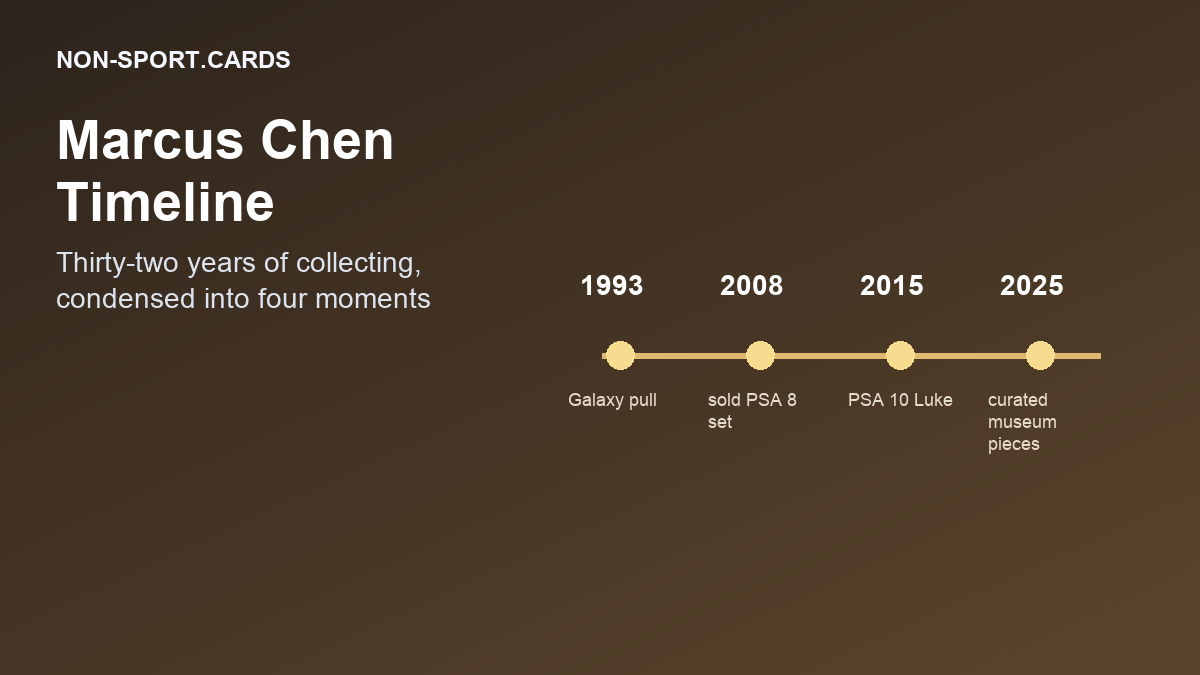
Marcus Chen is a 46-year-old software engineer from San Jose, California, who has collected Star Wars trading cards for thirty-two years and owns over 15,000 individual cards spanning every major release from 1977 to 2025. He started collecting in 1993 after pulling his first Topps Galaxy card and never stopped.
“I wasn’t a vintage guy initially,” Marcus explains. “I came in during the Galaxy era when everything was art and premium stock. The 1977 stuff felt old and boring to me as a teenager. I wanted chromium and foil stamps and painted artwork.” His collection evolved as he matured. By his twenties, he’d backfilled vintage sets.
By his thirties, he’d moved into graded cards and high-end modern hits. Now, in his forties, he focuses exclusively on what he calls “museum pieces” PSA 10 vintage keys, elite sketch cards, and low-numbered autographs from actors he grew up watching.
“I’ve sold off most of my base sets,” he says. “I kept the stuff that makes me feel something when I look at it. Everything else was just accumulation.” Marcus estimates his collection is worth somewhere between $400,000 and $600,000 at current market prices. He’s never had it formally appraised. He doesn’t plan to sell.
What Are Marcus’s Favorite Vintage Sets and Why?
Marcus’s favorite vintage Star Wars sets are the 1977 Topps blue border Series 1 for its historical significance and the 1993 Topps Galaxy series for introducing him to art-driven card collecting.
He owns complete raw sets of both and calls them the foundation of his collecting philosophy. “Series 1 is where it all started,” he says. “Those blue borders, that photography, and the fact that millions of kids ripped those packs in 1977 and most of the cards are gone now.
Holding a clean Series 1 card feels like holding a piece of cultural history.” He pulls out a binder and flips to the first page. Cards #1 through #8 sit in a grid, Luke, C3PO/R2, R2 solo, Han, Leia twice, Obi-Wan, Vader. All raw, all clean, all centered reasonably well.
“I’ll grade these eventually,” he says. “But part of me likes them unslabbed. I can touch them.” For modern collectors looking to understand the history and significance of the 1977 Topps Star Wars cards, Marcus recommends buying a complete raw set first before chasing graded keys.
“You need to feel the cardboard,” he insists. “You need to understand what made these cards special before you start treating them like stocks.” Galaxy is his other anchor. “Galaxy changed what cards could be,” he says. “Before Galaxy, Star Wars cards were photographs.
After Galaxy, they could be art. That shift opened the door for everything that came later.” He owns complete sets of Galaxy I, II, and III, plus a small collection of artist-signed variants he’s acquired over the years. His prized Galaxy card is a Series II Joe Jusko Darth Vader painting signed by Jusko at a convention in 1998. “I stood in line for three hours,” Marcus recalls. “Worth every minute.”
Which Modern Sets Does Marcus Collect and Chase?
Marcus actively collects Topps Chrome Star Wars releases, Topps Masterwork for premium autographs, and Galaxy reboots for continuity with his vintage collection. He focuses on refractor parallels numbered to 50 or fewer and on-card autographs from original trilogy actors.
“Chrome is the modern equivalent of Series 1,” he explains. “It’s the flagship annual product. If you collect only one modern set per year, make it Chrome. The refractors are gorgeous, the autograph checklist is deep, and the product holds value.” His Chrome strategy is surgical.
He buys sealed hobby boxes, rips them himself, and sells or trades everything except numbered parallels of key characters and any autographs he pulls. “I’m not completing Chrome base sets,” he clarifies. “I’m hunting Gold Refractors and better.
Everything else is noise.” For those exploring modern Star Wars cards and their unique insert structures, Marcus emphasizes understanding parallel ladders before ripping. “Know what you’re chasing. Know the odds. Don’t rip blindly hoping for magic.” Masterwork is his luxury purchase. “One box per year, maximum,” he says. “Masterwork boxes cost $200-$300, and you get ten cards. But every card is a hit.
You’re guaranteed autographs, sketches, or premium relics. It’s the high-roller product.” His best Masterwork pull came in 2019, a dual autograph card featuring Mark Hamill and Billy Dee Williams, numbered to 10, with both signatures on-card. “That’s a $15,000 card,” Marcus says quietly.
“I’ll never sell it. Hamill and Lando together on one card? That’s endgame stuff.”
What Is the Most Valuable Card Marcus Owns?
The most valuable card in Marcus’s collection is a PSA 10 1977 Topps Star Wars #1 Luke Skywalker that he purchased in 2015 for $8,200 and is now worth approximately $35,000-$40,000 based on recent comparable sales. He keeps it in a safe deposit box.
“I bought it with a work bonus,” Marcus explains. “My wife thought I was insane. I told her it was an investment. She said investments don’t come in plastic slabs with pictures of Mark Hamill.” He takes it out once a year on May 4th — Star Wars Day — and looks at it for a few minutes. “I don’t need to own it,” he admits. “But I want to own it. That card is the hobby’s Mount Everest.
Owning it in PSA 10 means I’ve reached the summit.” For context on why the 1977 Topps #1 ranks among the most valuable Star Wars cards in the hobby, Marcus points to scarcity, condition rarity, and cultural significance. “It’s the first card in the first Star Wars set ever made,” he says. “Nothing else has that combination of firsts.” His second-most valuable card is a Brian Kong sketch of Ahsoka Tano rendered in colored pencil with exceptional detail.
He pulled it from a 2020 Topps Chrome pack at a Target. “I stood in the aisle shaking,” he remembers. “I knew exactly who Brian Kong was. I knew what his sketches sold for. I sleeved it in the parking lot and drove straight to a card shop to get it in a one-touch.” The Kong sketch has sold comparables in the $8,000-$12,000 range. Marcus has turned down offers twice.
Has Marcus Ever Made Mistakes or Regrets in His Collecting Journey?
Marcus’s biggest collecting regret is selling his complete PSA 8 1977 Topps master set in 2008 for $6,500 to fund a down payment on a car. That same set would sell for $20,000-$25,000 today, and he’s never reassembled it.
“I was twenty-nine,” he says. “I needed a car. The cards were sitting in a closet. It seemed logical at the time. Now? I’d drive that car into a lake if I could get the set back.” He also regrets not grading more vintage cards when submission costs were lower. “PSA used to charge $10 per card,” he recalls. “I thought that was expensive.
Now it’s $50-$100 depending on turnaround time. I should have graded everything when it was cheap.” His third regret is chasing too many products simultaneously during the prequel era. “I was buying Episode I, Episode II, Evolution, Widevision, Chrome, everything Topps released between 1999 and 2005. I spent thousands on sealed boxes and completed exactly zero sets. I ended up with piles of duplicates and incomplete checklists.” “Focus beats accumulation,” Marcus says now. “Pick one or two sets per year and finish them.
Don’t spray bullets everywhere hoping something sticks.” For collectors wondering how to approach grading and authentication strategically, Marcus recommends grading only cards worth at least $50 raw and waiting for promotional discount periods offered by PSA and BGS.
What Advice Does Marcus Give to New Star Wars Card Collectors?
Marcus’s advice to new collectors is simple: buy what you love first, complete one vintage set raw before chasing graded keys, and never spend money you can’t afford to lose on sealed product hoping to hit valuable autographs or parallels.
“Start with a goal,” he insists. “Not ‘I want to collect Star Wars cards.’ That’s too vague. Say ‘I want a complete 1983 Return of the Jedi base set’ or ‘I want every Topps Chrome Grogu parallel’ or ‘I want autographs from every Mandalorian cast member.’ Specific goals keep you focused.” He also warns against FOMO, fear of missing out. “New products drop constantly. You’ll see breaks on YouTube where someone pulls a $5,000 autograph from a $200 box.
That’s gambling, not collecting. Most boxes lose money. Rip for fun, not profit.” His golden rule: “If you wouldn’t be happy owning the worst possible outcome from a sealed box, don’t buy the box. Buy the singles you actually want instead.” Marcus’s collecting philosophy has evolved from accumulation to curation.
“I used to measure success by quantity,” he reflects. “How many cards do I have? How many sets? How much is it all worth? Now I measure success by connection. Do I love these cards? Do they make me feel something? If not, why do I own them?” He pauses, then adds: “The cards worth keeping are the ones you’ll never sell.”
What Does Marcus See as the Future of Star Wars Card Collecting?
Marcus believes Star Wars card collecting will remain strong for decades because new content creates new collectors, Fanatics/Topps continues investing in premium products, and nostalgia-driven demand from multiple generations provides price stability even during market downturns.
“Star Wars isn’t going anywhere,” he says. “Disney produces movies and shows constantly. Every new series introduces characters, and every character gets cards. The pipeline never stops.” He’s optimistic about modern products but worried about oversaturation.
“Topps releases too many products per year,” he argues. “Chrome, Masterwork, Galaxy, Stellar Signatures, Archives, Movie Posters, Living Set, it’s exhausting. Collectors have finite budgets. Spreading those budgets across fifteen products dilutes demand.” His prediction: consolidation. “I think we’ll see fewer products with higher quality in the next five to ten years. Fanatics knows oversaturation kills hobbies.
They’ll pull back eventually.” Marcus also sees demographic shifts creating opportunities. “The prequel generation is hitting peak earning years now,” he notes. “They grew up with Hayden Christensen and Natalie Portman. Those autographs are going to appreciate as nostalgia kicks in.
The same thing will happen with sequel trilogy cards in another decade.” “Every generation of fans becomes collectors eventually,” Marcus concludes. “The hobby evolves, but it doesn’t die.”
What Are the Three Cards Marcus Would Save in a Fire?
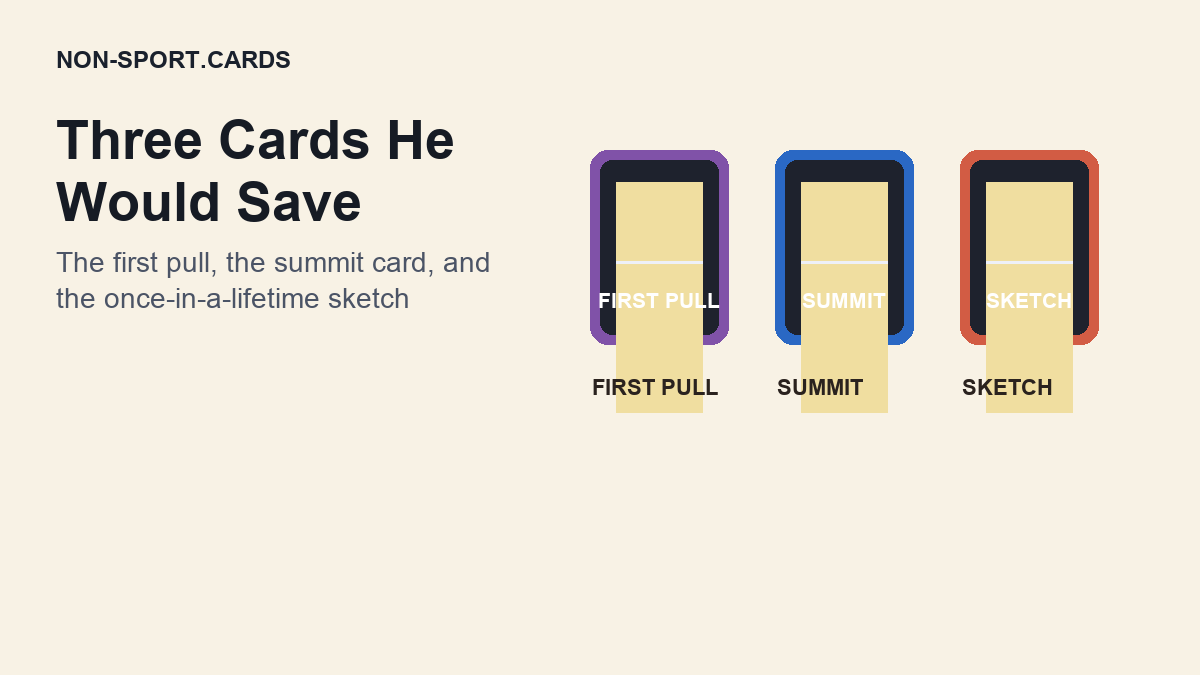
If Marcus could only save three cards from his collection in a fire, he would grab his raw 1993 Topps Galaxy Dave Dorman Boba Fett (his first Galaxy pull), his PSA 10 1977 Topps #1 Luke Skywalker, and his Brian Kong Ahsoka Tana sketch card. Everything else could burn.
“The Dorman Fett is where it all started,” he explains. “The PSA 10 Luke is the summit. The Kong Ahsoka is lightning in a bottle, a once-in-a-lifetime pull I’ll never replicate. Those three cards tell my entire collecting story.” The Fett is worth maybe $100 raw. The Luke is worth $35,000+. The Kong sketch is worth $8,000-$12,000. But Marcus doesn’t think about value when he looks at them.
“The Fett reminds me of being fourteen and believing cards could be art. The Luke reminds me that I achieved something I never thought I could afford. The Kong sketch reminds me that magic still happens.” He closes the binder. “Those three cards survive. Everything else is just inventory.”
Why Marcus Still Collects After Thirty-Two Years
Marcus Chen has been collecting Star Wars cards for thirty-two years. He’s spent six figures building his collection. He’s sold cards to pay for life. He’s bought cards he couldn’t afford. He’s chased sets, completed sets, and abandoned sets halfway through.
And he’s never stopped loving it. “People ask me why I still collect,” Marcus says. “I’m forty-six. I have a career, a family, responsibilities. Why do I care about trading cards?” He thinks for a moment. “Because these cards are the only physical connection I have to the stories that shaped my childhood. Star Wars isn’t just movies to me. It’s mythology. And these cards are the artifacts.” “When I hold a 1977 Topps card, I’m holding a piece of 1977.
When I pull a sketch card, I’m holding original art created specifically for that product. When I look at my collection, I’m looking at thirty-two years of my life organized by series and stored in toploaders.” “That’s why I collect. Not for investment. Not for status.
For connection.” For anyone looking to start their own Star Wars card collecting journey, Marcus’s story offers a roadmap: start with love, focus your goals, learn from mistakes, and remember that the cards worth keeping are the ones you’ll never sell.
To explore the sets and cards that collectors like Marcus chase, start with The Ultimate Star Wars Trading Card Guide for comprehensive coverage of every era from 1977 to today.
Where to Connect with the Star Wars Card Community
Marcus credits much of his knowledge to the Star Wars card collecting community. He’s active on Reddit’s r/StarWarsCards, participates in Facebook groups, and attends local card shows monthly.
“The community taught me everything,” he says. “How to spot reprints, where to find deals, which products to avoid, when to sell, when to hold. You can’t learn this stuff in a vacuum.” He recommends new collectors join online communities immediately. “Ask questions. Share your pulls. Learn from people who’ve been doing this longer than you.
The community is the hobby’s secret weapon.” For graded card populations and market research, Marcus uses PSA’s CardFacts database, eBay sold listings, and auction house results from Heritage and Goldin. “Data beats guessing,” he says.
“Always check comps before you buy or sell.” Marcus’s final piece of advice: “Enjoy the hunt. The chase is the fun part. Once you’ve completed every goal and owned every card you wanted, the hobby gets boring. Stay curious. Stay engaged.
And never stop opening packs.” The interview wraps. Marcus returns his cards to their cases and offers to show me his storage units sometime. I take him up on it.
Because after talking to Marcus Chen for two hours, I understand something fundamental about this hobby: it’s not about the cards. It’s about the stories the cards represent, the memories they preserve, and the community they create.
And that’s worth more than any price guide will ever show.