
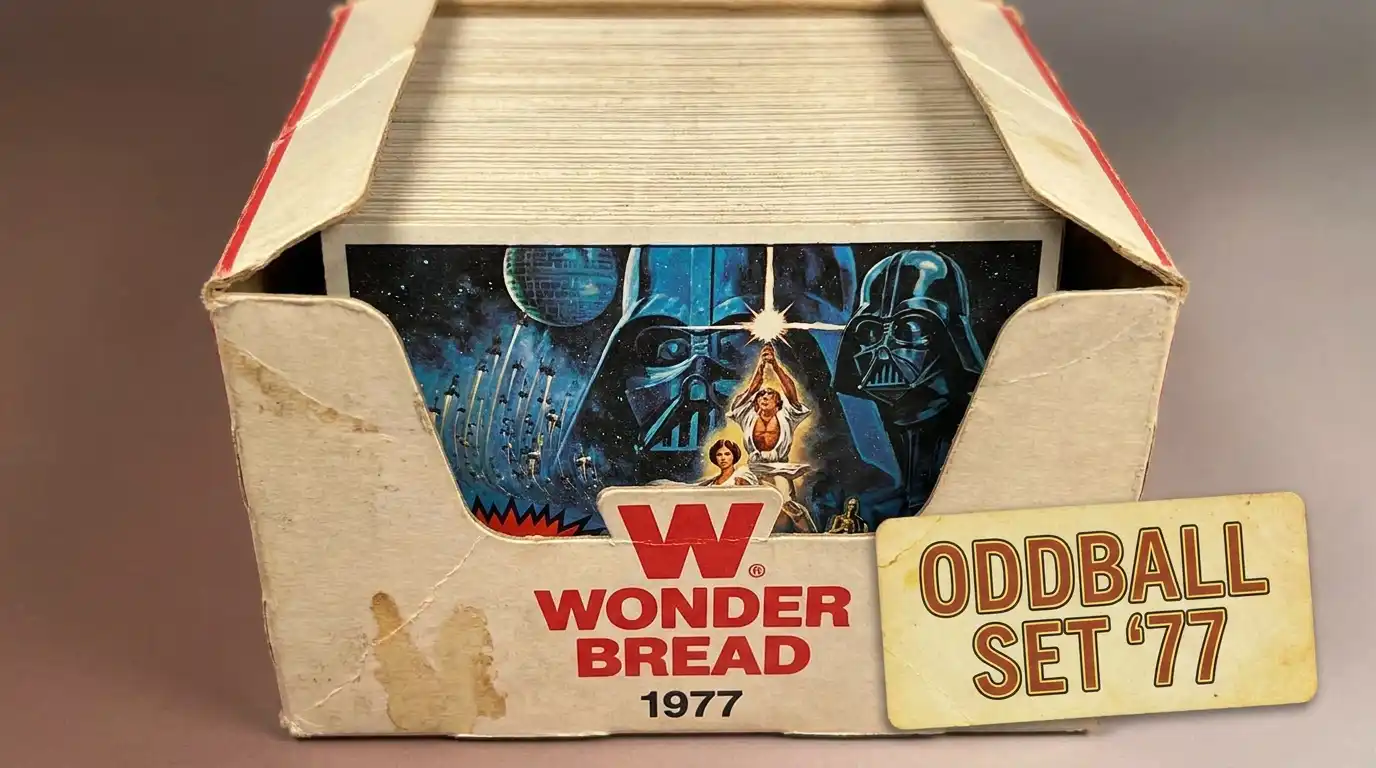

Ask a Star Wars collector to picture a 1977 card and they’ll almost always see the same thing: those colorful, starfield-bordered Topps cards that ran across five series. But there’s another 1977 Star Wars set from that very first summer, one you didn’t buy at a hobby shop or a corner store’s card rack. You got it in a loaf of bread.
The 1977 Wonder Bread Star Wars set is a 16-card oddball issue, one of the few 1970s card sets with no connection to Topps at all. It’s small, it’s humble, and a lot of collectors have never actually held one, yet it’s a genuine piece of Star Wars history from the year the saga began. This is the story of where it came from, what’s in it, how to spot a real one, and why it still charms collectors nearly fifty years later.
| 1977 WONDER BREAD STAR WARS, QUICK FACTS | |
| Set size | 16 cards, standard 2.5″ x 3.5″ |
| Maker | Continental Baking Co. (not Topps) |
| Distribution | One card per specially marked loaf |
| Also available | Mail-in offer for the full 16-card set |
| Sold | Fall 1977 through early 1978 |
| Designer | John Van Hammersveld |
| Subjects | Main characters, droids and spaceships |
What Are the 1977 Wonder Bread Star Wars Cards?
They’re a 16-card promotional set given away one card at a time inside specially marked loaves of Wonder Bread in 1977, produced by the Continental Baking Company rather than a traditional card maker. The whole point wasn’t to sell cards, it was to sell bread, with Star Wars as the irresistible hook during the movie’s original theatrical run.
That origin explains everything about the set: it’s small because it was a giveaway, it’s character-focused because that’s what kids wanted, and it’s plain on the back because it was a bonus, not a premium product.
Most of the front photos were the same marketing images Topps used, so the pictures feel familiar even though the set itself is a completely separate issue. If you’ve read our history of the 1977 Topps Star Wars cards, think of Wonder Bread as that set’s humble, bread-scented cousin.
How Was the Set Distributed?
Two ways: one card dropped loose inside each specially marked loaf of bread, and, crucially for collectors, the complete 16-card set was also available through a mail-in offer. That second path is the reason clean copies exist at all, and it’s central to understanding the set’s condition landscape today. Here’s the timeline of how these cards moved through the world:
| Summer 1977 | Star Wars is a phenomenon; Continental Baking launches the promotion to sell bread on the movie’s popularity. |
| Fall 1977 | One card is inserted loose into each specially marked loaf, no wrapper, so cards ride against the bread. |
| 1977-78 | Collectors mail in for the complete 16-card set, which arrives bagged and undamaged, the source of most high-grade copies. |
| Later runs | Unauthorized additional printings appear, which Fox pushed back on, part of why the cards remain plentiful and cheap. |
| Today | A beloved oddball: affordable, nostalgic, and a staple of serious vintage Star Wars collections. |
The “loose in the loaf” method is why so many surviving cards show wear: with no wrapper, they were squeezed, bent and stained before a kid ever fished them out. The mail-in copies, by contrast, came bagged and pristine, so when you see a razor-sharp example today, there’s a good chance it never touched a sandwich.
What’s on the Checklist?
The checklist is a tight, greatest-hits tour of A New Hope: the core heroes and villains, the droids, and a handful of iconic ships to close it out. Here’s the full 16-card run:
| # | Subject | Type |
|---|---|---|
| 1 | Luke Skywalker | Character |
| 2 | Ben (Obi-Wan) Kenobi | Character |
| 3 | Princess Leia Organa | Character |
| 4 | Han Solo | Character |
| 5 | Darth Vader | Character |
| 6 | Grand Moff Tarkin | Character |
| 7 | See-Threepio (C-3PO) | Droid |
| 8 | Artoo-Deetoo (R2-D2) | Droid |
| 9 | Chewbacca | Character |
| 10 | Jawas | Characters |
| 11 | Tusken Raiders | Characters |
| 12 | Stormtroopers | Characters |
| 13 | Millennium Falcon | Spaceship |
| 14 | Star Destroyer | Spaceship |
| 15 | X-Wing | Spaceship |
| 16 | TIE, Vader’s Ship | Spaceship |
The complete 16-card checklist. Compare that to the 330-card, five-series Topps run from the same year, a very different scale.
How Do You Spot a Real One?
The design is simple and consistent, which makes genuine cards easy to recognize once you know the four tells, and easy to separate from the unauthorized reprints floating around. Use this quick identification key:
| Design element | What to look for |
|---|---|
| Border | Thick black border around the whole card (prone to chipping) |
| Logo | “STAR WARS” in a blue box running vertically up the right side |
| Nameplate | Yellow strip at the bottom with the name in red text |
| Front image | Full-color posed or action photo, often familiar from Topps |
| Back | Plain white, black text description, card number spelled out |
Buyer beware: reprints Because unauthorized reprints exist, don’t assume a suspiciously crisp or oddly colored card is an untouched original. Learn the genuine back, plain white with the number spelled out, and when in doubt on a pricier copy, lean on grading. Our full walkthrough on that is linked below.
For a deeper method on separating originals from reprints and protecting condition, see our guide to grading and authenticating Star Wars cards.
Why Is This Set So Overlooked?
Mostly because it lives in the enormous shadow of the mainline Topps set, which offered 330 cards across five series while Wonder Bread gave you just 16. Next to that sprawling, colorful run, a small bread giveaway is easy to skip past, and for decades, many collectors did exactly that.
But that underdog status is precisely the appeal for a certain kind of collector. It’s affordable, it’s finite, and it carries a wonderfully specific slice of pop-culture history, a moment when Star Wars was so huge it sold white bread. The set also opens a door to a whole world of companion collectibles, which is where things get genuinely fun.
Field notes: collector trivia The set was designed by John Van Hammersveld, who also created the promotion’s in-store display artwork. Luke Skywalker’s card lists his age as 20, an error, since he’s canonically 19 in A New Hope. The promotion ran through at least two bread brands owned by the same company, including Braun’s Town Talk Bread. The empty bread bags are collectible in their own right, they mention the promotion and were mostly thrown away. Store items, shelf signs, hang tags and pole displays, are chased by collectors building a master collection.
What Else Can You Chase Beyond the 16 Cards?
Plenty, and this is where the set turns from a quick 16-card project into a genuine rabbit hole. Because the whole thing was a grocery-store promotion, an entire ecosystem of point-of-sale and packaging material was produced to push it, and much of that was thrown straight in the trash at the time. That disposability is exactly what makes the survivors desirable now. The companion pieces collectors chase include:
- The bread bags themselves, the original loaf packaging referenced the Star Wars offer, and intact examples are surprisingly tough to find today.
- Hang tags and bread labels, small promotional tags and labels tied to the campaign.
- Store displays, shelf signs, shelf tabs and pole displays used to advertise the promotion in grocery aisles.
- Posters and advertising art, colorful promo pieces, some sharing artwork with the cards themselves.
For a completist, assembling the cards plus the surrounding “ephemera” is the real endgame, a master collection that tells the whole story of how a bread company rode the biggest movie of 1977. It’s also a reminder that oddball issues are about more than the cards: they’re little time capsules of how products were actually sold.
Is the 1977 Wonder Bread Set Worth Collecting?
If you love vintage Star Wars and oddball history, absolutely, it’s one of the most affordable ways to own genuine 1977 cardboard, and completing all 16 is a very achievable goal. My honest take is that this is a joy-of-collecting set more than an investment play: you chase it because it’s charming and historic, not because you expect it to fund your retirement.
Values move with condition and demand like any vintage cardboard, and because the set is plentiful, common copies stay cheap while sharp, well-centered examples of the marquee characters command the real money. Treat any price figures as a moving target and check a current guide before you buy or sell.
For where this fits in the broader hobby, our ultimate Star Wars trading card guide maps the whole landscape, and our list of the most valuable Star Wars cards shows what happens at the top end of the market.
Final Thoughts
My honest take: the 1977 Wonder Bread set is one of the most charming corners of the entire Star Wars hobby. It’s tiny, it’s humble, and it was literally packaged with sandwich bread, and that’s exactly why it’s special. It captures a moment when a single movie was so culturally enormous that it turned grocery aisles into collectibles.
You don’t need deep pockets to enjoy it, either. Sixteen cards, a real 1977 pedigree, and a rabbit hole of bags and store displays to chase if you catch the bug, that’s a wonderful little collecting project. Whether you’re a lifelong vintage hound or a modern collector curious about where it all began, this is a set worth holding at least once. Just maybe wash your hands of any crumbs first.
This is an evergreen vintage overview; specific population and price figures shift over time, so treat any values as illustrative and confirm against a current price guide such as Beckett or PSA before buying or selling. Verified against PSA CardFacts, Beckett, the Trading Card Database and vintage Star Wars card history sources.
Frequently Asked Questions
How Many Cards Are in the 1977 Wonder Bread Star Wars Set?
There are 16 cards, covering the main A New Hope characters, the droids, and a handful of iconic ships. It’s a far smaller set than the 330-card Topps run from the same year.
How Were the Cards Distributed?
One card came loose inside each specially marked loaf of bread, and collectors could also mail in for the complete 16-card set. The mail-in copies arrived bagged and undamaged, which is why many high-grade examples exist today.
Are the Wonder Bread Cards Rare or Valuable?
They’re generally affordable and fairly plentiful, partly due to later unauthorized reprints. Common copies are inexpensive, while sharp, high-grade examples of popular characters carry the most value. Always check a current price guide, as figures shift over time.
How Can I Tell a Real One From a Reprint?
Look for the thick black border, the vertical blue “STAR WARS” box on the right, a yellow nameplate with red text, and a plain white back with the card number spelled out. For pricier copies, grading is the safest way to confirm authenticity.
How Is This Different From the 1977 Topps Star Wars Set?
The Topps set from 1977 ran 330 cards across five colorful series and was a standalone card product sold to collectors. The Wonder Bread set is a separate 16-card giveaway from Continental Baking, with black borders and plain backs, made to sell bread rather than cards. Same year, same movie, completely different issues.
Are the Bread Bags Collectible Too?
Yes. The original promotional bread bags mention the Star Wars offer and were mostly discarded at the time, so they can be tough to find and are prized by collectors building a complete, master-level collection.
External reference: For source context, see Trading Card Database Wonder Bread Star Wars checklist.