
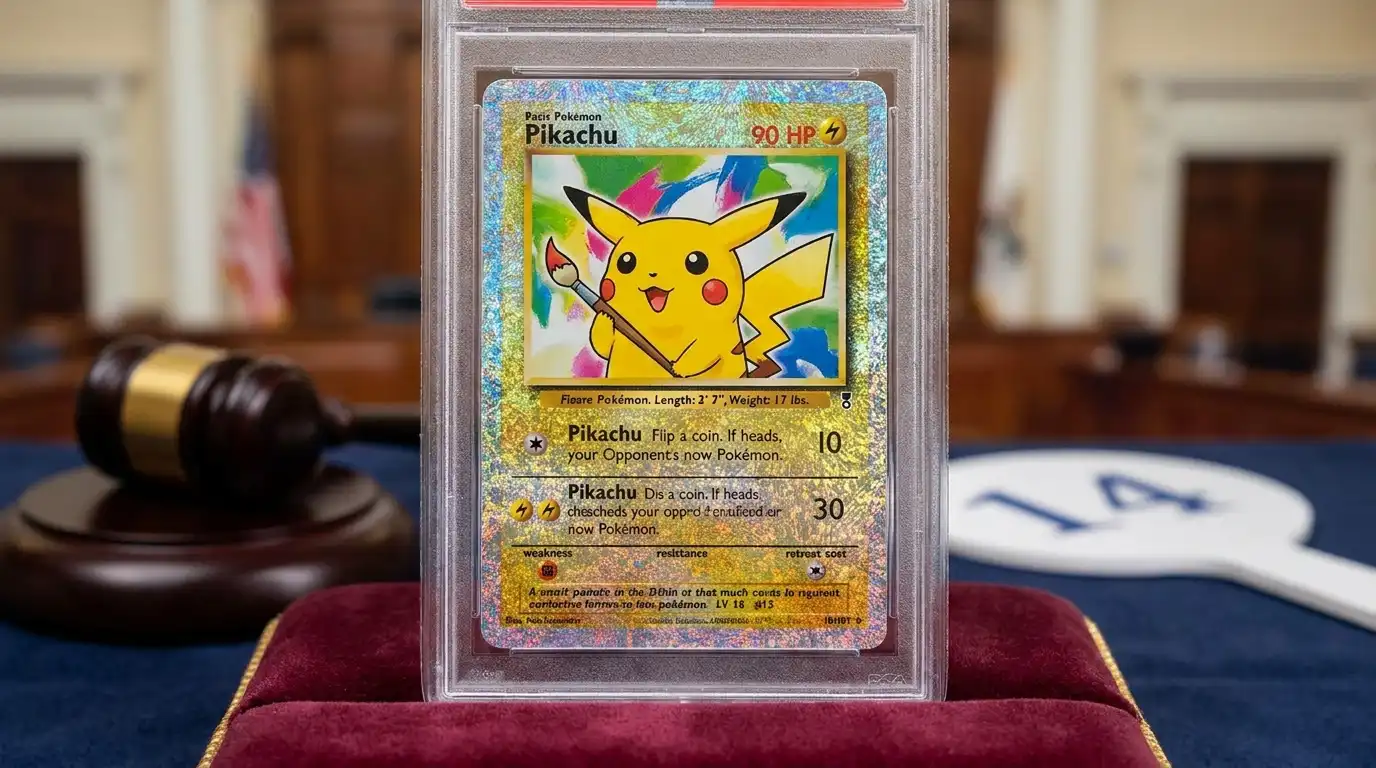

Logan Paul’s PSA 10 Pikachu Illustrator just sold at Goldin Auctions for $16,492,000, making it the most expensive trading card ever sold at auction.
Not just the most expensive Pokémon card. Not just the biggest non-sport card sale. The most expensive trading card in history.
For years, sports cards owned the top of the market. Mickey Mantle, Michael Jordan, Kobe Bryant, and other legends shaped the record books. Now, a Japanese Pokémon prize card from a 1990s magazine contest sits above them all.
So why did one Pikachu card sell for more than $16 million? The answer comes down to scarcity, condition, history, celebrity exposure, and one very important number: PSA 10.
What Is The Pikachu Illustrator Card?
The Pikachu Illustrator is one of the rarest and most famous Pokémon cards ever created. It was awarded to winners of Japanese CoroCoro Comic illustration contests between 1997 and 1998.
Only 39 copies were officially distributed.
Unlike regular Pokémon cards, this card was never made for play. It was a trophy card, a prize given to children who won an art contest. That makes it very different from mass-produced cards like Charizard, Blastoise, or Pikachu promos sold in stores.
The card is also unique because it says “Illustrator” instead of “Trainer.” No other Pokémon card carries that same title. Its artwork shows Pikachu holding a pen, as if creating art himself, a perfect design for a card given to young artists.
Even more importantly, the artwork was created by Atsuko Nishida, the original designer of Pikachu. That gives the card a direct connection to the creation of Pokémon’s most iconic character.
In simple terms, the Pikachu Illustrator is not just rare. It is historic.
Why Are There So Few Copies?
The Pikachu Illustrator was given out through three CoroCoro Comic contests tied to Pokémon’s early rise in Japan.
The first contest awarded 23 copies. Two later contests connected to Pokémon movie promotions awarded about 8 copies each. Together, that created the official 39-card print run.
But here is the important part: these cards were given to children in Japan during the late 1990s.
They were not placed into vaults. They were not immediately graded. They were not treated like million-dollar assets. Some were likely stored in binders, drawers, school bags, or family boxes. Some may have been lost forever.
That is why surviving copies are already rare. Surviving copies in top condition are almost impossible.
PSA has graded 47 total submissions, a number higher than 39 because cards can be resubmitted or reholdered. Out of those, only one has ever received a PSA 10 grade.
That one PSA 10 is the copy Logan Paul owned.
Why the PSA 10 Grade Matters So Much
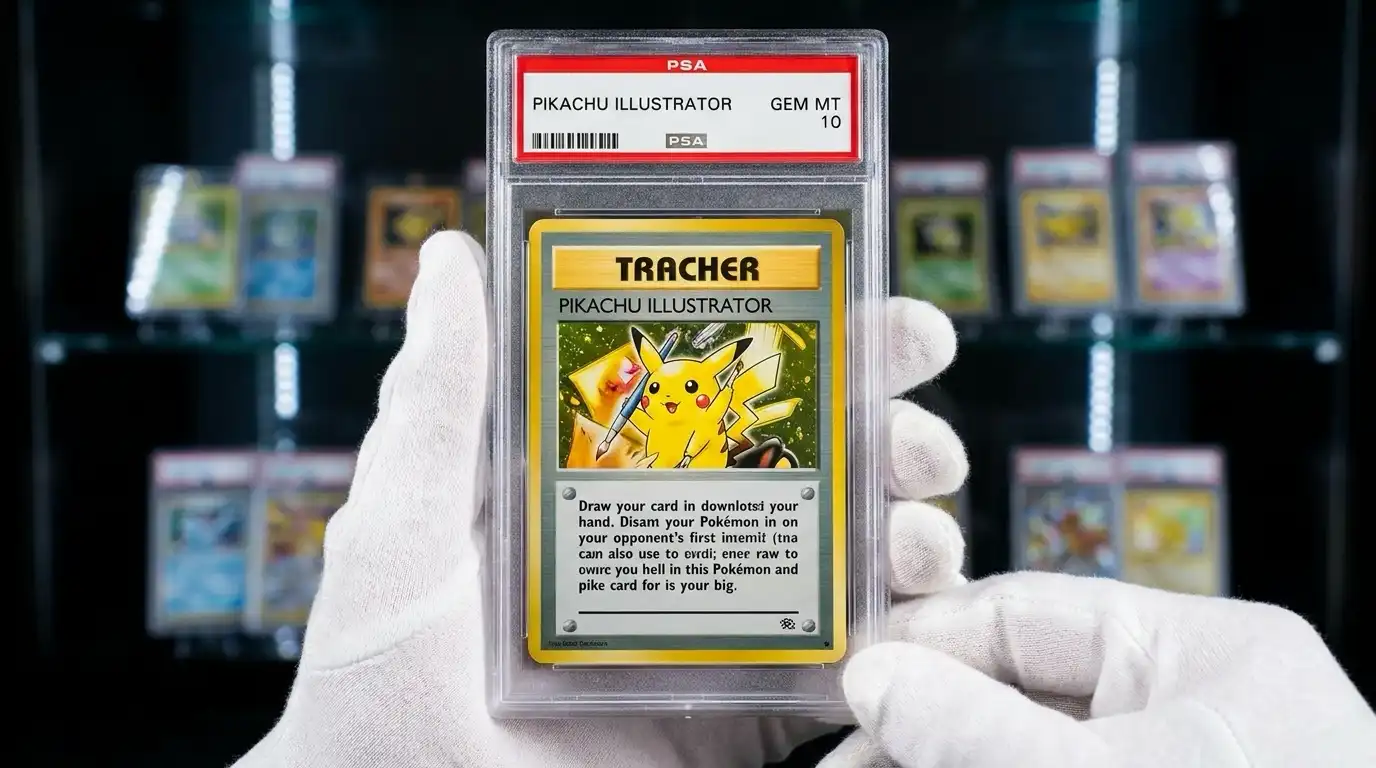
The biggest reason this card reached $16.49 million is not only because it is rare. It is because it is the only PSA 10 Pikachu Illustrator in existence.
A PSA 10 means Gem Mint condition. The card must have sharp corners, clean surfaces, strong centering, and no major visible flaws. For a 1998 prize card given to children, that level of preservation is almost unbelievable.
Lower-grade Pikachu Illustrator cards are still extremely valuable, but the PSA 10 sits in a category of its own.
That is what collectors call a “Pop 1.” It means only one card exists in that grade.
In the world of high-end collecting, Pop 1 status can completely change the price. A PSA 9 Pikachu Illustrator may be worth millions. But the only PSA 10 became a record-breaking cultural object.
The Grading Controversy
This sale also came with questions.
Some collectors have pointed out reports that Logan Paul’s card may have previously received PSA 9 grades before eventually becoming a PSA 10. Collector discussions have focused on whether the card’s condition history should be more transparent, especially at this price level.
PSA has not publicly explained the full grading history of this specific card.
That does not erase the sale, but it does raise an important point for collectors: the slab is not the whole story.
For any major purchase, especially six figures or higher, buyers should look beyond the grade. Provenance, past submissions, ownership history, and expert verification matter. A number on a label is powerful, but context matters too.
How the Auction Reached $16.49 Million
The Goldin auction ran for 41 days and attracted 97 total bids.
For much of the auction, the price climbed slowly. Then the final stretch turned dramatic. With less than 24 hours left, the price sat around $6.88 million. In the final hour, a bidding war pushed the hammer price to $13.3 million.
After Goldin’s buyer’s premium, the final sale price reached $16,492,000.
The auction was also a media event. Logan Paul hosted the closing live on YouTube. As the final bids came in, thousands of viewers watched the price climb in real time. When the auction ended, Guinness World Records officially certified the sale as the most expensive trading card ever sold at auction.
The lot included more than the card. It also came with Logan Paul’s custom diamond pendant case, appraised at about $75,000, and a personal hand-delivery from Paul to the buyer.
That kind of spectacle helped turn the sale into something bigger than a normal card auction.
Who Bought the Card?
The winning bidder was AJ Scaramucci, founder of Solari Capital and son of former White House Communications Director Anthony Scaramucci.
Scaramucci described the purchase as part of a larger mission to collect culturally important objects. He said he wanted to build a “planetary treasure hunt” that could include items like a T-Rex fossil and historical artifacts.
That is a major shift for the trading card market.
The buyer was not just another Pokémon collector trying to complete a set. He treated the card like a cultural artifact, something sitting closer to fine art, fossils, and historical documents than a normal collectible.
That matters because it shows how high-end buyers now view the very best pop-culture cards.
What Records Did the Sale Break?
Before this sale, the all-time trading card auction record belonged to a Michael Jordan and Kobe Bryant dual autograph card, which sold for $12.932 million in 2025.
Before that, the 1952 Topps Mickey Mantle card had held one of the most famous records in the hobby, selling for $12.6 million in 2022.
The Pikachu Illustrator passed both.
That means a Japanese Pokémon prize card now sits above the greatest sports cards ever sold at auction.
For non-sport collectors, that is huge. It proves that cards connected to pop culture, animation, gaming, movies, and entertainment can compete with the biggest names in sports collecting.
What This Means for Pokémon Collectors
This sale does not mean every Pokémon card is suddenly worth a fortune.
Modern cards printed in large numbers will not rise just because one historic trophy card broke a record. The real strength is in scarcity, condition, provenance, and cultural importance.
The categories most likely to benefit are:
- Vintage Japanese promo cards.
- Rare trophy cards.
- High-grade WOTC-era holos.
- Low-population PSA 9 and PSA 10 cards.
- Sealed vintage Pokémon products.
- Cards tied to major cultural moments.
The Pikachu Illustrator sale confirms that Pokémon is now a serious blue-chip category at the very top of the collectibles market.
It also shows that the strongest Pokémon cards are no longer being judged only inside the Pokémon hobby. They are now being compared to Mantle, Jordan, Kobe, and other top-tier collectible assets.
Should You Buy a Pikachu Illustrator?
For most collectors, the answer is simple: probably not.
Even lower-grade Pikachu Illustrator cards can sell for hundreds of thousands of dollars. PSA 7, PSA 8, and PSA 9 copies are trophy-level items. The PSA 10 is now in a different universe entirely.
But if you are ever considering one, authentication is everything.
Never buy a raw Pikachu Illustrator unless you are working with top-level experts. Counterfeits are common because the card is so famous and valuable. Only consider examples graded by PSA, BGS, or CGC, and always verify the certification number directly.
At this level, provenance matters as much as condition.
The Logan Paul Effect
Logan Paul’s ownership changed the public profile of the card.
He purchased the PSA 10 Pikachu Illustrator in 2021 for a deal valued at $5.275 million. He later wore it around his neck at WrestleMania 38 in a diamond case, introducing the card to a massive mainstream audience.
Some collectors disliked the spectacle. Others saw it as a turning point.
Either way, the exposure worked. Millions of people learned about the Pikachu Illustrator because Logan Paul turned it into a pop-culture symbol. That attention helped push the card beyond traditional collecting circles and into mainstream media.
By the time it reached Goldin Auctions, it was not just a rare card. It was a famous object.
That fame became part of the value.
Why This Matters Beyond Pokémon
The Pikachu Illustrator sale is not only a Pokémon story. It is a non-sport card story.
It proves that pop-culture cards can reach the same financial level as legendary sports cards. That matters for collectors of Star Wars, Marvel, DC, Disney, music cards, movie cards, vintage promos, and other entertainment-based collectibles.
The formula is clear:
- Extreme rarity.
- Strong cultural importance.
- Clear history.
- Condition rarity.
- Mainstream demand.
- A powerful story.
Cards that combine those ingredients have room to grow.
The Pikachu Illustrator is the strongest example we have ever seen, but it may not be the last.
Final Thoughts
The $16.49 million Pikachu Illustrator sale changed the trading card market.
It showed that Pokémon is not just nostalgia. It is not just a childhood brand. At the highest level, it is now part of the global collectibles conversation.
The sale also brings real questions. Collectors will continue debating the PSA 10 grade, the card’s past submission history, and whether celebrity attention inflated the result.
But one thing is clear: the record stands.
The most expensive trading card ever sold at auction is a Pokémon card.
And for non-sport collectors, that may be the most exciting part of all.
External reference: For official or source context, see Guinness World Records record listing.