


I still remember the feeling of ripping open a pack as a kid and not caring whether the card inside had a batting average or box office gross on the back. What mattered was the character. The image. The universe it came from. 2025 proved I wasn’t alone in feeling that way, and that the rest of the collecting world has finally caught up.
The non-sports card market surge of 2025 wasn’t a blip. It was a full-scale power shift. Pop culture trading cards dominated headlines, shattered auction records, rewrote price ceilings, and pulled in a new generation of collectors who’d never touched a hobby box in their lives. Star Wars, Pokémon, One Piece, and Disney didn’t just participate in the boom, they led it.
Here’s what actually happened, why it matters, and what it means for anyone still holding cardboard with characters (not quarterbacks) on the front.
How Big Did the Non-Sports Card Market Actually Get in 2025?
The non-sports card market didn’t just grow in 2025, it became the dominant force in the entire hobby. According to market research data, non-sports trading cards now represent 58% of global card circulation, officially outpacing their sports counterparts by volume.
The broader TCG and non-sports card market hit an estimated $7.8 billion in 2025, with projections pushing toward $12 billion within five years.
The raw sales numbers are equally telling. Research firm Circana reported that non-sports card sales rose 101% year-over-year from 2024, more than double the 48% growth seen in sports cards during the same period. Walmart’s online marketplace saw trading card sales jump 200% between February 2024 and June 2025. eBay credited trading cards with powering a 4% gain in Q2 revenue ($2.7 billion), marking the tenth consecutive quarter of card sales growth on the platform.
| Market Segment | 2025 Key Figures |
|---|---|
| Non-sports share of global card circulation | 58% |
| Estimated total TCG/non-sports market size | $7.8 billion |
| Non-sports YoY sales growth (Circana) | +101% |
| Walmart marketplace card sales growth | +200% (Feb 2024 – Jun 2025) |
| Graded card submission increase | +29% |
| Projected market size (next 5 years) | $12 billion |
Graded card submissions jumped 29% as investment-minded collectors poured into the space. Cross-brand collaborations were everywhere, nearly 37% of manufacturers entered co-branded card partnerships in 2025, driving collector engagement up 41%. None of this happened by accident. It happened because the franchises driving it are cultural juggernauts.
Why Did Star Wars Cards Suddenly Become a Quarter-Million-Dollar Obsession?
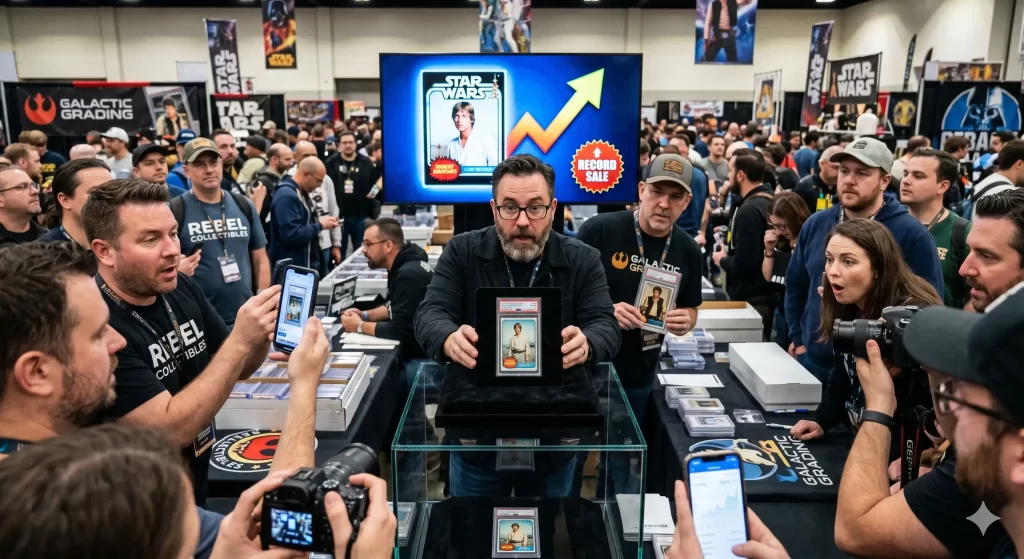
The force has always been strong with vintage Star Wars cards, but 2025 took it somewhere none of us quite expected. In October 2025, a PSA 10 copy of the 1977 Topps Star Wars #1 “Luke Skywalker” card sold for $268,400 at Heritage Auctions. That’s not a typo. A card that used to come packaged with a stick of bubble gum fetched the price of a house in most of the country.
The scarcity math explains the number. Out of more than 4,600 graded copies of this card in the PSA population report, only nine have ever achieved Gem Mint 10 status. When you’re working with single-digit PSA 10 populations on one of the most culturally significant cards in the non-sports hobby, a quarter-million dollars starts to feel almost rational.
That October sale sent a ripple through the collector community that’s still spreading. It triggered further consignments of top-tier Star Wars material to Heritage, including a Canadian Pee-Chee Luke Skywalker PSA 10 that sold for $375,000 at Heritage’s May the 4th Star Wars Day Auction, an almost eightfold jump over the same card’s previous high of $48,000 just months prior.
The original $268,400 result didn’t just set a record. It reset expectations for what vintage non-sports cards can fetch when the stars align (no pun intended).
For newer collectors entering the Star Wars space, the market structure looks like this:
- Vintage Blue-Border Series (1977–1980): The foundational Topps sets. Series 1 cards, especially #1–#8, carry the strongest premiums. PSA population reports are your best friend here.
- Error and Variant Cards: The C-3PO #207 error card (Series 5) remains one of the most talked-about anomalies in all of non-sports collecting. PSA 10 examples are extraordinarily rare.
- Modern Chrome and Art Sets: Upper Deck, Topps, and Fanatics have produced increasingly sophisticated Star Wars releases with refractors, sketch cards, and certified autographs that cater to the modern slab-first collector.
- TCG Expansion (Star Wars: Unlimited): The playable TCG from Fantasy Flight has carved out its own collector lane, with foil variants and promo cards generating healthy secondary market activity.
With 2027 marking the 50th anniversary of A New Hope, smart money says the vintage Star Wars card market has more headroom above those October numbers than most people realize.
What Made Pokémon’s 2025 Market Surge so Historically Significant?
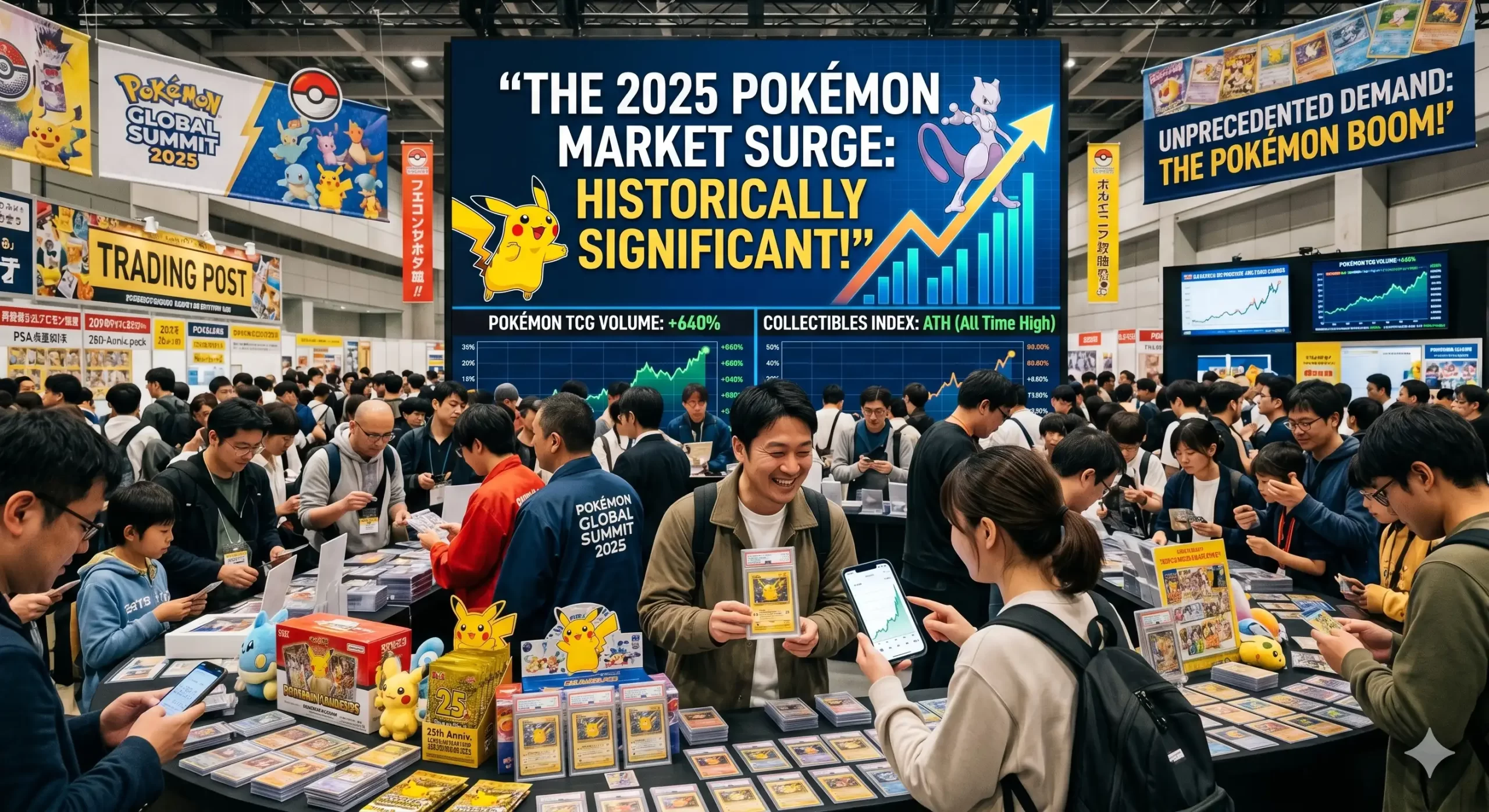
Pokémon remained the undisputed heavyweight of the non-sports and TCG world in 2025, but a single auction result crystallized just how far the franchise’s ceiling has moved. A 1999 Prerelease Raichu Holo graded PSA 6 sold for $550,000 at Heritage Auctions — the highest price ever paid for an English-language Pokémon card.
That number needs context to land properly. The previous Raichu record was held by a 2008 Japanese Promo Holo PSA 10, which sold for $44,900 in 2022. The 2025 sale smashed that benchmark by more than tenfold.
We’re talking about a PSA 6, not a gem mint copy, not a pristine slab, demolishing the all-time English record by a factor of ten. That’s what extreme rarity does to value when the collector base is paying attention.
On the volume side, Pokémon continued to dominate every metric that matters. According to TCGPlayer’s Q4 2025 sales data, Pokémon occupied 9 of the top 10 spots in bestselling singles by unique buyers, meaning more individual collectors were chasing Pokémon cards than any other game or franchise in the market. The franchise is both the blue-chip investment tier and the entry-level gateway for millions of new collectors simultaneously.
That dual appeal is extraordinarily rare and it’s why the floor on vintage Pokémon has continued to rise even as the ceiling shatters records.
How Did One Piece Go From Niche Anime TCG to Hobby Powerhouse?
One Piece’s 2025 run was arguably the most dramatic rise-in-real-time that the non-sports card hobby has witnessed in years. Fueled by Netflix’s hit live-action series, the anime’s ongoing march toward its conclusion, and a fanbase that spans over 500 million manga copies sold worldwide, the One Piece TCG transformed from a beloved niche product into a genuine pillar of the hobby.
The price action on top cards reflected that shift. The Monkey D. Luffy Manga Rare from OP-13 “Carrying On His Will” (OP13-118) reached $24,100 in PSA 10, the highest recorded sale from that set. Manga rares from OP-13 saw values double within 60 days of release. Promo cards appreciated wildly, the Luffy One Piece Day ’25 promo climbed 420% to $650 from its initial market value.
Tournament exclusives became legitimately coveted collectibles: the Uta Treasure Cup 2025 promo (OP09-002) and Nami Championship card (OP09-050) both commanded four-figure prices in ungraded condition.
| One Piece Card | 2025 Sale Price |
|---|---|
| Luffy Manga Rare OP13-118 (PSA 10) | $24,100 |
| Gol D. Roger Manga Parallel (PSA 10) | $6,800 |
| Luffy Tournament Promo ST01-001 | $7,100 |
| Nami Championship 2025–26 OP09-050 (ungraded) | $1,239 |
| Nami Championship 2025–26 OP09-050 (PSA 10) | $2,249 |
| Luffy One Piece Day ’25 Promo | $650 (+420%) |
The market structure data confirmed what the price charts were showing. One Piece officially outsold Yu-Gi-Oh! in both October and November 2025 on TCGPlayer, displacing a franchise that had held the #3 position in the hobby hierarchy for decades. The anniversary set OP-13 was the catalyst, pouring more high-end collectibles into the ecosystem than any single One Piece release before it.
By Q4, the conversation had shifted: it wasn’t whether One Piece belonged in the “Big Three” of TCGs, it was whether it had already arrived.
Where Does Disney Lorcana Fit Into the 2025 Non-Sports Picture?
Disney Lorcana’s 2025 story is more nuanced than a straight-line surge narrative, and collectors deserve the honest version. Ravensburger reported that Lorcana sales “normalised” in 2025 following an explosive two-year launch phase. The qualifier matters: “normalised” from a launch that produced over a billion cards sold by the beginning of 2025 and represented the most successful product launch in Ravensburger’s corporate history. Normalising from that baseline still means operating at a high level.
What actually happened is that Lorcana moved from category-disrupting phenomenon to sustainable franchise — which is exactly what long-term collecting value requires. The hyperbolic opening run cooled into a stable player base of dedicated Disney collectors and TCG enthusiasts who aren’t going anywhere. Lorcana fell from its brief flirtation with the Big Three down to fifth or sixth in TCGPlayer rankings by end of year, but it remained a top-ten TCG by revenue and built a community with genuine staying power.
For non-sport collectors specifically, Lorcana matters because it legitimised Disney characters as serious trading card subjects at a global scale. The infrastructure it built, collector communities, graded single markets, dedicated retail footprint, benefits the broader Disney card ecosystem, including vintage Topps Disney sets and the growing Fanatics/Topps Disney pipeline.
Speaking of which: Topps (now under Fanatics) holds a major licensing position on Disney, Star Wars, and Marvel card production going forward, with a 20-year deal that positions the company as a one-stop shop for pop culture non-sports cards. That pipeline is only getting stronger.
What’s Actually Driving The Shift From Sports to Pop Culture Collecting?
The underlying forces behind the non-sports surge aren’t complicated, but they’re worth naming clearly.
Franchise strength is the foundation: Star Wars, Pokémon, One Piece, and Disney aren’t trending, they’re multigenerational. Collectors who grew up with these properties are now adults with disposable income. When nostalgia meets financial capacity, auction records follow.
Media crossover accelerates everything: Netflix’s One Piece live-action series pulled millions of new fans into the franchise simultaneously. Every new Star Wars series on Disney+ refreshes the cultural relevance of vintage cards. The relationship between streaming and collecting has become a direct feedback loop.
Grading legitimised the investment case: The 29% jump in graded card submissions reflects a cohort of collectors who approach non-sports cards the way earlier generations approached gold or art. A PSA 10 slab is a standardised, verifiable, transferable asset. That framing opens the category to buyers who would never have touched raw cardboard.
The sports card ceiling is visible: Premium rookie cards have already reached stratospheric prices that feel inaccessible to most collectors. Non-sports cards, especially vintage, offer genuine upside potential at lower entry points. The 1977 Topps Star Wars #1 Luke Skywalker hit $268,400 because the PSA 10 population is nine copies. That’s the kind of scarcity math that serious collectors recognise immediately.
Who Should be Paying Attention to the Non-Sports Surge Right Now?
Honestly? Almost everyone in this hobby. But let me break down who specifically has the most to gain from understanding what happened in 2025.
- Vintage collectors who’ve been sitting on mid-grade Star Wars, early Pokémon, or classic entertainment sets from the 1980s–1990s: your ceiling just moved significantly upward. Get those cards evaluated.
- TCG players who buy for gameplay but haven’t considered the collectible angle: the intersection of playability and rarity is where One Piece’s manga rares and promo cards live. Those are simultaneously useful and valuable.
- New collectors entering through a franchise they love: this is genuinely the right time. The non-sports market is deep, varied, and still has legitimate discovery plays, sets that haven’t been fully recognised yet, franchises whose card history hasn’t been properly documented. This site exists to help you find them.
- Investors and flippers who’ve been focused on sports: the non-sports category offers better scarcity dynamics on vintage material and stronger emotional attachment from collectors, which tends to support floors more reliably than pure investment demand.
What Does the 2026 Non-Sports Card Market Look Like From Here?
The trajectory is firmly upward. The TCG/non-sports market is projected to grow from $7.8 billion toward $12 billion over the next five years, and the structural drivers, franchise strength, grading adoption, media crossover, and mainstream retail presence, are all intact.
The Star Wars market has a 50th anniversary tailwind building toward 2027. One Piece is in the final act of a 30-year story, which historically creates collector urgency.
Pokémon continues adding generational layers of vintage material with genuinely restricted populations. Disney Lorcana, despite its 2025 cool-down, is settling into a sustainable long-term position with a loyal player base.
What I’m watching most closely heading into the next 12–18 months:
- PSA population thinning on top vintage non-sports cards. As more high-grade copies are absorbed into long-term collections and taken off the market, scarcity dynamics on the remaining tradable examples will intensify.
- New brand entries. Fanatics’ Topps-powered Disney/Star Wars/Marvel pipeline could introduce the kind of premium insert and autograph programming that the non-sports space has historically lacked compared to sports.
- International expansion of One Piece’s collector base. The anime’s conclusion will be a global cultural event. The card game that carries the franchise’s DNA will feel that moment.
This Wasn’t a Flash – It Was a Foundation
The 2025 non-sports market surge wasn’t a speculative bubble or a COVID-era flashback. It was the market catching up with something that collectors like us have known for a long time: the characters, worlds, and franchises that shaped our childhoods belong on cardboard just as much as any athlete. Maybe more.
$268,400 for a Luke Skywalker. $550,000 for a Prerelease Raichu. One Piece displacing Yu-Gi-Oh after 25 years. These aren’t flukes. They’re data points in a longer story about what collecting actually means, and pop culture is writing that story now.
The hobby is ours. Keep collecting what you love.