
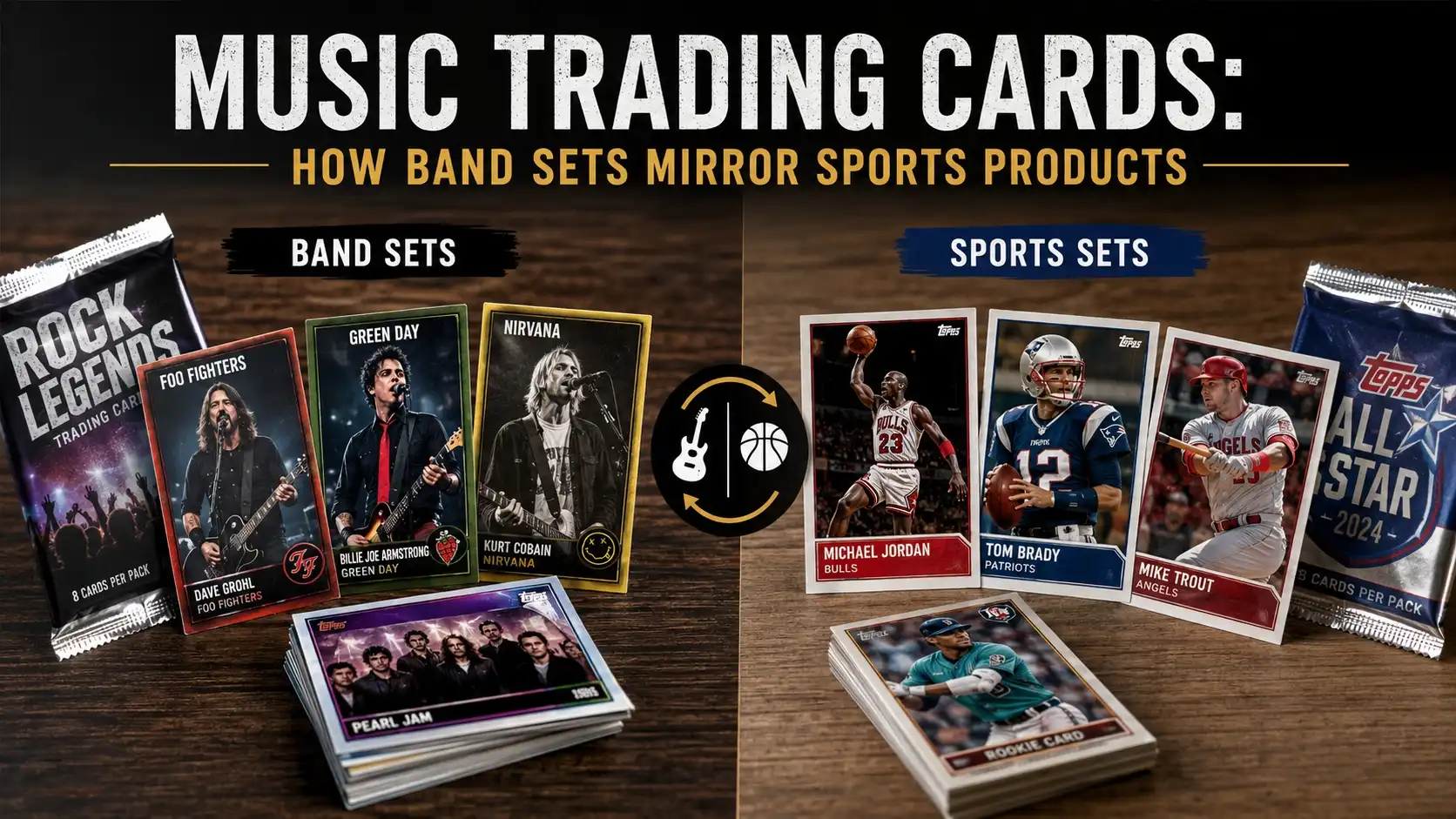

I still remember buying my first pack of non-sport cards at a local flea market and thinking the hobby had its own language. The guy next to me was doing the same thing with a box of football wax, and somehow we were both chasing the same feeling.
These days that gap between the sports and non-sport worlds keeps shrinking, and nowhere is it more obvious than in music trading cards.
Music trading cards are no longer just nostalgia items sitting in a discount bin. They are structured, tiered, collectible products built with the same architecture that drives billion-dollar sports releases.
And when Panini brought the Prizm brand, the engine behind some of basketball’s most sought-after cards, to The Rolling Stones, something clicked for a lot of collectors who had been sitting on the fence.
Let me break down what that actually means and why it matters.
What Changed? Music Cards Now Have the Same Architecture as Sports Products
For years, music trading cards existed in their own lane, vintage bubble gum sets, sketch cards at conventions, the occasional licensed release. What they rarely had was the systematic, scalable structure that turns a product into a long-term chase.
That structure has three pillars in sports: a base set, a parallel rainbow, and themed inserts tied to performance or narrative moments. If you collect NBA Prizm, you know the feeling of chasing a specific colorway. You know what numbered to /25 means versus /10 versus a 1/1. That whole language is now being applied to music.
The 2025 Panini Prizm Rolling Stones set is the clearest example. It opens with 100 base cards printed on chromium stock, covering the band’s entire career across six decades. Then it layers over 15 parallels, numbered and non-numbered, including the Silver Prizms and rarer numbered editions that Prizm collectors have chased in basketball since 2012.
A Hobby Mega Box ($50) averages two Silver Prizms and four numbered parallels. A Blaster ($29.99) carries its own exclusive Confetti or Lazer Prizms depending on box color. That is sports product logic applied to Mick Jagger.
This is not a small shift. It is Panini signaling that the infrastructure that built Prizm Football, Prizm Basketball, and Prizm Soccer can carry music just as well.
How Do a Band’s Albums, Tours, and Eras Work Like Seasons and Subsets?
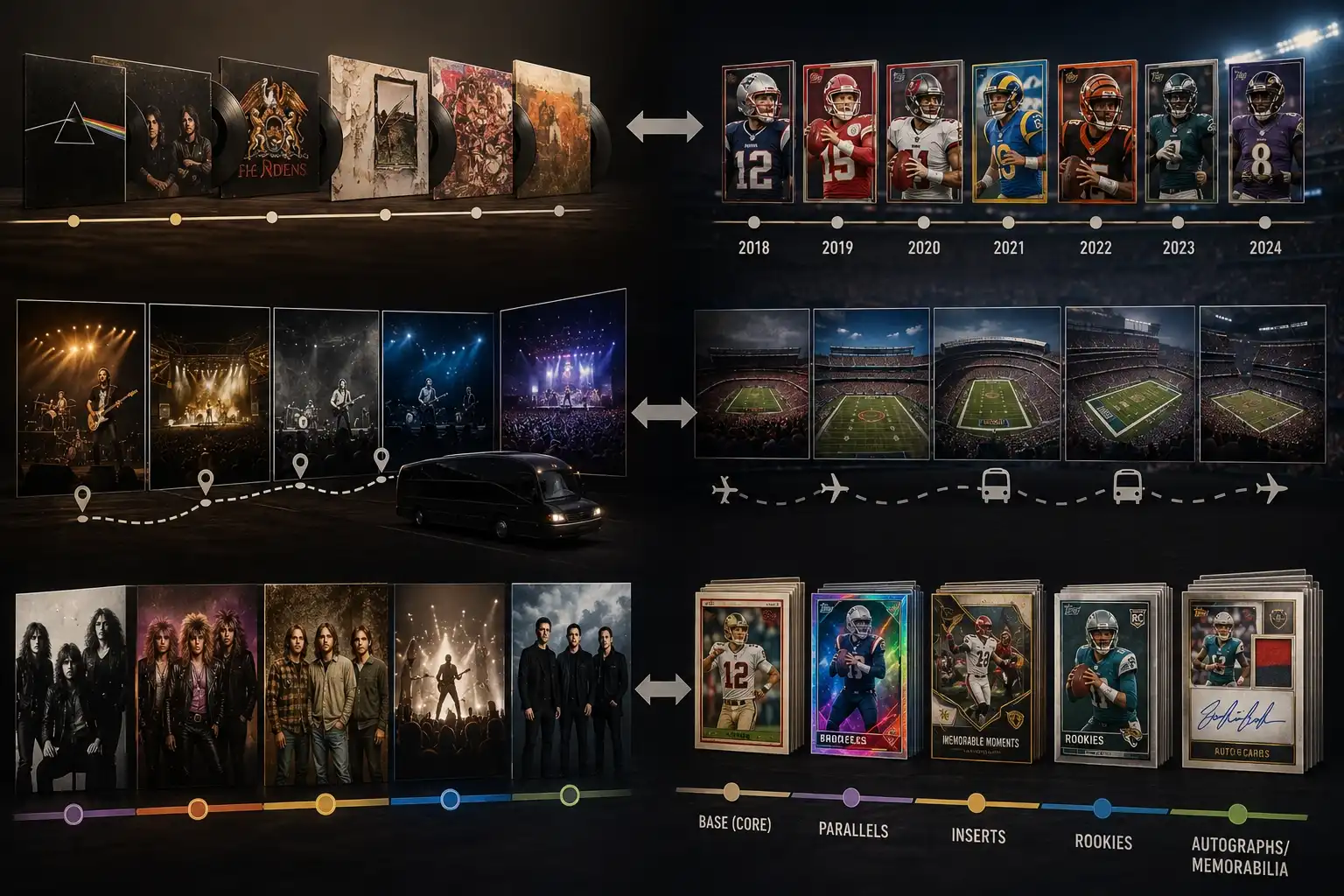
Here’s where it gets genuinely interesting for collectors who straddle both worlds. In sports, seasons and eras define subsets. You get rookie cards for a player’s debut year, milestone cards for championships, and throwback designs tied to iconic moments. A band’s career maps onto exactly the same structure.
The Panini Prizm Rolling Stones checklist uses that logic directly. The insert sets do not just celebrate the Stones as a general entity. They break the band’s career into functional collecting chapters:
- Milestones & Moments: landmark events in the band’s history, working like “Achievements” inserts in basketball
- Behind the Scenes: the inner-circle perspective, similar to practice or locker room content in sports sets
- The Original Stadium Show: celebrating stage designs from specific tours, the equivalent of venue-specific game notes
- Poster Perfection: artwork tied to individual tour eras, functioning the way team logo or throwback design inserts work in sports
- Singles Artwork: specific hit-by-hit coverage that mirrors the per-game or per-season breakdown sports sets use
- Albums: die-cut in a vinyl shape, one card per album in the Stones’ discography, working exactly like per-season base variations
Think about what that means for someone building a personal collection (PC). Instead of collecting everything Mick Jagger, you can decide you only collect cards tied to the Exile on Main St. era. Or you target everything associated with the Voodoo Lounge tour.
You are PC’ing a moment, not just a name. That is the same mental model a sports collector uses when they say “I only collect Jordan from the championship runs.”
It is a simple idea but it changes how personal collecting works in the music card space entirely.
Rolling Stones Inserts vs. Sports Card Equivalents
|
Rolling Stones Insert |
Sports Equivalent |
What You’re Chasing |
| Milestones & Moments | Achievement / Award Cards | Landmark career events |
| The Original Stadium Show | Venue-Specific Game Cards | Tour stage designs |
| Poster Perfection | Throwback / Logo Cards | Era-specific artwork |
| Singles Artwork | Per-Game Highlights | Hit-by-hit coverage |
| Albums Die-Cut | Season-Specific Variation | Full discography cards |
| Base Variation (Brian Jones) | RC / Rookie Variation | Former member coverage |
Which Other Music Card Sets Are Worth Watching Right Now?
Panini’s Rolling Stones set is the most sports-adjacent release in the music card world right now, but it is not the only one worth tracking. The broader music card category is filling in fast.
Upper Deck Grateful Dead – 60 Years So Far (2026)
Upper Deck entered the music card space in early 2026 with a 50-card factory box set celebrating the Grateful Dead’s 60th anniversary. The set takes a different approach to the Stones release, venue poster art and band iconography rather than chromium sports design, but it still carries the structural DNA that serious collectors recognize.
You get colored Dancing Parallels (Yellow, Green, Orange, Pink), a serial-numbered 1/1 High Potency Purple, and a Transmissions from Dave’s Desk insert series that includes autographs from legendary Dead archivist David Lemieux.
That is a hierarchy. Thematic inserts, numbered parallels, and ink. Dead Heads now have a proper chase product.
Panini Prizm Minecraft – The Template Set
Before the Stones, Panini tested the Prizm brand in non-sport with Minecraft. It worked. That proof of concept is why the Stones release exists and why more music and entertainment Prizm products are likely coming. Panini is not guessing here. They proved the parallel rainbow format translates beyond sports, and now they are scaling it.
The Vintage Baseline – Why This Matters More Than You Think
Music cards are not new. The Beatles had bubble-gum card series in the 1960s. Elvis Presley cards have circulated since the 1950s. KISS cards date back to the 1970s. What makes this moment different is the infrastructure catching up to the content.
PSA and BGS are grading music cards with greater frequency, PSA population reports are being tracked on vintage sets the same way they are tracked for rookie cards, and market data platforms are now indexing music card sales alongside sports.
That infrastructure, grading, population data, transparent secondary market pricing, is what turns a casual release into a long-term collectible category. Music cards now have it.
How Should You PC Music Cards the Way Sports Collectors PC Athletes?
The most natural starting point is defining your scope the same way you would in sports: era, member, or theme. Here are three approaches that actually work:
PC by Era
Choose a specific period of a band’s career and only target cards tied to that era. Stones collectors can go full Sticky Fingers era. Dead collectors can zero in on the Europe ’72 tour subset in the Upper Deck set. This is the tightest and most satisfying approach because it mirrors how fans already relate to the music.
PC by Member
The Stones release includes Base Variation cards for former members Brian Jones and Mick Taylor, listed as case hits. If you have a thing for the Brian Jones-era Stones, those are your grails. The same logic applies to any band set with member-specific coverage. Chase the person, not just the band name.
PC by Parallel Rainbow
If you come from the sports card world, rainbow chasing will feel immediately familiar. The Stones Prizm set has over 15 parallels including the Red & Black Checker Prizm numbered to /179. Pick one card — a Mick Jagger base, a Keith Richards insert — and try to complete every parallel. That is a multi-year project with a clear finish line.
2025–2026 Music Card Releases at a Glance
| Set | Manufacturer | Format | Key Chase |
| Prizm Rolling Stones | Panini | Hobby Mega / Blaster | Numbered parallels, die-cuts |
| Grateful Dead 60 Years | Upper Deck | Factory Box Set | 1/1 Purple, Lemieux autos |
| Prizm Minecraft | Panini | Hobby Mega / Blaster | Prizm parallels |
Is Music the Next Big Frontier for the Trading Card Hobby?
I think so, yes, but not because of hype. Because of structure.
The trading card market is projected to reach $13 billion in 2025 and grow to $21 billion by 2034. Music is one of the few segments that brings in audiences who were never interested in sports cards.
A Stones fan who grew up in the 1970s and never touched a basketball card will open a Prizm Stones box because it is a different kind of passport to a relationship they already have with that music.
And for collectors who already speak the sports card language, who know what a numbered parallel means, who understand PSA population reports, who have chased a rainbow, music sets now speak exactly the same dialect.
The Panini Prizm Rolling Stones set is not the peak of this. It is the proof of concept that opens the door. Expect more major bands, more Prizm crossovers, and eventually autograph and relic products that will take this category fully into the territory that sports has occupied for decades.
Right now is a good time to be paying attention.