

The Stranger Things card market moved fast the moment the finale aired in 2025. A 2025 Topps High Tek 1/1 autograph of Millie Bobby Brown, Eleven herself, sold for $5,600 just three days after the final episode, setting the all-time record for the most valuable Stranger Things card ever pulled.
That sale didn’t happen by accident. It happened because nine years of television had built a fanbase willing to pay serious money for something permanent.
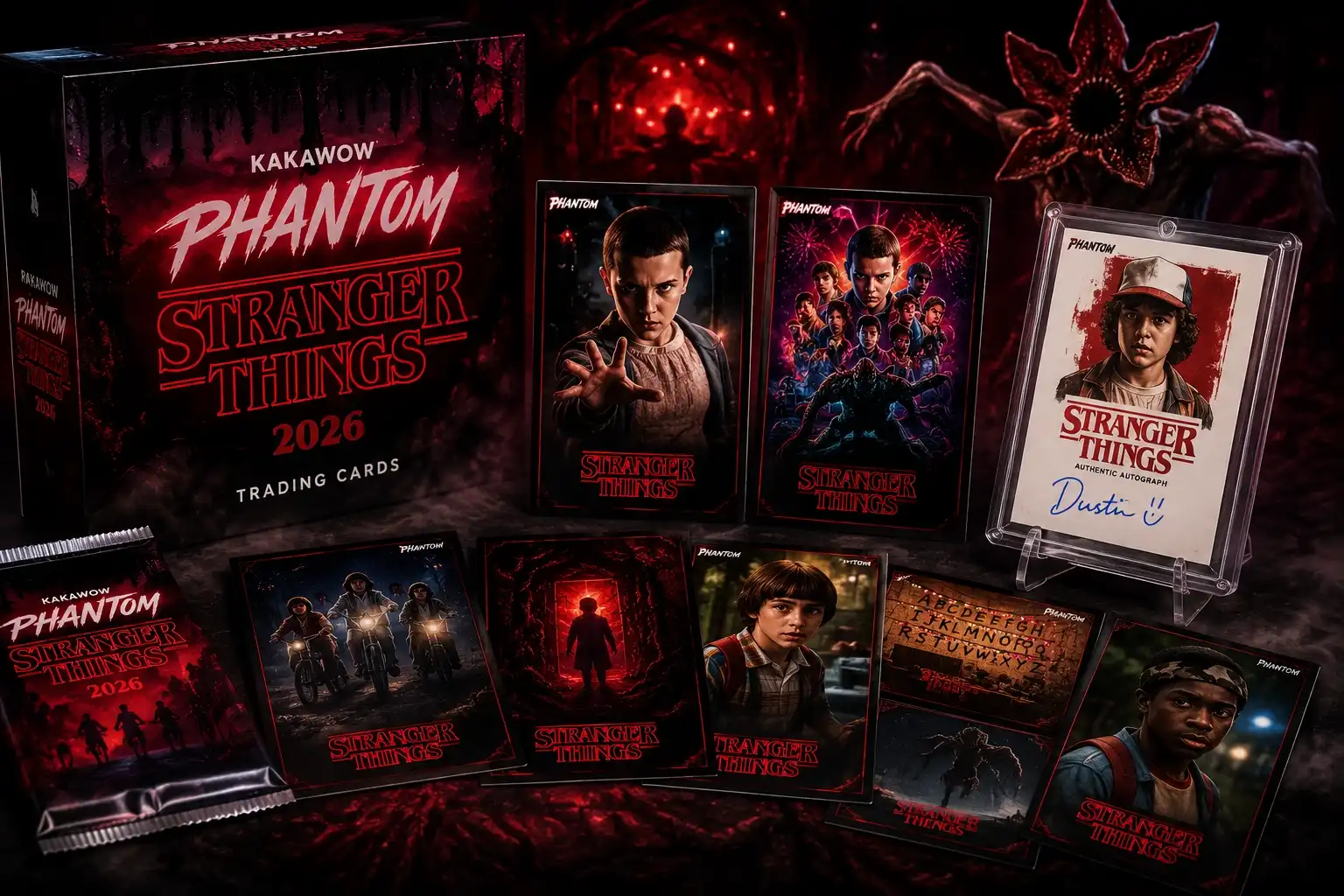
The KAKAWOW PHANTOM Stranger Things set is the product built for that moment, released in 2026 on chromium stock, with 1–4 Limited/Numbered cards per box, one Parallel, and six distinct insert lines.
For collectors who’ve been waiting for a premium card product that matches how much the show actually meant to them, this is it.
What Is the KAKAWOW PHANTOM Stranger Things 2026 Set?
KAKAWOW PHANTOM Stranger Things is a 2026 premium entertainment card release covering the full run of the Netflix series, all four seasons, from Hawkins in 1983 through the franchise’s 2025 conclusion.
KAKAWOW isn’t a name every hobbyist knows yet, but that’s changing fast. They’re a newer manufacturer that built their identity in premium entertainment cards with one clear philosophy: every card in a PHANTOM box should be display-worthy, not binder-worthy.
Before Stranger Things, their PHANTOM line tackled Disney, Marvel, Harry Potter, and Warner Bros. properties, and each release established the same signature: chromium-printed card stock, rich production finishes, and a rarity structure that rewards the collectors who go deepest.
The Stranger Things license is the biggest entertainment property KAKAWOW has touched under the PHANTOM banner. It’s also the right one, because the show’s visual identity, neon string lights against darkness, the grey desolation of the Upside Down, the electric crack of interdimensional gates opening, is exactly the kind of imagery that gains something on chromium stock rather than losing it.
Why Does KAKAWOW Use Chromium Stock and Why Does It Matter Here?
Chromium stock means every card surface is reflective, catching and shifting light in a way that matte stock cannot, and for Stranger Things specifically, that difference is significant.
The franchise’s visual language was built around light and darkness. Eleven glowing, the Upside Down consuming color, Hawkins in fluorescent school hallways and wood-paneled basements and the dim red glow of the lab.
These images were made to live on a surface that responds to light. A chromium-finish card of the Demogorgon at full spread looks fundamentally different from a flat matte version of the same image, the deep blacks deepen, the highlights catch, and the card looks alive in a way that makes you want to prop it up rather than sleeve it.
KAKAWOW’s PHANTOM line has proven this approach across every franchise they’ve worked with. For Stranger Things, it’s not a production choice. It’s the correct production choice.
What Do You Get in a Box of KAKAWOW PHANTOM Stranger Things?
Every box delivers a guaranteed mix across numbered cards, parallels, and inserts, here’s the full breakdown:
| Content Type | Per Box |
|---|---|
| Limited/Numbered Cards | 1–4 guaranteed |
| Parallel Card | 1 guaranteed |
| Insert Lines | 6 distinct lines |
The 1–4 numbered card range is the variable that makes every box feel like its own event. Four numbered pulls in a single box is a stack that generates real excitement in a break. One numbered pull is the floor that ensures no box opens empty.
The spread exists because PHANTOM boxes are intentionally tiered, the production run distributes higher-numbered pulls across most boxes and concentrates the rarest pulls in a smaller percentage.
The guaranteed Parallel is a chromium-finish base card with a specific serialized print run. In the PHANTOM line’s established rarity hierarchy, parallels aren’t low-value throwaway pulls, they’re the entry point into a ladder that goes deep.
The six insert lines are where most of the box’s visual content lives, and based on KAKAWOW’s PHANTOM architecture across prior releases, collectors can expect at least one character-focused line, one moment or scene-based line, and at least one specialty format card, whether that’s a stereoscopic lithography card that creates genuine depth on a flat surface, an acetate treatment, or another premium format KAKAWOW has used to distinguish PHANTOM boxes from standard entertainment releases.
Which Stranger Things Characters Are the Key Cards to Chase?
The pull hierarchy for any Stranger Things set follows the franchise’s emotional and narrative weight, and that maps cleanly onto specific characters.
The big four from the secondary market’s perspective:
- Eleven (Millie Bobby Brown): The franchise’s anchor character. The $5,600 High Tek 1/1 sale was an Eleven card. Every premium Stranger Things set rises or falls on what its Eleven cards look like and how they’re numbered. A serialized chromium Eleven card from the PHANTOM line sits at the top of the pull hierarchy.
- Jim Hopper (David Harbour): Consistently the second-strongest secondary pull across Stranger Things releases. The character’s arc, death, resurrection, sacrifice, gives Hopper cards emotional weight that translates to value.
- Vecna/Henry Creel (Jamie Campbell Bower): The franchise’s final and most psychologically complex villain. Post-finale, Vecna cards have appreciated as collectors solidify their understanding of his role across the full run of the series.
- The Demogorgon: The franchise’s original icon. Demogorgon cards carry nostalgia for Season One alongside ongoing creature design appeal.
Characters worth watching in the mid-tier: Eddie Munson (Joseph Quinn) generated outsized demand from his Season Four introduction before his departure.
Max Mayfield and Robin Buckley both have devoted collector followings. A well-designed chromium card of any of these characters on a numbered PHANTOM parallel is a genuine secondary market target.
How Does the KAKAWOW PHANTOM Numbered Card System Work?
In PHANTOM releases, the numbered card tier runs from mid-range serial numbers down to the true 1/1 chase, and the structure rewards collectors who understand where each tier sits.
Based on KAKAWOW’s PHANTOM line architecture across prior releases, the rarity ladder looks like this:
| Tier | Print Run | Notes |
|---|---|---|
| Base Parallel | Higher-numbered | Per-box guarantee |
| Limited Numbered | Varies | 1–4 per box (set range) |
| Low-numbered Chase | Very scarce | Case-hit level pulls |
| 1/1 Variants | 1 copy | Ultimate chase (Black/White Card treatment in prior PHANTOM releases) |
The 1/1 treatment is the card that ends up framed. KAKAWOW’s prior PHANTOM releases have featured Black Card and White Card 1/1 variants, opposite-end treatments of the same subject that create two unique objects from a single card concept. Whether the Stranger Things set carries the same specific format hasn’t been confirmed in the full checklist yet, but the PHANTOM line’s pattern of building 1/1 treatments into their top-tier pulls has been consistent.
A 1/1 of Eleven or Vecna from a premium post-finale chromium release is not a card you find at a discount later. It’s the card the collection is built around.
You also may like these Upper Deck Grateful Dead cards reviews.
Why Does the Post-Finale Market Timing Matter for Collectors?
Buying into a concluded franchise’s premium card product is a fundamentally different decision than buying into an active one, and for Stranger Things, the timing works in collectors’ favor.
When a franchise is still running, new seasons generate new product, new characters, and competing supply. The market stays fluid. When a franchise concludes, every print run that existed on the final day is the permanent population. No new supply. No competing release featuring the same characters in a newer, shinier format. What exists is what will ever exist.
Stranger Things concluded in 2025. The KAKAWOW PHANTOM set releases into a closed market, which means:
- Supply is finite: numbered print runs from this release cannot be reprinted or supplemented
- Demand continues to grow: the franchise’s emotional legacy deepens over time rather than fading into the background noise of ongoing seasons
- The $5,600 data point matters: that sale happened before this PHANTOM set entered the market, which means the ceiling had already been established before KAKAWOW’s chromium product was even available
Post-finale entertainment card markets have historically rewarded early collectors. The pattern shows up across concluded franchises: initial sales at or near release price, followed by steady appreciation as supply tightens and emotional attachment compounds into financial demand.
Who Should Buy the KAKAWOW PHANTOM Stranger Things Set?
There are three collector profiles this set is squarely built for, and all three have compelling reasons to act now rather than later.
The franchise devotee: You watched Stranger Things from season one. You know what the Upside Down means to you personally. You want a card product that matches the quality of that feeling. The PHANTOM line’s display-ready chromium aesthetic is the format for this. These cards go under glass, not into pages.
The entertainment card investor: Post-finale, premium chromium stock, six insert lines, numbered pulls from a closed print run. Every marker that drives long-term appreciation in the entertainment card space is present. The fundamentals here are cleaner than most active-franchise releases.
The set builder: If you’re assembling a complete Stranger Things card library across multiple products and manufacturers, the KAKAWOW PHANTOM release is the premium anchor that everything else orbits. There is no more visually ambitious licensed Stranger Things card product available in 2026.
Is KAKAWOW PHANTOM Stranger Things Worth It?
Yes, and the reasoning is simpler than it might appear.
KAKAWOW built a premium chromium product for one of the most emotionally invested collector fanbases in entertainment cards, released it into a post-finale market with permanently closed supply, and backed it with an insert architecture deep enough to reward collectors at every level of the hobby.
The 1–4 numbered card guarantee means every box has real pull potential. The six insert lines mean every box has real visual content. And the chromium stock means every card, even the base pulls, looks like it belongs somewhere better than a pocket page.
The $5,600 Millie Bobby Brown sale in January 2026 proved that the Stranger Things market has a ceiling most entertainment card releases never reach. The KAKAWOW PHANTOM set is the product positioned directly beneath that ceiling.
Open the box. Hawkins earned this one.
Pulled a numbered card from the PHANTOM Stranger Things set? Drop your hit on our contact page, we want to see what came through.