
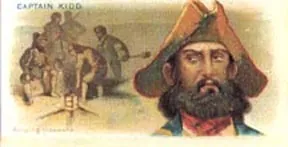
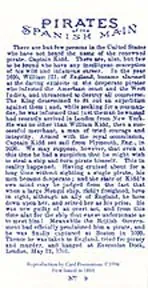
Each card shows a picture of a well known pirate and and action scene in the background. Unlike most Allen and Ginter issues, the backs have a narrative about the pirate. This series is also numbered. Backs contain the set name, company, and lithographer as well.
An advertising banner (G14) was also issued.
Reproduction of orig. Pirates of the Spanish Main by Allen & Ginter 1888
Photos (2)
Checklist (50)
Card (50)
Checklist taken from card fronts. See complete set of images following checklist.
- Numbering
- 1-50
- Dimensions
- 1 1/2" W by 2 3/4" H
| # | Card | Photo |
|---|---|---|
| 1 | Pierre Francois | |
| 2 | Samuel Bellamy | |
| 3 | William Fly | |
| 4 | Charles Vane | |
| 5 | Jack Avery | |
| 6 | John Gow | |
| 7 | Sir Henry Morgan | |
| 8 | George Lowther | |
| 9 | Captain Kidd | |
| 10 | Peter The Great | |
| 11 | Roc The Brazilian | |
| 12 | Sawkins | |
| 13 | Degraff | |
| 14 | Michael Le Basque | |
| 15 | Sieur De Grammont | |
| 16 | John Davis | |
| 17 | Captain Martel | |
| 18 | Howel Davis | |
| 19 | Montbar | |
| 20 | Captain Condent | |
| 21 | Bart Roberts | |
| 22 | Captain Halsey | |
| 23 | Sharp | |
| 24 | Sieur De Montauban | |
| 25 | Stede Bonnet | |
| 26 | John Evans | |
| 27 | Alexander Bras-De-Fer | |
| 28 | Captain Lewis | |
| 29 | Van Horn | |
| 30 | Captain Worley | |
| 31 | Edward England | |
| 32 | Anne Bonney | |
| 33 | Francis Lolonois | |
| 34 | Edward Teach (Blackbeard) | |
| 35 | Mary Read | |
| 36 | Captain Tew | |
| 37 | Portuguese Barthelemy | |
| 38 | Bradley | |
| 39 | Bradish | |
| 40 | Pierre Picard | |
| 41 | Mans Veit | |
| 42 | Captain Jack Rackam | |
| 43 | Edward Low | |
| 44 | Thomas Anstis | |
| 45 | Francis Spriggs | |
| 46 | Kennedy | |
| 47 | Sir Raveneau De Lussan | |
| 48 | Moses Vauclin | |
| 49 | John Phillips | |
| 50 | Lewis Scot |
About Allen & Ginter
Richmond, Virginia based tobacco manufacturer that was formed by John Allen and Lewis Ginter in 1875. Early on the company offered a prize to anyone who could invent a machine that could roll cigarettes which had to be done by hand. Around 1880 or 1881 James Albert Bonsack won the prize for his invention to do just that.