
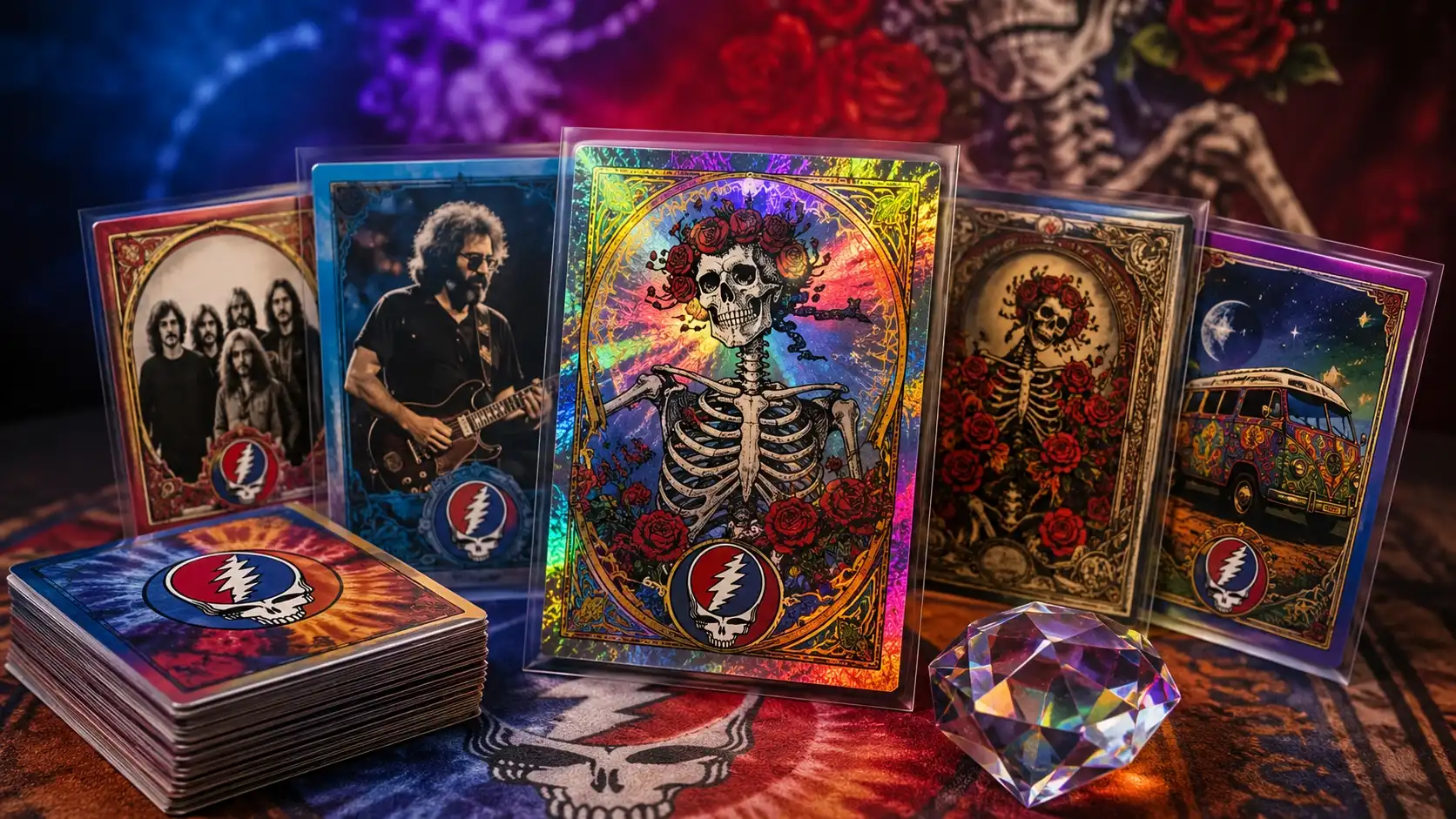

Sixty years of psychedelic rock. Fifty cards. One 1/1 that only a single person on earth can own. Upper Deck’s Grateful Dead trading cards , officially titled “60 Years So Far… A Visual Trip” , released January 21, 2026, and the market reacted fast: sealed boxes hit eBay within days, numbered Blue parallels (/149) are already selling at $27 ungraded, and the Europe ’72 poster section is quietly becoming the most talked-about sub-set in any music card release this year.
Here is every card ranked, every parallel tier priced, and every pull worth chasing.
What Is the Upper Deck Grateful Dead 60 Years So Far Set?
Upper Deck’s Grateful Dead trading cards are the first officially licensed standalone music card set the company has ever released , 50 base cards plus five guaranteed box hits, built entirely around the Dead’s six-decade visual identity.
Set at a glance:
| Spec | Detail |
|---|---|
| Set name | 60 Years So Far… A Visual Trip |
| Release date | January 21, 2026 |
| Base set size | 50 cards |
| Cards per box | 55 (50 base + 5 hits) |
| Boxes per case | 20 |
| Parallel tiers | 6 (Yellow through High Potency Purple 1/1) |
| Insert lines | Transmissions from Dave’s Desk (50 cards) |
| Autograph signer | David Lemieux (/5 per card) |
This isn’t Upper Deck’s first entertainment card, but it is their first true music card set , a distinction that matters for the hobby’s long-term record. First releases in any format carry historical weight that second editions can’t replicate. Twenty years from now, this box is the origin point.
What Is the Full 50-Card Checklist and How Is It Structured?
The 50-card base checklist is split across five thematic sections, each covering a distinct chapter of Grateful Dead visual history. No individual band member photos. No tour biography cards. Just the iconography.
| Theme | Card Numbers | Cards | What You’re Looking At |
|---|---|---|---|
| Uncle Sam | #1 | 1 | The skeleton in patriotic costume , Dead’s single most iconic image |
| Dancing Bears | #2–6 | 5 | One bear per color: Blue, Green, Yellow, Orange, Pink |
| Wave That Flag | #7–16 | 10 | American flag motifs with skulls and psychedelic twists |
| Colors in Motion | #17–28 | 12 | Abstract psychedelic art from across the band’s visual archive |
| Trippin’ Across Europe ’72 | #29–50 | 22 | Venue-specific show posters from the legendary 1972 European tour |
The Europe ’72 section takes up the largest slice of the checklist , 22 cards, one per show date across the tour. Cards 29 through 31 alone cover three London and Newcastle shows from April 1972.
For Deadheads, the Europe ’72 tour isn’t just a recording , it’s a sacred document. The live album it produced is consistently ranked among the greatest live records ever made. Owning a card-by-card run of that tour is a specific and meaningful collection goal that standard music memorabilia doesn’t offer.
Why Are the Dancing Bears the Cards Every Collector Is Actually Chasing?
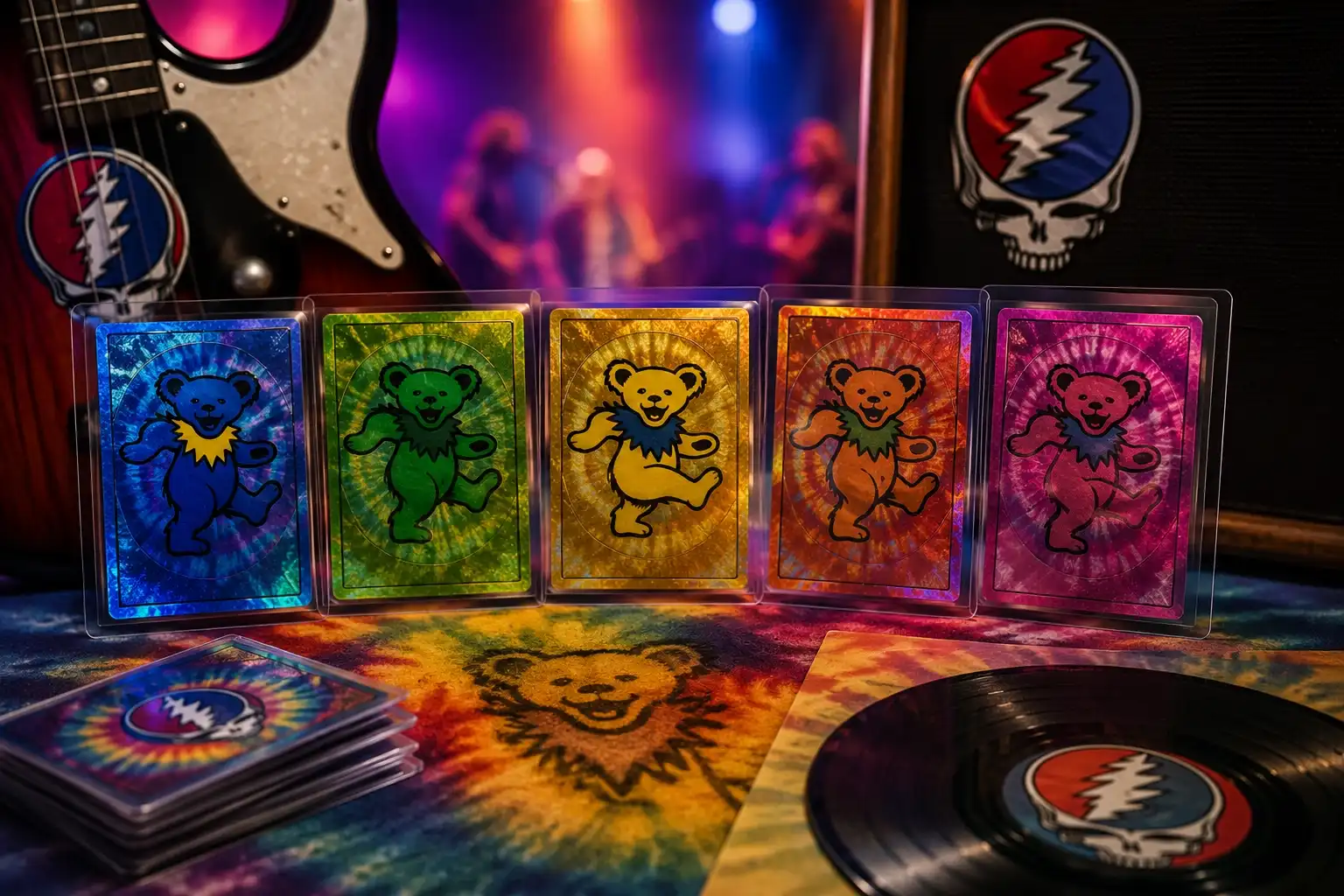
The five Dancing Bears cards (Cards 2–6) are the emotional and commercial center of this entire set , and the parallel structure was designed specifically around them.
The Dancing Bears were created by artist Bob Thomas in the early 1970s, first appearing on the back of History of the Grateful Dead, Volume One (Bear’s Choice). Five bears, five colors: Blue, Green, Yellow, Orange, Pink. Each bear mid-step, arms lifted, instantly recognizable from fifty feet at any show.
They became the secondary visual mascot of the Dead , the image that ended up on bumper stickers, embroidered patches, and tattoos worn by multiple generations of Deadheads.
Upper Deck built the parallel program directly around them. The “Dancing Parallels” mirror the same five colors as the bears themselves: a Pink Dancing Bear parallel is a Pink bear on a Pink card. That alignment is deliberate and elegant. For collectors who’ve loved these bears since childhood, pulling the correct color parallel for the correct bear card feels satisfying in a way that most parallel programs don’t achieve.
A confirmed secondary market data point: A Dancing Bear Blue #6 parallel (/149) , that’s copy 10 of 149 , sold for $27 ungraded on eBay in March 2026. For an unlicensed, ungraded mid-tier parallel five weeks after release, that’s a meaningful baseline.
How Scarce Is Each Parallel Tier? The Population Numbers
Six parallel tiers. One ultimate chase. Here’s every tier ranked by scarcity, with full population math across the 50-card base set.
| Parallel | Print Run | Total Population | Approx. Per Box | Secondary Market |
|---|---|---|---|---|
| Yellow | Unlimited | Unannounced | 3 guaranteed | Entry-level; volume pull |
| Green | /199 | 9,950 total | Variable | $15–40 depending on subject |
| Blue | /149 | 7,450 total | Variable | $20–50; confirmed $27 sold |
| Orange | /65 | 3,250 total | Variable | $40–100+ on key cards |
| Pink | /13 | 650 total | ~1 in 10–20 boxes | $100–300+ on key subjects |
| High Potency Purple | 1/1 | 50 total | Ultra-rare | Auction-only; no ceiling |
The population math tells the real story. Only 650 Pink parallels exist in the entire print run , across all 50 base cards, spread across potentially thousands of boxes globally.
A Pink Dancing Bear Blue (#2) is one of 13 copies of that card that will ever exist. A Pink Uncle Sam (#1) is the same. These aren’t rare by trading card standards alone. They’re rare by any collectible standard.
The High Potency Purple tier is even more stark: 50 total 1/1s in the world , one per base card, no exceptions, no additional print runs. When the production run closes, the population is permanently sealed.
What Are Transmissions from Dave’s Desk and Why Do They Matter?

Transmissions from Dave’s Desk is a 50-card insert set curated entirely by David Lemieux , the Grateful Dead’s official archivist and the man who has managed the band’s vault recordings for decades.
Each Transmissions from Dave’s Desk card celebrates one of the first 50 Dave’s Picks live archival releases, complete with artwork, setlists, and show notes. Lemieux personally selected which shows are represented. These aren’t marketing-approved highlights chosen by an executive. They’re the shows a career archivist identifies as the performances that defined the band.
The insert falls at approximately one per complete base set , making a full 50-card Transmissions run a genuine long-term project rather than a box-break target.
Why the rarity matters: Lemieux signed five copies of each card , 250 total David Lemieux autographs exist across the entire Transmissions from Dave’s Desk series. That’s 5 signed copies of each of the 50 shows he selected as the best of the best. For collectors who understand that Lemieux’s curatorial role is inseparable from what the Grateful Dead mean as an archival force, his autograph on a show he personally chose is a specific and meaningful object. It won’t command Jerry Garcia prices. But it tells a better story.
What Makes the High Potency Purple 1/1 the Ultimate Chase?
The High Potency Purple is the rarest card in the set , 50 total in existence, one per base card, with no second chances.
Familiar symbols like the Dancing Bears and Uncle Sam appear throughout as High Potency Purple 1/1 editions. A High Potency Purple Uncle Sam (#1) , the most iconic image in the set, one single copy anywhere , is the pull that ends the conversation. A High Potency Purple Dancing Bear Pink (#6) is similarly singular.
These cards don’t trade like typical 1/1s from a sports release where the subject’s market fluctuates based on performance. The Grateful Dead’s value as a cultural institution is fixed. Jerry Garcia has been gone since 1995. The iconography he helped build is permanent.
The name earns its place in the hobby on its own terms. “High Potency Purple” isn’t a standard rarity designation. It’s the kind of phrase you’d find on a hand-lettered sign outside a 1970 show at the Fillmore. Upper Deck named it correctly , and Deadheads noticed.
Which Cards Should You Actually Buy, and in What Order?
Here’s a clear priority ranking for building a meaningful Grateful Dead trading card collection, from lowest barrier to highest:
1. Start with the complete 50-card base set. Sealed boxes on eBay are currently trading around $41. That’s 50 archival-quality cards across five thematic sections of Dead history , easily the strongest value entry point in the set. Complete base sets are already moving.
2. Target Dancing Bear parallels by color match. If you love the Pink Bear, hunt Pink parallels of Card 6. If you’re a Green Bear person, hunt Green. The color-coded parallel system rewards thematic collecting in a way most card sets don’t allow.
3. Watch Orange /65 parallels before they disappear. With only 3,250 Orange parallels across the entire print run and a fanbase that spans multiple generations, the Orange tier is underpriced relative to its scarcity. Secondary market pricing hasn’t caught up yet.
4. Set a budget for Pink /13 and stick to it. With 650 Pink parallels in total existence and hit rates reportedly running 1 in 10–20 boxes, sealed-product hunting for Pink is expensive. Buy the singles you actually want on eBay rather than gambling on box hits.
5. The High Potency Purple 1/1 is an auction play. No ceiling. No comparable. If one surfaces, it prices based on which card it is and who’s bidding , not on any rational card market logic.
Are Grateful Dead Trading Cards Worth Buying?
For Deadheads: yes, immediately and without much deliberation. This set was built for you , the iconography, the Europe ’72 tour posters, the Dancing Bears in their correct colors, the Lemieux-curated insert celebrating the vault releases. Nothing about this product feels like a licensing cash-grab. It feels like something made by people who know what these symbols mean.
For investors: the math is clean. First-ever licensed Grateful Dead trading card set, from Upper Deck’s first true music card release, with permanently closed print runs, a devoted multi-generational collector base, and a Deadhead community that already understands scarcity and secondary market value from decades of vintage poster and memorabilia collecting. The crossover audience here is larger and wealthier than most entertainment card markets.
More Upper Deck and Grateful Dead collaborations are confirmed to follow. This box is where it all started.
Which parallel tier are you hunting? Drop your Dancing Bear target in the comments , we’re tracking what the market does next.