
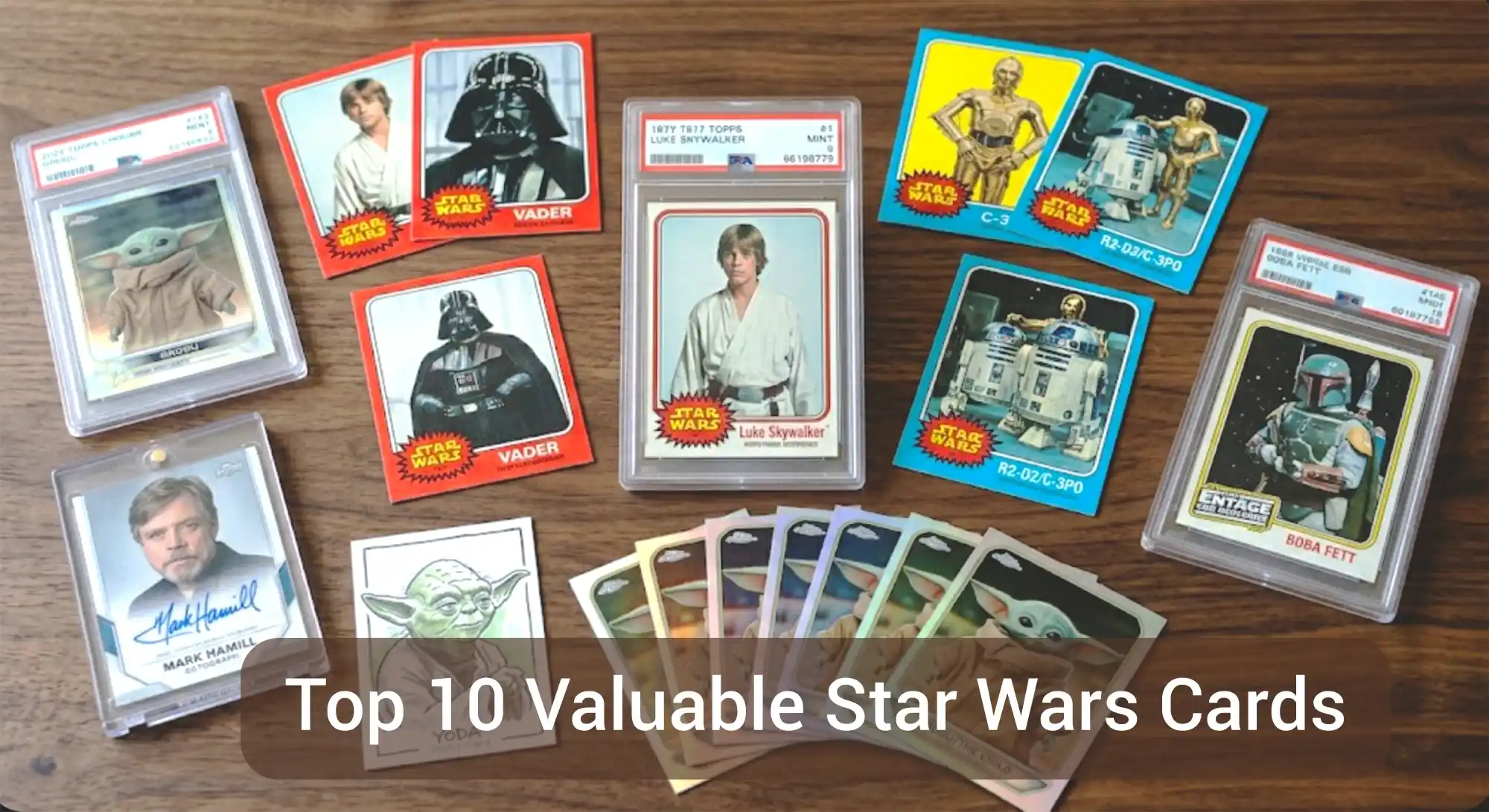

The auction notification hit my phone at 2:47 AM. A PSA 10 1977 Topps Star Wars #1, the Luke Skywalker rookie, had just sold for $28,750. I wasn’t bidding. I couldn’t afford to bid. But I set the alert anyway because I wanted to watch history happen in real time.
I refreshed the page and stared at the final price. Twenty-eight thousand dollars for a piece of cardboard that originally cost fifteen cents in a wax pack. A card that millions of kids owned and most of them destroyed through ordinary childhood. A card that survived.
That’s the thing about the most valuable Star Wars cards, the price is just the number. The real value is in what survives, what’s rare, what captures a moment in cultural history, and what collectors will pay to own a piece of the galaxy. Some of these cards are expensive because of scarcity. Some because of iconic imagery. Some because of pure emotional connection.
This is the definitive list of the ten most valuable Star Wars trading cards in the hobby today, with real market data and the stories that make collectors chase them.
What Makes a Star Wars Card Valuable?
A Star Wars card becomes valuable through a combination of scarcity, condition, character demand, historical significance, and collector sentiment. The most expensive cards maximize all five factors simultaneously.
Scarcity alone isn’t enough. Plenty of cards exist in tiny quantities but trade for pocket change because nobody cares about the character or the set. Condition matters, but a PSA 10 Stormtrooper background card won’t touch the price of a PSA 7 Luke Skywalker rookie.
Character demand fluctuates, Boba Fett cards surged after The Mandalorian, Ahsoka cards exploded after her Disney+ series.
Historical significance anchors value long-term. The 1977 Topps set will always matter because it was first. The C3PO error will always matter because it’s legendary. Mark Hamill autographs will always matter because he is Luke Skywalker.
The cards on this list represent the intersection of all these factors. They’re rare, they’re iconic, they’re chased, and they’re loved.
No. 10: Complete 1977 Topps Star Wars Master Set (PSA 10)
Estimated Value: $150,000 – $250,000+
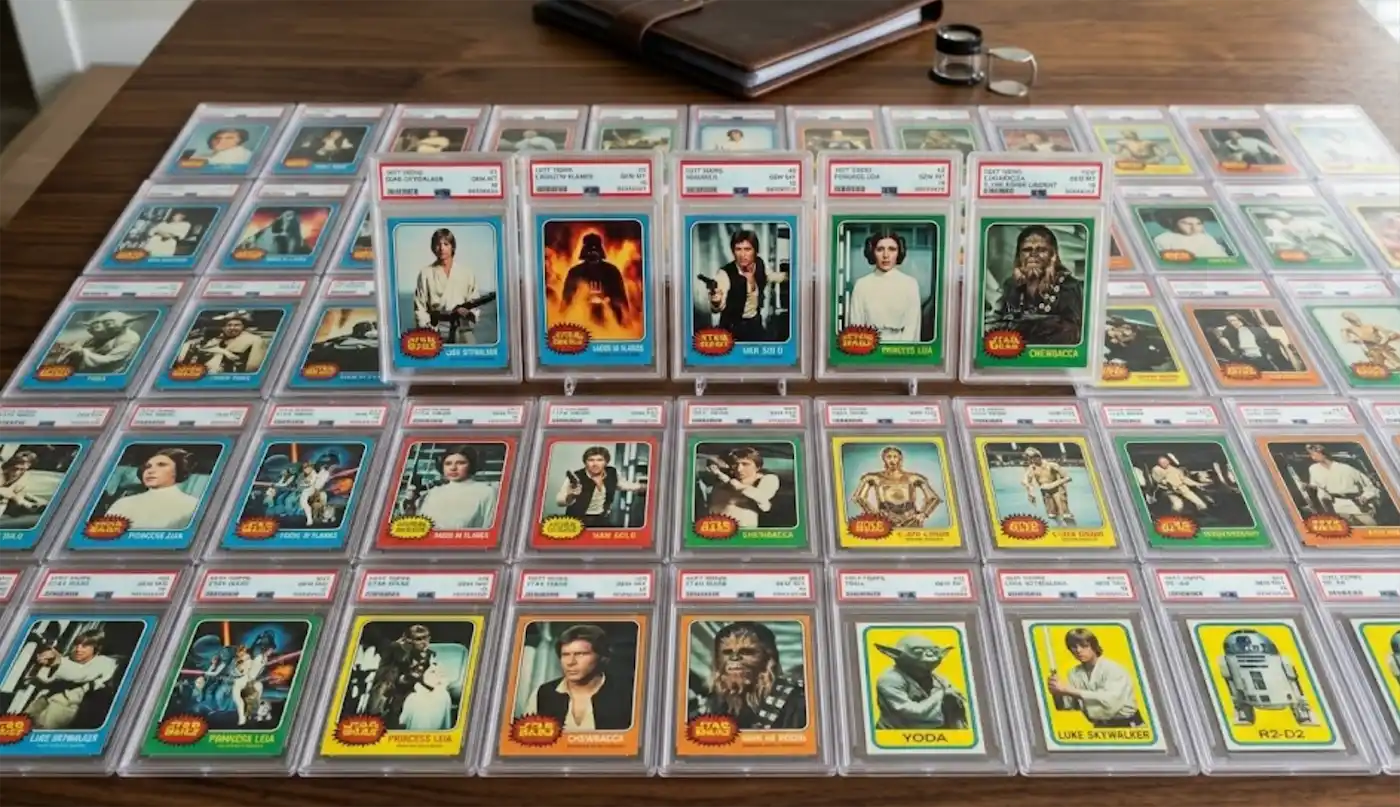
What It Is: All 330 base cards and all 55 stickers from the 1977 Topps Star Wars set, every single card graded PSA 10 Gem Mint.
A complete PSA 10 master set of the 1977 Topps Star Wars series doesn’t just represent cards. It represents obsession. Building this set requires years of hunting, tens of thousands of dollars, and an acceptance that some cards may never surface in PSA 10 condition during your lifetime.
PSA’s population reports show brutal scarcity. Card #1 has fewer than 100 PSA 10 examples ever graded. Some commons from Series 4 and 5 have populations under 20. Stickers are even worse, many have single-digit PSA 10 populations because kids peeled and used them in 1977.
The market for complete graded master sets is thin because so few exist. When one sells at auction, it’s an event. Collectors who own complete PSA 10 sets rarely sell them. They’re endgame achievements, the collecting equivalent of climbing Everest and planting a flag.
Why collectors love this: Completing a PSA 10 master set proves you’ve conquered the vintage hobby. It’s not about owning one grail card. It’s about owning all of them. The completionist satisfaction is unmatched, and the bragging rights are eternal.
No. 9: 1980 Topps Empire Strikes Back Boba Fett PSA 10
Estimated Value: $8,000 – $15,000
What It Is: High-grade cards featuring Boba Fett from the 1980 Topps Empire Strikes Back set, particularly cards #188 and #214.
Boba Fett is the perfect case study in character-driven card value. He appeared on screen for minutes in the original trilogy, spoke maybe five lines, and died falling into a Sarlacc pit. Yet decades later, he’s one of the most valuable characters in the entire Star Wars card universe.
The Mandalorian amplified Fett’s cultural cachet, and The Book of Boba Fett cemented him as a multi-generational icon. Cards that featured him in the 1980 Empire Strikes Back set have appreciated dramatically. A PSA 10 of card #188 – Boba Fett standing on the Executor bridge — now sells for low five figures at auction.
Why collectors love this: Boba Fett represents the anti-hero mystique. He’s cool, dangerous, and mysterious. Owning a high-grade Fett card from his original trilogy appearance connects you to the character before Disney, before the prequels, before the helmet became a brand. It’s Fett at his purest, a bounty hunter in the shadows.
No. 8: Topps Star Wars Stellar Signatures Dual Autograph (Hamill/Fisher)
Estimated Value: $10,000 – $25,000+
What It Is: Modern dual autograph cards featuring signatures from both Mark Hamill and the late Carrie Fisher, typically numbered to 10 copies or fewer.
Dual autographs are the holy grail of modern insert cards. Getting two major actors to sign the same card requires coordination, timing, and sometimes years of production lag. Mark Hamill and Carrie Fisher dual autographs are especially poignant because Fisher passed away in 2016, making any posthumous archive dual signings incredibly rare.
These cards appear in ultra-premium products like Masterwork and high-end Stellar Signatures cases. Print runs are minuscule — often 5 or 10 copies total. The cards themselves are visually striking, with dual photo panels and side-by-side signatures.
Why collectors love this: Hamill and Fisher are Luke and Leia. They’re the heart of Star Wars.
Owning both signatures on a single card feels like holding a piece of the Skywalker legacy. Fisher’s passing added tragic emotional weight that transformed these cards from premium hits into memorials.
No. 7: High-End Sketch Card by Elite Artist (Brian Kong, Cat Staggs, Randy Martinez)
Estimated Value: $5,000 – $20,000+
What It Is: One-of-one original artwork sketch cards featuring iconic characters, created by the hobby’s top-tier artists.
Not all sketch cards are created equal. A stick-figure Ewok by an unknown artist might sell for $50. A fully rendered, museum-quality colored-pencil portrait of Darth Vader by Brian Kong can sell for $15,000+. The difference is artistry, character choice, and the artist’s reputation within the hobby.
Elite artists like Kong, Staggs, Martinez, and Jeff Mallinson have cult followings. Collectors track which artists are in each product and break cases hunting for their work specifically. A Kong Ahsoka or a Staggs Rey is an instant six-month salary for most people.
These cards aren’t just collectibles. They’re original art. The artist drew it by hand on card stock, signed it, and it went into a pack. You could pull it at Target or a card show. The lottery-ticket aspect combined with genuine artistic merit creates a market unlike any other insert type.
Why collectors love this: You’re not buying a printed card. You’re buying a one-of-one original painting the size of a playing card. It’s art collecting compressed into cardboard. And if you pull one yourself from a pack, the story becomes part of the card’s provenance forever.
No. 6: 1977 Topps Star Wars #7 Darth Vader PSA 10
Estimated Value: $12,000 – $20,000
What It Is: The first-ever trading card depicting Darth Vader, from Series 1 of the 1977 Topps Star Wars set, in PSA 10 Gem Mint condition.
If card #1 is Luke’s rookie card, then card #7 is Vader’s. The image shows Vader’s helmet in menacing profile, backlit against darkness, with the caption “Menacing Darth Vader.” It’s iconic, it’s haunting, and in high grade it’s devastatingly rare.
Vader is the franchise’s most recognizable villain and one of the most iconic characters in film history. His first card appearance carries weight that transcends the hobby. A PSA 10 combines pop-culture significance with vintage scarcity and visual impact.
Population reports show fewer than 50 PSA 10 examples. Most survivors have centering issues or corner wear from the rough Series 1 print run. Finding a clean copy requires patience and deep pockets.
Why collectors love this: Vader is eternal. He’s the villain every kid feared and every adult respects. Owning his rookie card in perfect condition is like owning a piece of cinematic history.
It’s not just a card. It’s Darth Vader, frozen in cardboard, forever.
No. 5: Topps Chrome SuperFractor 1/1 (Key Character)
Estimated Value: $10,000 – $50,000+
What It Is: The lone 1/1 SuperFractor parallel of a key character from any given Topps Chrome Star Wars release.
SuperFractors are the apex of the Chrome parallel pyramid. Every base card has one — and only one — SuperFractor printed. It’s serial-numbered 1/1, features the most intense rainbow refraction of any parallel, and is the single rarest version of that card in existence.
The value swings wildly depending on the character. A SuperFractor of a background Resistance pilot might sell for $500. A SuperFractor of Grogu, Rey, Vader, or Luke from a flagship Chrome release can hit five figures. Character demand drives everything.
I’ve never pulled a SuperFractor. I’ve opened hundreds of Chrome packs. I’ve hit Gold Refractors, Orange Refractors, even a Red /5 once. But never the 1/1. The math is brutal, one SuperFractor per card in a 100-card set means 100 total SuperFractors across potentially millions of packs.
Your odds are microscopic. When someone hits one, it’s an event.
Why collectors love this: It’s the ultimate chase card. You’ll never own a rarer version of that specific card because only one exists in the world. If you pull it, you’re the only person on Earth who can. That exclusivity is intoxicating.
No. 4: Production-Used Hero Costume Relic (Luke, Leia, Vader)
Estimated Value: $15,000 – $40,000+
What It Is: Relic cards containing embedded fabric swatches authenticated as coming from hero costumes worn on-screen by principal actors in the original trilogy.
Standard relic cards contain production-used materials, but most come from backup costumes, stunt doubles, or background extras. True hero relics, fabric from Mark Hamill’s Luke tunic, Carrie Fisher’s white gown, or the actual Vader suit used in filming, are vanishingly rare and command stratospheric prices.
Topps occasionally releases ultra-premium relic cards authenticated as hero costume pieces, often in products like Masterwork or high-end case incentives. These cards come with certificates of authenticity, detailed provenance, and print runs in the single digits or as 1/1 book cards.
The market for these is niche but fanatical. Costume collectors who can’t afford full screen-used outfits at Hollywood auction will pay five figures for a card containing a single swatch.
Why collectors love this: You’re holding a piece of the actual costume Mark Hamill wore as Luke Skywalker in A New Hope. Not a replica. Not a backup. The real thing. It’s the closest most collectors will ever get to touching the movies themselves.
No. 3: Mark Hamill On-Card Autograph (Low Numbered)
Estimated Value: $20,000 – $60,000+
What It Is: On-card autographs signed directly by Mark Hamill, typically serial-numbered to 10 or fewer copies.
Mark Hamill is the single most valuable autograph signer in Star Wars cards, period. He signs sparingly, he rarely participates in mass private signings for card companies, and his on-card autographs are among the rarest hits in the modern hobby.
When Hamill does sign for Topps, the production runs are tiny. A dual autograph with Hamill and another actor might be numbered to 5. A solo Hamill on-card might be numbered to 10.
Some products include Hamill as an unlisted short-print with no publicly disclosed print run. These cards appear in premium products and sell for staggering prices at auction. A Hamill on-card autograph numbered /5 or less routinely clears $20,000+. A 1/1 with exceptional photography or dual signatures can hit $50,000-$60,000.
Why collectors love this: Mark Hamill is Luke Skywalker. He is Star Wars in human form. His autograph isn’t just a signature — it’s a connection to the character who saved the galaxy.
Owning a Hamill on-card auto is the modern equivalent of owning a PSA 10 rookie from 1977, except rarer.
No. 2: 1977 Topps Star Wars C3PO #207 Error Card PSA 10
Estimated Value: $25,000 – $50,000+
What It Is: The infamous C3PO printing error from Series 4 of the 1977 Topps set, showing an anatomically suggestive feature, in PSA 10 condition.
The C3PO #207 error is the most famous card in non-sports trading card history. It’s been written about in major publications, featured in documentaries, and discussed on every card forum and podcast. The error itself is unmistakable and hilarious, and the mythology around it has only grown over five decades.
In raw condition with visible wear, the error sells for hundreds. In mid-grades like PSA 7-8, it sells for low-to-mid four figures. In PSA 10? The handful of known examples have sold privately for $25,000-$50,000+, and public auction results are sparse because owners rarely sell.
The corrected version — where Topps fixed the printing plate, is worth normal Series 4 pricing. The error drives all the value. Scarcity combined with legendary status creates a perfect storm.
Why collectors love this: It’s the hobby’s greatest story. Everyone knows the C3PO error. Owning it means you own the punchline, the legend, the mistake that shouldn’t exist but does. It’s a conversation piece, a flex, and a testament to the chaos of vintage card production.
No. 1: 1977 Topps Star Wars #1 Luke Skywalker PSA 10
Estimated Value: $30,000 – $60,000+
What It Is: The first card in the first Star Wars trading card set ever produced, featuring Luke Skywalker holding his lightsaber, in PSA 10 Gem Mint condition.
This is the crown jewel. The flagship. The card every serious Star Wars collector wants and most will never own. Card #1 from the 1977 Topps Star Wars set is, for all practical purposes, the rookie card of the entire franchise.
The image is perfect, Luke in his farm-boy tunic, lightsaber raised toward twin suns, the classic hero pose that appeared on posters and lunchboxes worldwide. The blue border frames it cleanly.
The back describes him as “a typical young man of the galaxy.” Everything about the card screams “first.” PSA 10 examples are brutally rare. Fewer than 100 have been graded in the company’s history.
Most blue-border cards from Series 1 suffer from centering and edge issues. Finding one with perfect corners, sharp borders, and dead-center alignment is lottery-level luck.
Recent sales have cleared $30,000 with regularity. High-profile auctions have pushed into the $40,000-$60,000 range. The card has appreciated at double-digit annual rates for two decades and shows no signs of slowing.
Why collectors love this: This card is the beginning. Before sequels, prequels, Disney+, or the Expanded Universe, there was Luke with a lightsaber and a dream. Card #1 is the origin point of the hobby, the character, and the cultural phenomenon. Owning it in PSA 10 is owning perfection.
I’ll never own one. I’ve made peace with that. But I’ve seen three in person at card shows, each time sealed in a PSA slab, sitting in a display case behind plexiglass like a museum artifact. Each time, I stopped and stared. I watched the light catch the blue border. I read the “10” on the label.
And I thought about the kid in 1977 who opened that pack, pulled that card, and somehow kept it perfect for fifty years.
That’s the magic. Not the price. The survival.
How Do These Cards Compare to Sports Card Values?
Star Wars cards at the highest tier compete directly with vintage sports cards in both price and collector prestige, with PSA 10 examples of #1 and key rookies trading in the same five-to-six-figure range as comparable baseball and basketball rookies.
A PSA 10 1977 Topps Star Wars #1 sells for $30,000-$60,000. A PSA 10 1986 Fleer Michael Jordan rookie sells for $100,000-$250,000+. A PSA 10 1952 Topps Mickey Mantle sells for $1,000,000+.
The Mantle is out of reach. The Jordan is a stretch. But the Luke Skywalker? That’s attainable for serious collectors. The gap between sports and non-sports cards is closing because the collector base is maturing.
Kids who grew up with Star Wars now have the same disposable income as kids who grew up with baseball. Nostalgia drives both markets equally. And scarcity in high grade affects both markets the same way.
Non-sports cards also have an advantage: they’re fun. A 1952 Mantle is an investment and a status symbol. A PSA 10 C3PO error is an investment, a status symbol, and a hilarious conversation starter. Star Wars cards carry emotional weight that transcends pure financial speculation.
What Happens to Value When Actors Pass Away?
Card values typically spike immediately following an actor’s death as collectors rush to acquire signatures and associated cards, then stabilize at a new elevated baseline as supply becomes permanently fixed and demand remains constant among fans.
When Carrie Fisher passed in 2016, her autograph cards spiked 50-100% within weeks. Prices have since stabilized, but they’ve never returned to pre-2016 levels. The same pattern occurred with Peter Mayhew (Chewbacca), Kenny Baker (R2-D2), and other original trilogy actors.
The logic is simple: no new autographs will ever be signed. Supply is frozen. Demand persists because new fans discover Star Wars every year through streaming, re-releases, and cultural osmosis. Fixed supply plus sustained demand equals rising prices over time.
This isn’t morbid speculation. It’s market reality. Collectors who loved an actor’s work want to own their signature as a memorial. The cards become tributes, not just collectibles.
Should You Buy These Cards as Investments?
You should buy expensive Star Wars cards only if you love Star Wars and can afford to hold them for years without needing liquidity. Treat appreciation as a bonus, not a guarantee.
Cards are not stocks. They don’t pay dividends. They don’t guarantee returns. The market can collapse if collector interest fades, if grading standards change, if counterfeits flood the market, or if a recession forces mass selling.
That said, high-grade vintage Star Wars cards and elite modern hits have appreciated consistently for two decades. The 1977 Topps #1 PSA 10 has outperformed the S&P 500 over that timeframe. Mark Hamill autographs haven’t depreciated. SuperFractors of key characters retain value.
If you’re buying as a pure investment, you’d better know grading, authentication, market cycles, and exit strategies. If you’re buying because you love Star Wars and want to own the best cards in the hobby, then buy them, enjoy them, and let the market do what it does.
I buy cards to own, not to flip. My Hayden Christensen autograph has probably appreciated. I’ve never checked. I bought it because I love the prequels and I wanted a piece of Anakin Skywalker in my collection. That’s the right reason.
Value Is Subjective, Love Is Permanent
The most valuable Star Wars cards on this list range from $8,000 to $60,000+. The numbers are real. The sales are documented. The market exists.
But here’s what the price guides won’t tell you: value is subjective. A card worth $50,000 at auction is worthless if you don’t care about Star Wars. A card worth $50 on eBay is priceless if it’s the first pack you ever opened or the card that made you fall in love with the hobby.
The cards on this list are valuable because collectors decided they matter. We collectively agreed that a PSA 10 Luke Skywalker rookie is worth a used car. We decided that a Mark Hamill autograph is worth a semester of college tuition. We created the market by caring.
So if you’re chasing these cards, ask yourself why. If the answer is “because I love Star Wars and I want to own the best,” then chase them. If the answer is “because I think they’ll make me rich,” then maybe reconsider.
The cards worth chasing are the ones you’ll never sell.
Continue Your Star Wars Card Journey
This article is part of our complete Star Wars trading cards knowledge cluster. Explore more:
- The Ultimate Star Wars Trading Card Guide — The full pillar covering all eras from 1977 to
modern Chrome. - 1977 Topps Star Wars Cards: History and Key Cards — Deep dive into the vintage
foundation. - Modern Star Wars Cards: Top Sets and Their Unique Inserts — Chrome, Galaxy,
autographs, and sketch cards explained. - The C3PO #207 Error Card: Mystery, Myth, and Market — The hobby’s most famous error.
- How to Grade Vintage Star Wars Cards: A Step-by-Step Guide — PSA, BGS, and CGC grading explained.
For broader collecting context, see our parent pillar: Non-Sports Trading Cards: The Complete
Guide.