

Somewhere between Counter-Strike 2 and Palworld on Steam’s Top Sellers list sits a small black cube that isn’t a game at all. Valve’s Steam Machine, the $1,049 living-room PC it started shipping at the end of June 2026, has spent weeks camped near the top of its own storefront’s revenue chart, quietly out-earning nearly every title on the platform. Free-to-play juggernauts included.
That’s a genuinely strange thing to watch happen, and it flew under the radar while everyone argued about the price. So let’s talk about what’s actually going on, why a four-figure box is stomping games that cost a tenth as much, and what that number does and doesn’t prove.
How Is a $1,049 Box Beating Games on Steam?
Because Steam’s Global Top Sellers chart ranks by revenue, not by copies sold. That one detail explains almost everything.
Steam doesn’t measure “most popular” by how many people bought a thing. It measures dollars in. A free-to-play game earning millions from cosmetics, a $10 indie darling, a $5 Counter-Strike case key, and a $1,349 Steam Machine all get dumped into the same pot, and every dollar counts the same. So a product that charges four figures per transaction doesn’t need to move many units to punch way above its weight. It just needs to match the financial output of whatever’s sitting above it.
Put bluntly: the Steam Machine doesn’t have to outsell games. It only has to out-*earn* them. And at over a thousand dollars a pop, that math is a lot friendlier than it sounds. A store that can turn a weird little $7 title like Trading Card Inspector into a chart regular is the same store where a single premium box can leapfrog dozens of them on revenue alone.
None of that makes the ranking fake. It just means “beating games on Steam” and “selling more than games on Steam” are two different sentences, and only the first one is strictly true.
Is the Steam Machine Actually Selling, or Is This a Chart Illusion?
It’s both, genuinely selling *and* flattered by the chart. The nuance is where it gets interesting.
Valve, as always, refuses to publish hardware numbers. It never gave a real Steam Deck total either, so analysts do what they always do: reverse-engineer it from the Top Sellers chart. The go-to breakdown came from Boiling Steam, which used the Steam Machine’s chart neighbors to build a revenue “bounding box.”
With the box sitting between Counter-Strike 2 (roughly $19–20 million a week) and Palworld, the estimate landed at about $10–18 million in weekly revenue, which shakes out to somewhere near 12,000–15,000 units a week. Hold that pace for a year and you’re looking at 600,000 to 750,000 units, a strong result for premium hardware that half the internet declared dead on arrival.
Here’s roughly how a snapshot of the chart looked in early July:
| Rank | Product | Type | Why it’s here |
|---|---|---|---|
| 1 | Steam Machine / Counter-Strike 2 | Hardware / F2P | Revenue crown traded between them week to week |
| 2 | Steam Machine | Hardware | ~$1,049+ per unit does the heavy lifting |
| 3 | Palworld | Paid game | Rode its version 1.0 momentum |
| 5 | Steam Deck | Hardware | Valve’s *other* box also in the top five |
The takeaway from that table isn’t “hardware beats games.” It’s that Valve had two devices in the top five of its own store at the same time, which is a quietly wild thing for a company that spent a decade being mocked for its first Steam Machine. The 2015 version started at $449 and went nowhere. This one costs more than double and it’s a fixture.
A fair warning, though: these are estimates with a self-reported margin of error, built on the assumption that the chart’s revenue weighting behaves predictably week to week. Treat 12k–15k as a well-reasoned ballpark, not a Valve press release.
Why Didn’t the $1,049 Price Tank It?
Because the demand was underestimated, and because the price mostly reflects a real hardware crunch rather than pure Valve greed.
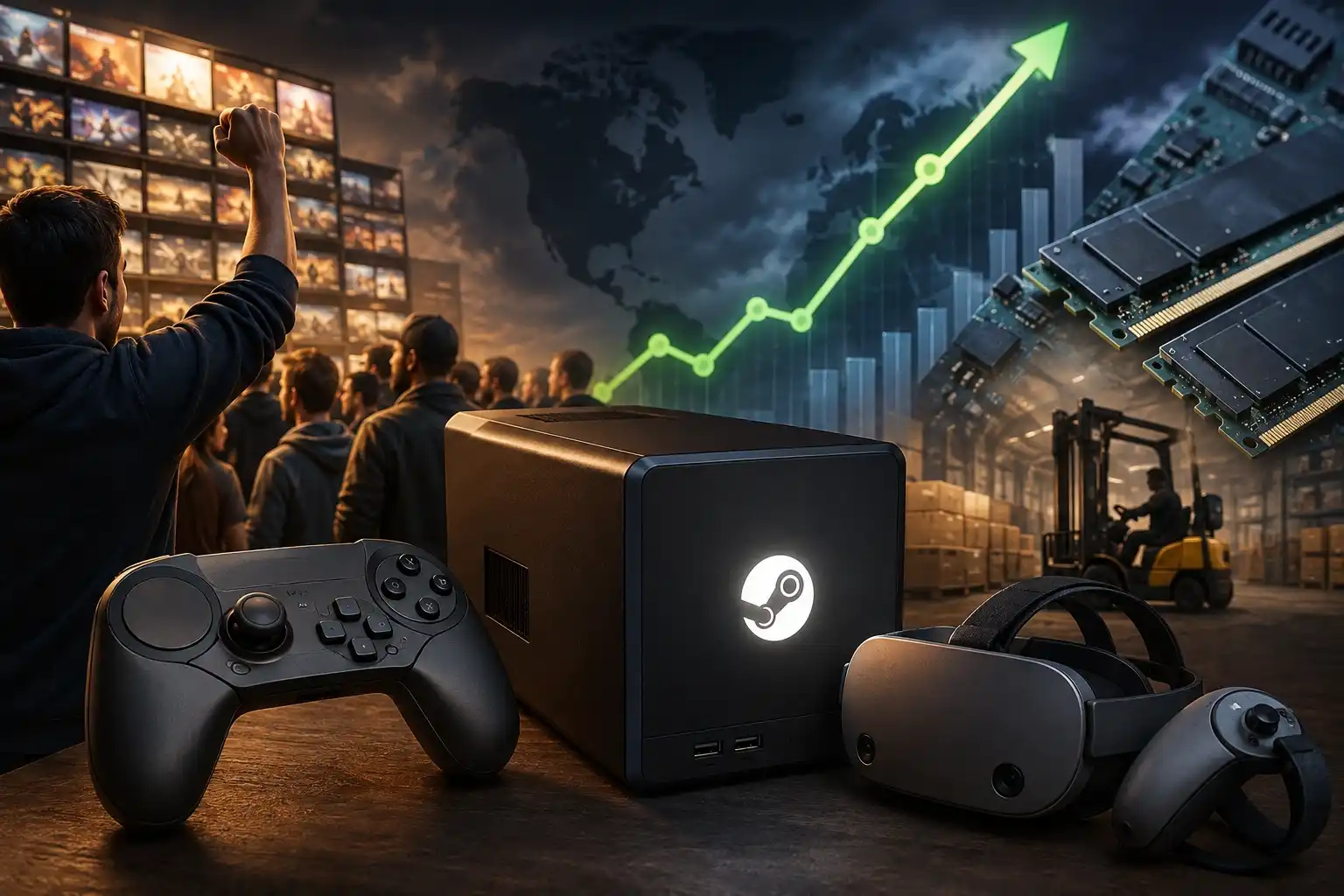
Rewind to the November 2025 reveal, when the Steam Machine landed alongside a new Steam Controller and the Steam Frame VR headset. Plenty of analysts were penciling in $600–800, and as late as February 2026 there were reports Valve had originally aimed for a spring launch at a much lower number. Then the global memory shortage hit, RAM and NAND prices spiking hard on the back of AI data-center demand, and the whole plan got rewritten. The same crunch forced Valve to jack up Steam Deck prices by more than 40% earlier in the year.
Valve was unusually blunt about it, admitting the price was higher than it wanted and that its original target was “no longer viable.” It also made a philosophical point that matters here: unlike Sony and Microsoft, it refuses to sell the box at a loss and recoup later through locked-in game sales. Every Steam Machine is meant to make money on day one. That’s a very different business model, and the Top Sellers chart is the first public evidence it might actually work.
The launch itself dodged the usual scalper circus, too. Instead of a midnight on-sale stampede, Valve ran a randomized reservation lottery, drawing names to decide who got to buy first. Reviews were honestly mixed, a lot of “great idea, steep price, unspectacular raw performance for the money”, and it charted anyway. When a product survives lukewarm reviews *and* a four-figure sticker and still parks itself at the top of the store, the demand is real, not manufactured.
What the Top Sellers Chart Won’t Tell You
It won’t tell you units, margins, returns, or whether any of this holds past the launch window. Those blanks are worth respecting before anyone declares victory.
A few honest caveats:
- Revenue isn’t units. The chart position is real, but it does not mean the Steam Machine outsold Counter-Strike 2 by headcount. Not remotely close.
- Launch spikes fade. Steam weights very recent sales heavily to catch launch surges, so early-window placement always looks rosier than a steady-state month will.
- Nobody outside Valve has real numbers. Everything above is careful napkin math off a chart designed for browsing, not accounting.
- Scalper resale muddies it. Long queues and lottery-gated stock mean some of that “demand” is resellers, not end users.
I’m not raining on it, a premium box holding a podium spot for weeks is a legitimately strong start. I just wouldn’t confuse a revenue ranking for a sales report, and neither should anyone quoting it back to you.
Why This Matters If You Follow Steam’s Card Scene
Because Steam has quietly become the home turf for a huge chunk of card-adjacent culture, and this is Valve flexing on its own lawn.
If you’ve been anywhere near the complete 2026 guide to video game trading cards, you already know the crossover between gaming and collecting isn’t a niche anymore, it’s a lane with real momentum. The same storefront that just crowned its own hardware is also where a shocking number of collectors now spend their downtime, whether that’s running a fake storefront in TCG Card Shop Simulator or messing around with oddball battlers like Planks Wars.
Here’s the connecting thread. Those $5–15 card games and a $1,049 machine are all fighting for the same chart, judged by the same dollar-for-dollar rule. That’s a useful mental model for anyone who cares about how attention and money move through Steam: the platform doesn’t reward the most players, it rewards the most revenue. Cheap-but-beloved products live and die on volume; premium products can crash the party on price alone. Once you see the chart that way, a lot of “how is *that* trending?” moments suddenly make sense.
For the collecting crowd specifically, there’s a bigger signal buried in here. Valve just demonstrated that a premium, sell-at-a-profit hardware product can dominate its own marketplace without a loss-leader crutch. If that model sticks, expect more expensive, limited-run, lottery-gated gear across gaming, and if there’s one audience that understands what artificial scarcity and reservation queues do to demand, it’s people who collect.
Final Thoughts
My honest take: the Steam Machine story is impressive and overstated at the same time, and both things can be true. Impressive, because a $1,049 box surviving mixed reviews to camp near the top of Steam’s revenue chart for weeks is a real result, and because Valve quietly proved a no-loss hardware model can headline its own marketplace. Overstated, because “beating every game on Steam” leans entirely on a revenue chart that was never meant to be read as a sales report.
If you take one thing away, make it the chart mechanic, not the headline. Once you understand that Steam ranks dollars rather than players, you’ll read every “shocking chart-topper” story, hardware or a $7 card sim, with a much clearer eye. And that’s a more useful skill than knowing this week’s exact ranking, which will have rotated by the time you finish reading anyway.
Frequently Asked Questions
Is the Steam Machine really the #1 seller on Steam?
At times, yes, but with an asterisk. It has traded the top spot on the Global Top Sellers chart with Counter-Strike 2 and mostly settled around #1–#2 globally in its launch window, with regional variation. Crucially, that chart ranks by revenue, not copies sold, so “#1 seller” means “most money in,” not “most units moved.”
How many Steam Machines is Valve actually selling?
Nobody outside Valve knows for sure. The most-cited independent estimate, from Boiling Steam, pegs it at roughly 12,000–15,000 units per week and $10–18 million in weekly revenue, based on its chart position relative to Counter-Strike 2 and Palworld. Those are informed estimates with a stated margin of error, not official figures.
Does topping the chart mean the Steam Machine outsold Counter-Strike 2?
No. Counter-Strike 2 is free and moves enormous volume through cases and cosmetics. The Steam Machine reaches similar revenue with a tiny fraction of the transactions because each one is a four-figure sale. It out-earns; it does not out-sell by unit count.
Why is the Steam Machine so expensive at $1,049?
Mostly the 2026 memory shortage. Spiking RAM and NAND prices, driven largely by AI data-center demand, pushed Valve’s original target out of reach. Valve openly said the price is higher than it wanted and blamed component costs, the same crunch that also raised Steam Deck prices earlier in the year. The base 512GB model is $1,049; the 2TB version runs $1,349, more with a bundled controller.
Will the Steam Machine stay near the top of the charts?
Uncertain, and probably not indefinitely. Launch windows always flatter a product because Steam weights recent sales heavily. The real test is whether it holds a respectable position months out, once the reservation backlog clears and the novelty cools. Sustained podium placement would be the impressive part, early placement mostly just proves the launch worked.
Current listing: Steam Machine on Steam.