
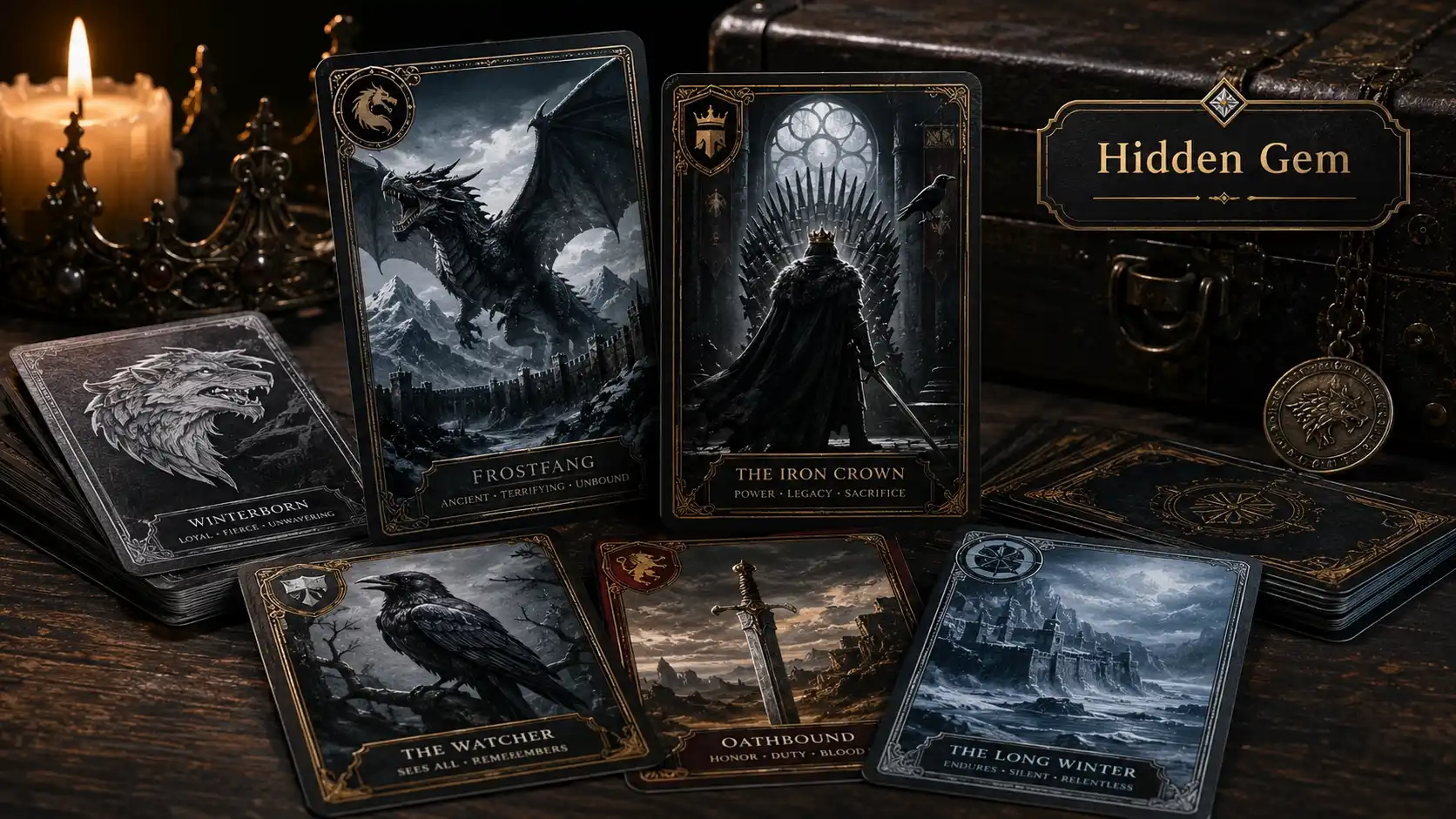

Here’s a riddle for you. Name a TV franchise that dominated pop culture for a decade, spawned a hit prequel, has a card set released almost every single year, and yet somehow barely registers when collectors talk about “the big licences.” Give up? It’s Game of Thrones, and I’d argue it’s the most under-collected prestige licence in the entire hobby.
That’s a bold claim, so I’m going to back it up. In this piece I’ll lay out the evidence: a back catalogue most people don’t realize exists, scarcity numbers that would make a Star Wars collector blink, and a fresh House of the Dragon set landing this autumn.
Then I’ll play devil’s advocate against my own argument, because a good case has to survive its counterpoints. Let’s hold court.
Why Do I Say Game of Thrones Is Under-Collected?

Because the gap between the franchise’s cultural size and its footprint in hobby conversation is enormous, the demand for the cards simply hasn’t kept pace with the fame of the show.
Game of Thrones was a global phenomenon for eight seasons, House of the Dragon reignited it, and Rittenhouse has quietly built one of the deepest licensed catalogues in non-sport cards around it.
Yet walk into most hobby chatter and you’ll hear endless talk about Marvel, Star Wars and Pokémon, with Westeros barely getting a mention. That mismatch, a top-tier IP with a modest collector spotlight, is the whole thesis. And the receipts are in the release history.
How Deep Is the Game of Thrones Card Catalogue?
Much deeper than casual collectors assume, Rittenhouse has put out a Game of Thrones product almost every year for over a decade, building a back catalogue that rivals far noisier licences. Here’s a sampler of the modern run, and it’s only part of the story:
| Rittenhouse Game of Thrones set | Released |
| Valyrian Steel Special Edition | 2017 |
| Season Seven | 2018 |
| Inflexions | 2019 |
| Season Eight | 2020 |
| Complete Series (Vol. 1) | 2020 |
| Iron Anniversary Series 1 & 2 | 2021 |
| The Complete Series Vol. 2 | 2022 |
| Art and Images | 2023 |
| House of the Dragon Season One | 2024 |
| Legends of the Realm | 2024 |
| The Great Houses | 2025 |
| House of the Dragon Season 2 | Fall 2026 (upcoming) |
A partial modern timeline; Rittenhouse also produced season-by-season sets going back to the early 2010s. Source: Rittenhouse Archives (scifihobby.com).
That’s a set almost every year, each stuffed with on-card autographs, wardrobe relics and hand-drawn sketches. For a franchise this size, that’s a serious body of work, and most of it flies under the radar.
What Makes the Scarcity So Interesting?

What Makes the Scarcity So Interesting?
Rittenhouse prints these sets in genuinely tiny quantities, which is exactly the kind of scarcity collectors usually chase, they just haven’t clocked it here yet. Take the most recent flagship, 2025’s The Great Houses: it was capped at 500 cases, with all 10,000 boxes individually numbered.
Let that sink in. Ten thousand boxes, worldwide, for a franchise that pulled tens of millions of viewers a week. Compare that to the print runs of the biggest sports and character products and it’s not even close.
The set is autograph-driven, too, every box delivers two signatures and two screen-used wardrobe relics, with a Pedro Pascal, Kit Harington or Emilia Clarke autograph in every case. That’s premium, low-supply cardboard by any measure.
The receipts: The Great Houses (2025) 500 cases worldwide. 10,000 individually numbered boxes. A 61-card base set organized by the Seven Kingdoms’ houses. Two autographs and two wardrobe relics per box. Marquee case-hit autos from Pedro Pascal, Kit Harington and Emilia Clarke. That’s flagship-level content at boutique-level supply.
What’s the Best Stuff to Actually Hunt?
If the thesis has you curious, the smart entry points are the marquee autographs and the clever chase inserts, not just the base cards. Because these sets lean so hard on signatures and memorabilia, the value and the fun both live in the hits. A few things worth targeting:
- Marquee cast autographs, Emilia Clarke (Daenerys), Kit Harington (Jon Snow) and Pedro Pascal (Oberyn) are the names that anchor demand.
- Inscription autographs, signers add handwritten quotes, and Rittenhouse offers hundreds of variations, so no two are quite alike.
- Wardrobe relics, screen-used costume pieces are a staple, sometimes with multiple swatches on a single card.
- Clever inserts, chases like the sprawling 67-card Saga of Tyrion Lannister, Dragonglass Acetate (just 15 copies) and the Artifex Metal art series (/25) reward deeper diggers.
This whole space rides a bigger wave, too, the one we cover in why movie and TV trading cards are booming, where prestige TV licences are quietly gaining ground on comic IP.
Okay, but What Is the Case Against?
A fair argument has to survive its own weak spots, so let me be honest: there are real reasons Game of Thrones cards sit quieter than the giants. This isn’t a guaranteed goldmine, and pretending otherwise would be selling you a story. The counterpoints:
- Autograph-heavy means expensive entry. With no cheap, hype-driven base chase, the cost of admission skews high, which keeps casual flippers away.
- TV licences historically lag character IP. Cards tied to live-action shows have often trailed evergreen universes like Marvel and Star Wars in long-term demand.
- The divisive ending cooled some heat. The show’s final season split fans, and that lingering ambivalence arguably dampened collector fervor.
- Thin, illiquid market. Low print runs cut both ways, scarce supply is great until you try to sell and find few active buyers.
- Even the autos hit snags. For The Great Houses, planned George R.R. Martin autographs were pulled, a reminder that signer line-ups can shift.
None of that sinks the thesis, but it sharpens it. “Under-collected” isn’t the same as “undervalued and about to moon.” It means the interest is smaller than the franchise’s stature, which is an opportunity for fans, not a promise of profit.
So Should You Start Collecting Game of Thrones Cards?
If you love the show and enjoy premium, autograph-driven sets, this is a genuinely rewarding corner of the hobby to explore, just do it as a fan, not a flipper. My honest take is that Westeros offers something increasingly rare: a top-tier licence you can still get into without a stampede of speculators bidding against you.
With House of the Dragon Season 2 arriving this autumn, there’s a natural on-ramp, and the back catalogue is right there waiting. Buy the autographs and relics of characters you actually love, treat the scarcity as a bonus rather than a business plan, and you’ll be collecting one of the great pop-culture sagas while most of the hobby is looking the other way. Sometimes the best seat in the house is the empty one nobody fought over.
For the wider backdrop on where demand is flowing, our overview of the 2026 non-sport card market and the state of the $13B trading card industry both help put this sleeper in context.
Why Game of Thrones Trading Cards Are Still Under-Collected
My honest take: Game of Thrones is a genuine anomaly, a colossal, decade-defining franchise with a deep, scarce, beautifully made card catalogue that the hobby mostly overlooks. That’s not a knock on the cards; it’s an invitation. When a licence this big flies this quietly, fans get to collect on their own terms, without the frenzy that surrounds the usual heavyweights.
Just keep your head. Under-collected means quiet, not guaranteed to soar, and the thin market cuts both ways. But if you love Westeros, there may never be a better time to build a collection you actually care about, before the rest of the realm remembers these cards exist. Valar collectibus, as nobody has ever said.
The “under-collected” framing is this site’s analysis, not a reported market trend or investment advice; set details, print runs and schedules are subject to change. Verified against Rittenhouse Archives (scifihobby.com), Beckett and checklist trackers.
External reference: For source context, see Rittenhouse Archives Game of Thrones trading card information.
Frequently Asked Questions
Who Makes Game of Thrones Trading Cards?
Rittenhouse Archives is the primary maker of official Game of Thrones and House of the Dragon cards, and has produced sets almost every year for well over a decade. They’re premium, autograph-and-relic-driven releases rather than mass-market packs.
Are Game of Thrones Cards Rare?
Many are printed in genuinely small quantities. The 2025 flagship, The Great Houses, was capped at 500 cases with 10,000 individually numbered boxes worldwide, tiny supply for a franchise this famous. Scarcity is real, though thin markets can make selling slower.
What Is the Great Houses Set?
It’s Rittenhouse’s 2025 Game of Thrones release, built around the Seven Kingdoms’ major houses. It has a 61-card base set, two autographs and two wardrobe relics per box, and case-hit autos from Pedro Pascal, Kit Harington or Emilia Clarke.
Are Game of Thrones Cards a Good Investment?
Treat them as a fan purchase first. The scarcity and prestige are appealing, but the market is thinner than Marvel, Star Wars or Pokémon, and TV-licence cards can be slow to appreciate. Buy what you love and view any upside as a bonus, not a plan.
Is Now a Good Time to Start?
It’s a sensible entry point, with House of the Dragon Season 2 arriving in Fall 2026 and a deep back catalogue available. Getting in before a new release refreshes attention is often smarter than chasing after prices react.