
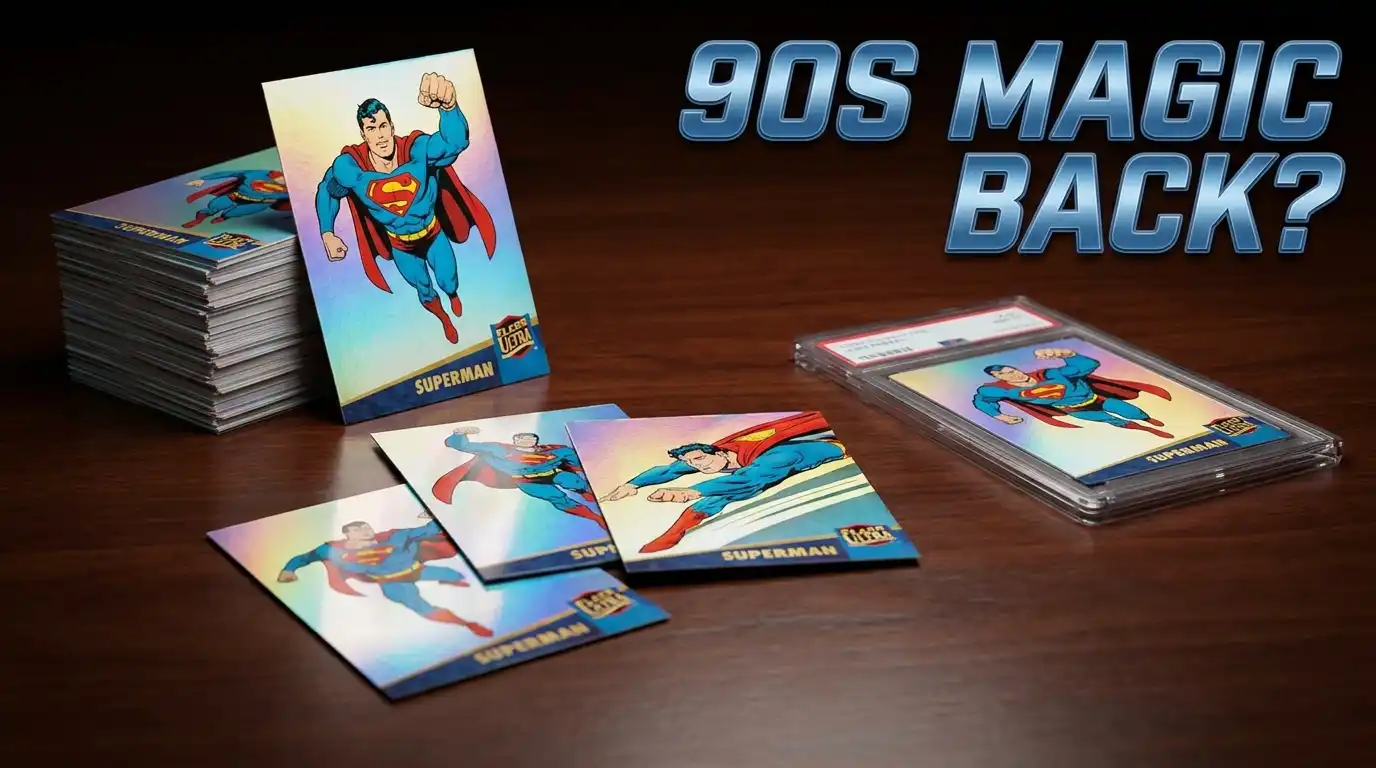

If you collected in the 1990s, the words “Fleer Ultra” trigger a very specific feeling: thick foil, dazzling inserts, and the electric moment a chase card slid out of a pack. Now the brand is back and pointed at Metropolis.
Fleer Ultra Superman landed April 8, 2026 from Upper Deck, and the question every collector of a certain age is asking is whether it recaptures that feeling, or just borrows the logo.
My short answer: this one actually gets it, and for a reason most reviews skip. It isn’t just cosplaying the ’90s aesthetic, it rebuilds the *philosophy*, where inserts outnumber base cards and the art is the whole point.
Below I’ll walk through the box math, the parallel ladder, the insert tree, and the one genuinely clever wrinkle in the autographs, plus the honest caveats before you spend.
What Is the Fleer Ultra Superman Set?
It’s an Upper Deck DC release that rebuilds the classic Fleer Ultra formula around Superman: a 100-card base set of all-new original artwork, a deep serial-numbered parallel ladder, and a mountain of ’90s-style inserts. Rather than recycling comic panels or movie stills, the entire base is freshly illustrated by working artists, which turns out to be the foundation everything else is built on.
The checklist covers Superman’s full world: heroes, villains and the Metropolis supporting cast, from Krypto to Kitty Faulkner. It follows 2025’s Fleer Brilliants Superman as Upper Deck continues leaning into legacy ’90s brands under the DC license it picked up in 2024. And crucially, this is an insert-first product, roughly half of every hobby pack is non-base cards.
It’s the same original-art playbook Upper Deck ran with its other Ultra revival, which we broke down in Fleer Ultra Harry Potter: can original art win? – and it works even better with a superhero.
Hobby or Blaster? The Box Math
Hobby gives you far more cards and access to the entire parallel ladder; blasters are the cheap way in but lock you out of most numbered parallels. That distinction matters more here than in most products, so pick deliberately:
| Hobby box | Blaster / retail | |
| Packs per box | 12 packs, 6 cards each | 3 packs, 6 cards each |
| Per case | 12 boxes (two 6-box inners) | 20 boxes |
| Guaranteed inserts | At least 20 per box | At least 3 per box |
| Green base parallels | 4 per box | 1 per box |
| Medallions | 4 per box | 1 per box |
| Numbered parallels | Full ladder available | Green, The Flash, Electric Foil only |
| Big tech inserts & autos | Case-level chases | Pushed to case level |
Configuration per Upper Deck and checklist trackers. The highlighted row is the key difference: Black, Kryptonite, Debut Year and Gold Spectrum are Hobby/e-Pack exclusives.
That last row is the buying advice in a nutshell. If you’re chasing the deep rainbow, the /75s, /61s, /38s and the 1/1 Gold Spectrum, blasters simply can’t get you there. Blasters are a fine, affordable way to enjoy the art and pull some inserts, but they’re a different product experience, not a cheaper version of the same one.
How Deep Is the Parallel Ladder?
The base rainbow runs from a common Green through six numbered tiers to a one-of-one Gold Spectrum, with Printing Plates alongside at 1/1. Here’s the climb:
| Parallel | Serial / odds | Where you can pull it |
| Green | About 1:3 packs | All formats |
| The Flash | /199 | All formats |
| Electric Foil | /123 | All formats |
| Black | /75 | Hobby / e-Pack |
| Kryptonite | /61 | Hobby / e-Pack |
| Debut Year | /38 | Hobby / e-Pack |
| Gold Spectrum | 1/1 | Hobby / e-Pack |
| Printing Plates | 1/1 | Hobby / e-Pack |
Base parallel ladder per checklist trackers; a Black Mercy parallel is also referenced in some listings. Odds and tiers subject to change.
It’s a well-judged ladder, accessible at the bottom, genuinely scarce at the top, and thematically named throughout. Kryptonite at /61 is a nice touch (Superman debuted in 1938; Debut Year at /38 nods to that directly), and those little details are exactly the kind of thing that separates a thoughtful set from a lazy one.
The Smartest Idea in the Set: Artist Autographs
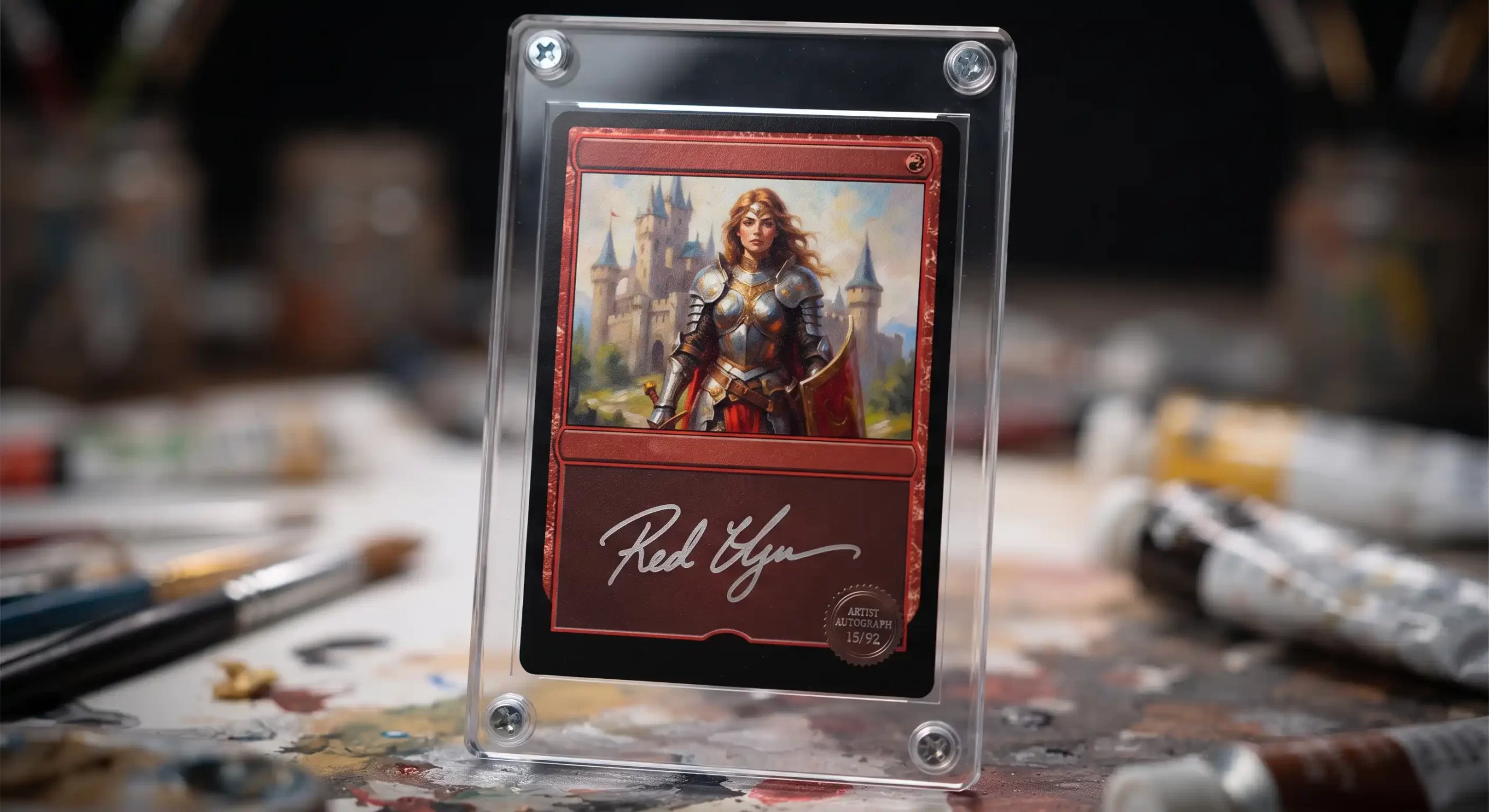
Because the base set is entirely original art, the autographs come from the artists who actually drew the cards — 92 of them signed Red parallel versions of their own illustrations, numbered to 92. That’s a genuinely elegant piece of design logic, and it’s the detail that best captures why this set works.
|
Why that matters In a set built on original art, an artist signature isn’t a bolted-on celebrity autograph, it’s the creator signing their own work. It ties the chase directly to the thing that makes the product special, rather than treating signatures as a separate add-on. |
Be warned, though: they’re tough. The Red Artist Autographs land roughly once per case, and the scarcer signatures, Retro ’95 Autographs (/38) and Animation Cel Red Autographs (/13), are considerably harder still. This is an insert-driven product with autographs as a rare bonus, not an autograph-driven one.
If artist-signed cards are your lane, our piece on Marvel comic artist autographs as the most underrated chase explains why these tend to be undervalued relative to actor signatures.
Which Inserts Are Actually Worth Chasing?
The inserts are the heart of this set, and Upper Deck stacked them with genuine ’90s card technology rather than just printed designs. Here’s what the flashiest chases actually are:
| Insert | The card tech | Why it matters |
| ’95 Retro | Acetate “clear chromium” | A 50-character homage to the 1995 Fleer Ultra Spider-Man ClearChrome inserts — and it falls in nearly every pack |
| Kryptonite | Plexi-glow | Glowing green tech card; a case-level chase |
| Man of Steel | Metal | Literal metal cards, heavy and premium |
| 1961 Fleer 3D | Lenticular | A 3D throwback to Fleer’s own history |
| Shield Bearers | Embedded acetate | An S-shield set into the card itself |
| Medallions | Manufactured medallion | An Ultra staple since the mid-’90s; four per hobby box |
| Ultra Stars | Dual-sided rainbow foil | The classic Ultra chase, with a Gold parallel /99 |
| Animation Cel | Cel-style art | Home to the scarcest autographs (/13) |
Beyond the tech cards sit the storytelling inserts: Ultrabilities, Greatest Battles, Family Genealogy (characters tied to Superman by blood or the House of El), Ask Jimmy Olsen, and a 9-card Bizarro Variant set. The ’95 Retro line alone has its own parallel tree, Purple (/25), Gold (/10), Black (1/1) and Artist Autographs (/38).
The Insert That Rewards Set Builders
The 3×3 Connected Image puzzles are the cleverest thing here for anyone who actually completes sets: three nine-card puzzles where the fronts assemble into a 3×3 image, and the backs line up into a long 3×9 mural. You need all nine cards to see either picture.
That’s a wonderfully old-school idea, it makes completing a subset genuinely rewarding rather than just a checkbox, and it gives the cards a reason to be laid out and displayed. In an era where most inserts are singles you slab and forget, a puzzle that demands the full run is a refreshing throwback.
Does It Actually Feel Like ’90s Fleer Ultra?
Largely, yes – because it copies the right thing. The ’90s Ultra magic wasn’t really about foil; it was about *insert density*, the sense that every pack might hold something strange and shiny. This set replicates that by making half of each hobby pack non-base cards and guaranteeing 20-plus inserts per box.
Add the direct homages, the ’95 Spider-Man ClearChrome tribute, Medallions carried over from the mid-’90s, Ultra Stars in dual-sided rainbow foil, a nod to 1961 Fleer 3D, and you get a product that feels like a love letter rather than a cash-in. What’s new is the modern layer: serial numbering, plexi-glow, embedded acetate and artist autographs, none of which the original era could deliver.
For more ’90s DC nostalgia, our look at the 1993 DC Cosmic Cards is a great companion, and our guide to the top DC card sets puts this release in context.
Is It Worth Buying?
If you’re a Superman fan or a ’90s-insert nostalgic, yes, every hobby box guarantees a genuine stack of inserts, and the art is the best reason to buy it. My honest take is that this is a set built for the joy of ripping and displaying rather than flipping, and it delivers on that promise better than most legacy-brand revivals.
Two honest caveats, though. First, the autographs are genuinely scarce, roughly one Red Artist Auto per case, with the /38s and /13s far tougher, so don’t buy expecting a signature. Second, like any insert-heavy product, most of what you pull will be commons and mid-tier parallels; the real value concentrates in the low-numbered chases, the case hits and the 1/1s. Go in for the experience and the artwork and you’ll love it; go in hunting profit and the math gets harder.
For our initial coverage when the set was announced, see our first look at the Fleer Ultra Superman comeback, and if the hand-drawn sketch cards caught your eye, our guide to finding hidden-gem sketch cards is worth a read.
Frequently Asked Questions
When did Fleer Ultra Superman release?
It released April 8, 2026, from Upper Deck under its DC license. Hobby boxes hold 12 packs of 6 cards, with at least 20 inserts and four base Green parallels guaranteed per box.
How big is the base set?
The base set is 100 cards of all-new original artwork covering Superman’s heroes, villains and Metropolis supporting cast, topped by a foil and serial-numbered parallel rainbow running to a 1-of-1 Gold Spectrum.
Should I buy hobby or blaster boxes?
Hobby, if you want the full chase. Blasters only offer the Green, The Flash and Electric Foil parallels, while Black (/75), Kryptonite (/61), Debut Year (/38) and Gold Spectrum (1/1) are Hobby/e-Pack exclusives. Blasters are still a fun, cheaper way to enjoy the art.
Are the autographs easy to pull?
No. Red Artist Autographs are numbered to 92 and land about once per case, with Retro ’95 (/38) and Animation Cel (/13) autos far scarcer. Treat signatures as a rare bonus rather than an expectation.
Who signs the autographs?
The artists who illustrated the cards. Ninety-two artists signed Red parallel versions of the base cards they drew themselves, which ties the autograph chase directly to the set’s original-art concept.
Does it really feel like ’90s Fleer Ultra?
Largely yes. It revives Ultra Stars and Medallions, uses ’95-style acetate clear-chromium inserts, and keeps roughly half of every hobby pack non-base, the insert density that defined the era, while adding modern serial numbering and card tech.
Who is this set best for?
Superman fans, DC collectors and anyone nostalgic for the ’90s insert boom. It rewards collectors who enjoy chasing inserts, building puzzle subsets and appreciating original art more than buyers hunting guaranteed big-money hits.
Final Thoughts
My honest take: Fleer Ultra Superman is that rare revival that understands what made the original special. It doesn’t just stamp a legacy name on a modern set, it rebuilds the insert-first, art-forward Ultra experience, then dresses it in card technology the ’90s could only dream about. The artist-signed base parallels and the 3×3 connected puzzles are the kind of thoughtful touches that show someone genuinely cared.
Just collect it for the love of the chase. The autographs are scarce, most pulls are commons, and this is a set to rip, sort and display rather than one to bank on. But if you want a Superman product that captures the golden age of inserts, with a modern shine and a real respect for the artists, this is about as good as the nostalgia gets. Up, up and away, indeed.