

Steam players are not just battling with cards anymore. They are stocking shelves, pricing booster packs, opening rare pulls, cleaning messy shops, hiring staff, and pretending to run the local card store of their dreams.
That is why TCG Card Shop Simulator is so fun to watch.
It takes the fantasy of owning a trading card shop and turns it into a relaxing, slightly chaotic, cardboard-business simulator. And honestly, it understands card collectors better than many “serious” TCG games do.
What Is TCG Card Shop Simulator?
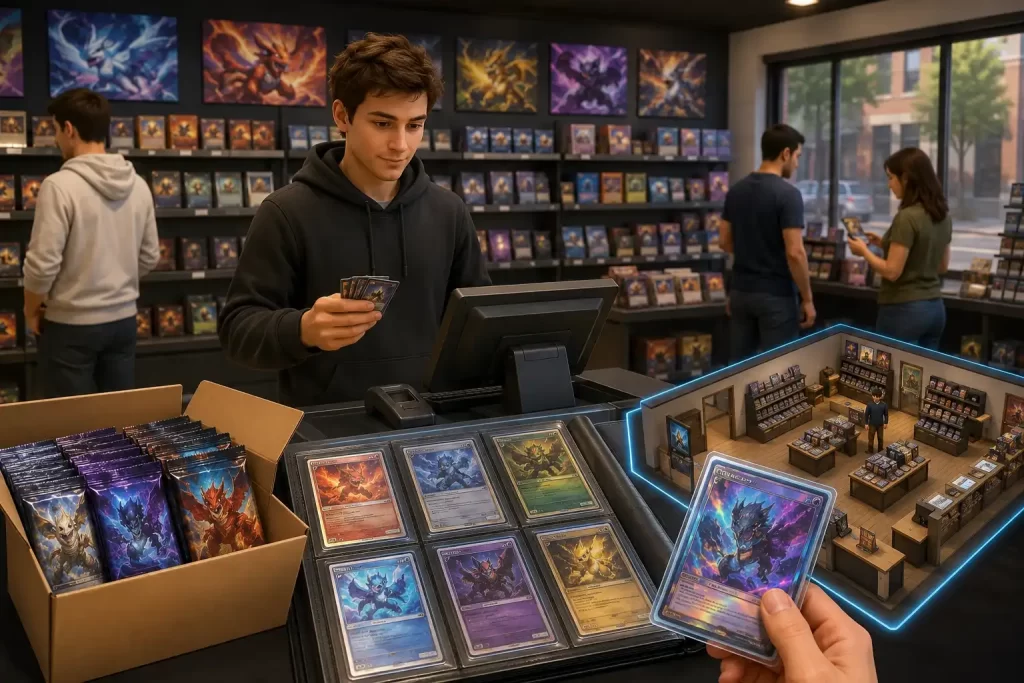
TCG Card Shop Simulator is a Steam game where you run your own local trading card store, sell booster packs, open packs yourself, set prices, hire staff, host events, and expand your shop. That is the core gameplay loop.
The game was released on Steam in Early Access on September 15, 2024, and it was developed and published by OPNeon Games. Steam describes it as a trading card shop simulation where you sell card booster packs to earn money and build your card shop business.
That sounds simple, but the idea is weirdly powerful.
Because deep down, a lot of collectors have had this fantasy.
Not just opening packs.
Not just buying singles.
Not just arguing over card prices online.
But actually owning the shop.
The little local store with shelves full of sealed products. The counter with loose singles. The tables where players sit for games. The regular customers. The rare pulls. The messy stockroom. The dream of turning cardboard into a business.
TCG Card Shop Simulator takes that daydream and says, “Fine, here are the keys. Try not to bankrupt yourself.”
Why Are Steam Players Running Fake Local Card Shops?
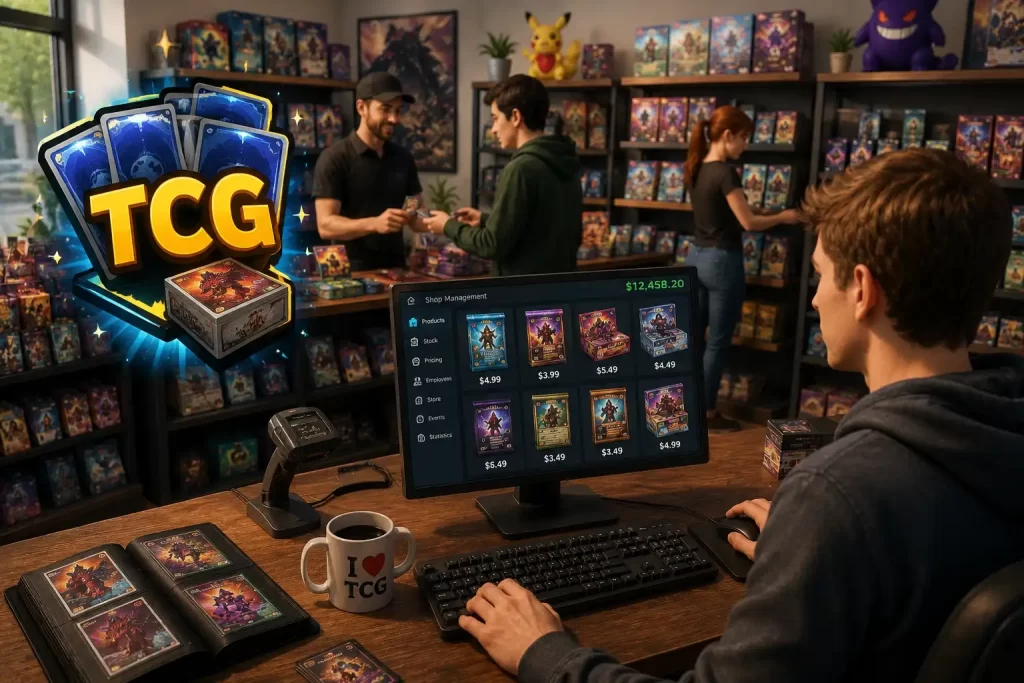
Steam players are running fake local card shops because the game captures the best parts of card collecting without the real-life rent, inventory risk, angry customers, or terrifying distributor invoices. It is the card shop fantasy without the real business headache.
That is the magic.
In real life, opening a card shop is hard. You need capital, stock, rent, suppliers, staff, local demand, events, insurance, marketing, and a strong stomach for customers who ask if you can price-match an eBay listing from 2017.
In TCG Card Shop Simulator, you get the fun version first.
You stock booster packs.
You open packs.
You find rare cards.
You sell products.
You expand the store.
You watch money come in.
You slowly build the kind of shop every collector secretly wants to visit.
At the time of checking, Steam showed Very Positive recent reviews, with 93% of 672 recent reviews marked positive, while English reviews were listed as Overwhelmingly Positive, with 97% of 32,775 English reviews positive.
That tells us something important. This is not just a random simulator joke. Players are actually sticking with the idea.
And I get it.
Running a fake card shop sounds more relaxing than playing against someone using a broken meta deck and taking eight minutes to complete one turn.
Is TCG Card Shop Simulator a Real Trading Card Game?
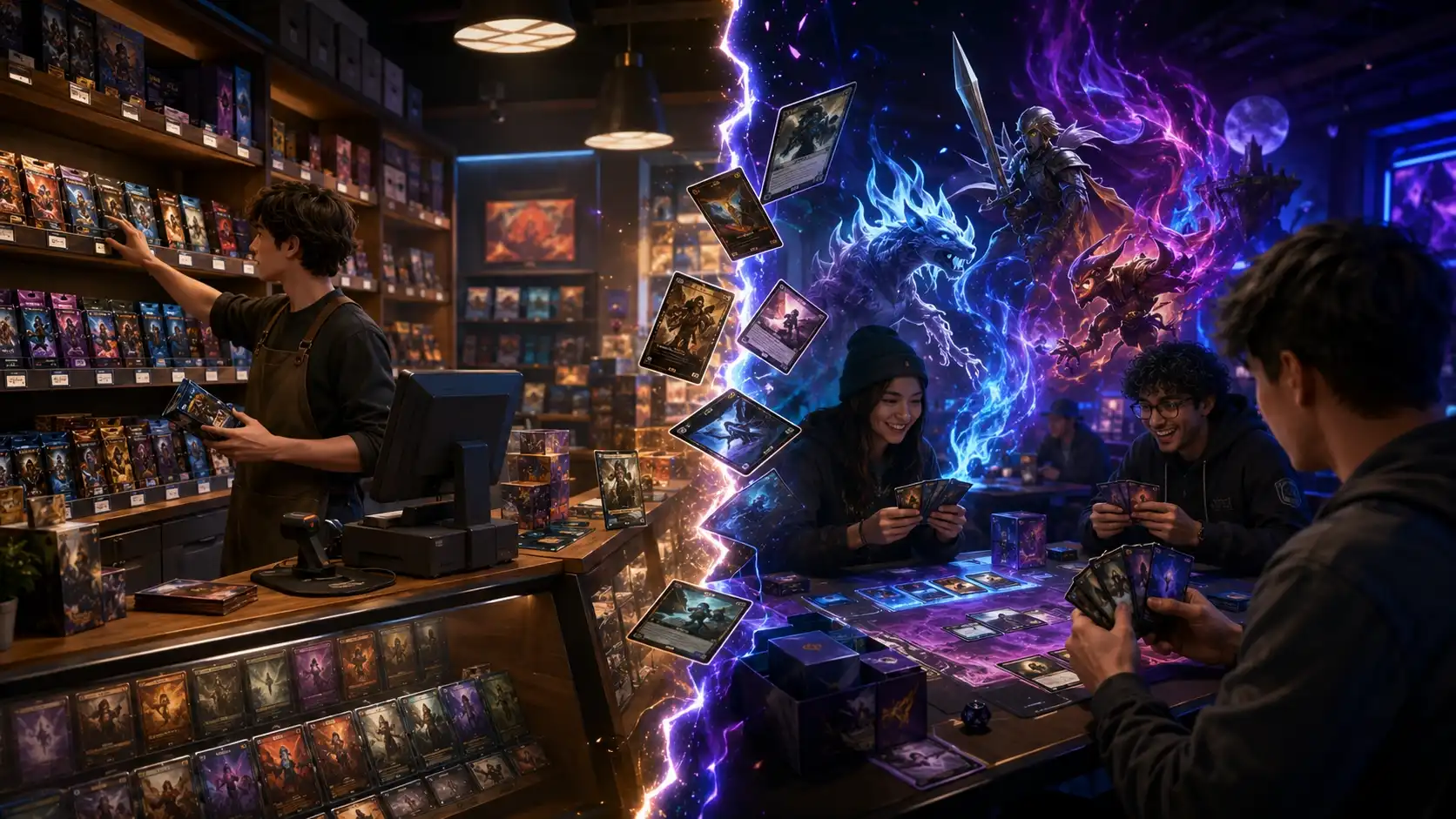
TCG Card Shop Simulator is not mainly a traditional TCG battle game. It is a shop management simulator built around trading cards, booster packs, collecting, pricing, store growth, and customer service. The business is the game.
That is where some players may get confused.
If you hear “TCG,” you might expect deck-building, tournaments, card effects, energy costs, monsters, spells, and dramatic final turns. But this game is more about the world around trading cards.
Steam tags include Simulation, Management, Economy, Collectathon, Trading Card Game, Card Game, Shop Keeper, Job Simulator, and Sandbox. Those tags explain the game better than calling it only a “card game.”
Here is the easiest way to understand it:
| Game Type | Main Fantasy | What You Actually Do |
|---|---|---|
| Traditional TCG | Win matches | Build decks and battle |
| Digital card battler | Climb ranked ladder | Play against opponents |
| Pack-opening game | Pull rare cards | Open packs repeatedly |
| TCG Card Shop Simulator | Own the shop | Stock, price, sell, collect, expand |
That last one is why the game feels different.
You are not the hero of the card game.
You are the person selling the hero their booster packs.
And honestly, that might be even better.
How Does TCG Card Shop Simulator Gameplay Work?
TCG Card Shop Simulator gameplay works by letting you manage a card shop from the ground up: organize shelves, order products, open booster packs, sell cards, host games, and reinvest profits. It is simple but addictive.
Steam’s “About This Game” section breaks the gameplay into clear shop-management actions. You design your shop, organize shelves and card packs, open boosters yourself, collect cards, find rare cards, sell them, host card games, order products, track trends, expand space, unlock new sets, and upgrade facilities.
That is a very satisfying loop because every action feeds the next one.
Here is the basic cycle:
- Order products
You bring in booster packs and card products. - Stock shelves
You arrange your store so customers can shop smoothly. - Set prices
You decide how much profit you want to make. - Sell to customers
Customers buy products and bring money back into the shop. - Open packs yourself
You chase rare cards like every normal collector with zero self-control. - Sell or keep rare pulls
You decide whether the card is business inventory or personal treasure. - Expand the shop
You reinvest profits into a bigger and better store.
This is why the game can become dangerous.
Not dangerous like “evil villain destroys the world.”
Dangerous like “I was going to play for 20 minutes and now it is 2:47 AM and I’m reorganizing virtual booster shelves.”
That is real simulator power.
Why Does Opening Booster Packs Feel So Addictive?
Opening booster packs feels addictive because the game copies the real collector thrill of not knowing what is inside. Every pack is a tiny gamble, a tiny dream, and sometimes a tiny disappointment wearing shiny artwork.
This is probably the most realistic part of the game.
Collectors love sealed products because sealed products contain hope. A single booster pack could be nothing. It could also be the rare pull that makes your whole night.
TCG Card Shop Simulator understands this very clearly. Steam says players can open booster packs themselves, collect cards, find rare cards, and either sell them to make a fortune or keep them to complete their collection.
That “sell or keep” choice is perfect.
Because every collector knows that pain.
You pull a rare card and immediately become two different people:
- Business brain: “Sell it now while the price is hot.”
- Collector brain: “No. It is mine. I will protect it forever.”
- Third secret brain: “Open more packs. Maybe there is another one.”
That is where the game becomes fun. It does not only simulate a shop. It simulates collector weakness.
And yes, I say that with love. Card collectors are some of the most disciplined people in the world until a sealed booster box appears.
TCG Card Shop Simulator Quick Info Table
TCG Card Shop Simulator is best understood as a card shop business simulator with collecting, booster packs, pricing, and store expansion. It is ideal for players who love the culture around trading cards.
| Detail | Information |
|---|---|
| Game name | TCG Card Shop Simulator |
| Platform | Steam |
| Developer | OPNeon Games |
| Publisher | OPNeon Games |
| Steam release date | September 15, 2024 |
| Status | Early Access |
| Main genre | Simulation / Management |
| Main hook | Run your own local trading card shop |
| Core activities | Stock shelves, sell boosters, open packs, price cards, host events |
| Review signal | Very Positive recent reviews at time of checking |
| Best for | TCG fans, collectors, shop sim fans, pack-opening addicts |
| Not best for | Players who only want competitive deck battles |
The Early Access page also says the current version includes shop management and card collecting, with more than 2,500 cards to collect.
Why Is TCG Card Shop Simulator So Good for Collectors?
TCG Card Shop Simulator is good for collectors because it understands that collecting is not only about owning cards. It is about hunting, sorting, pricing, displaying, selling, upgrading, and chasing the next great pull.
That is the part many outsiders miss.
People think card collecting is just “buy card, own card.”
No. That is baby-level collecting.
The real hobby has layers:
- Finding the product
- Opening packs
- Checking rarity
- Deciding what to keep
- Deciding what to sell
- Watching market value
- Sorting bulk
- Protecting good pulls
- Displaying favorites
- Telling yourself you are done buying, then buying more
TCG Card Shop Simulator turns many of those habits into gameplay.
And my honest opinion? That is why it works better than some traditional card games for casual collectors.
Not every card fan wants to study a competitive meta. Not every collector wants to lose online matches to someone named “DarkComboLord99.” Some people just want to open packs, organize a shop, and feel that little dopamine hit when the money number goes up.
This game gives them that.
How Is TCG Card Shop Simulator Different From Real Card Shops?
TCG Card Shop Simulator is different from real card shops because it removes most of the painful parts of the business and focuses on the fun fantasy. Real shops deal with risk. The game gives you the dream version.
Real card shop owners work hard.
They deal with slow days, damaged products, difficult customers, distributor limits, online competition, rent, theft, events, cash flow, and market swings. A card shop can look fun from the outside, but behind the counter it is still a business.
TCG Card Shop Simulator keeps the fun parts:
- Opening the shop
- Stocking shelves
- Selling packs
- Pulling rare cards
- Expanding the store
- Hosting card games
- Watching customers browse
But it softens the scary parts.
That is why the game is relaxing. It gives players the feeling of entrepreneurship without the real-world panic of checking monthly rent.
And that is okay. Games do not need to be painfully realistic to be valuable. Sometimes they need to capture the emotion, not the tax paperwork.
Card Shop Simulator Fun Graph: Why Players Keep Playing
Players keep playing TCG Card Shop Simulator because the game stacks multiple satisfying loops together: money, collecting, shop upgrades, rare pulls, and business growth. Each loop gives players a reason to continue.
Here is the unofficial collector-addiction graph:
| Gameplay Feeling | Power Level |
|---|---|
| Opening booster packs | ██████████ 10/10 |
| Finding rare cards | ██████████ 10/10 |
| Setting prices | ████████ 8/10 |
| Stocking shelves | ███████ 7/10 |
| Expanding the shop | █████████ 9/10 |
| Completing collection | ██████████ 10/10 |
| Cleaning up business chaos | ██████ 6/10 |
| Pretending you are financially responsible | ██ 2/10 |
That last one is very important.
This is a game where you can pretend to be a smart card shop owner while also opening your own inventory because you “just want to check something.”
Very realistic.
Is TCG Card Shop Simulator Worth Playing in 2026?
Yes, TCG Card Shop Simulator is worth playing in 2026 if you enjoy trading cards, shop management games, collecting, pack opening, and slow business growth. It is especially fun if you have ever dreamed of owning a card shop.
The game is still in Early Access, so players should expect updates, changes, and some unfinished parts. Steam’s Early Access section says the developer planned to use player feedback, add roadmap features, and update the game during development.
That is worth keeping in mind.
This is not a perfectly finished card empire simulator. It is still growing. But that may actually be part of the appeal. Players get to watch the game expand while the shop itself expands.
You may enjoy it if you like:
- Card collecting
- Shop management
- Booster pack opening
- Cozy business simulators
- Rare-card hunting
- Inventory organization
- Watching small stores become bigger stores
You may not enjoy it if you need:
- Competitive online matches
- Deep TCG battle systems
- Licensed real-world cards
- Fast action gameplay
- A finished full-release experience
For me, the appeal is simple: it turns card collecting into a business fantasy without losing the silly collector joy.
That is a strong combination.
Why Non-Sports Card Fans Should Watch This Game
Non-sports card fans should watch TCG Card Shop Simulator because it proves card culture is now strong enough to support games about collecting, selling, and shop ownership – not just card battles.
That matters for the whole hobby.
Non-sports card collectors already understand this world. Many of them collect for characters, artwork, movies, comics, music, nostalgia, promos, autographs, sketch cards, and rare inserts. They may not care about battling at all.
TCG Card Shop Simulator still connects with them because the fantasy is universal.
A card shop is not only a place to buy competitive cards. It is where collectors discover strange sets, chase rare pulls, trade stories, ask questions, browse binders, and make very questionable spending decisions.
The game may be built around fictional TCG products, but the feeling is familiar to any collector.
That feeling is:
“I came in for one pack.”
Then you leave with a box, three singles, and a new financial problem.
Why Are Steam Players Obsessed With Running Card Shops?
Steam players are obsessed with running card shops because TCG Card Shop Simulator turns the collector dream into a playable business. It mixes booster-pack excitement, shop management, collecting, pricing, and expansion into one easy-to-understand fantasy.
And honestly, I think that is why it works.
This is not just a simulator about shelves and cash registers. It is a simulator about the emotional ecosystem around trading cards.
The chase.
The stock.
The rare pull.
The display case.
The customer flow.
The price decision.
The “just one more pack” lie.
TCG Card Shop Simulator understands that card collecting is not only about cards. It is about the ritual around the cards.
That is what makes the game interesting for TCG fans, non-sports card collectors, Steam players, and anyone who has ever walked into a local card shop and thought:
“I could run one of these.”
Could you really?
Maybe.
Maybe not.
But on Steam, you can try — and you do not even have to pay real rent.