
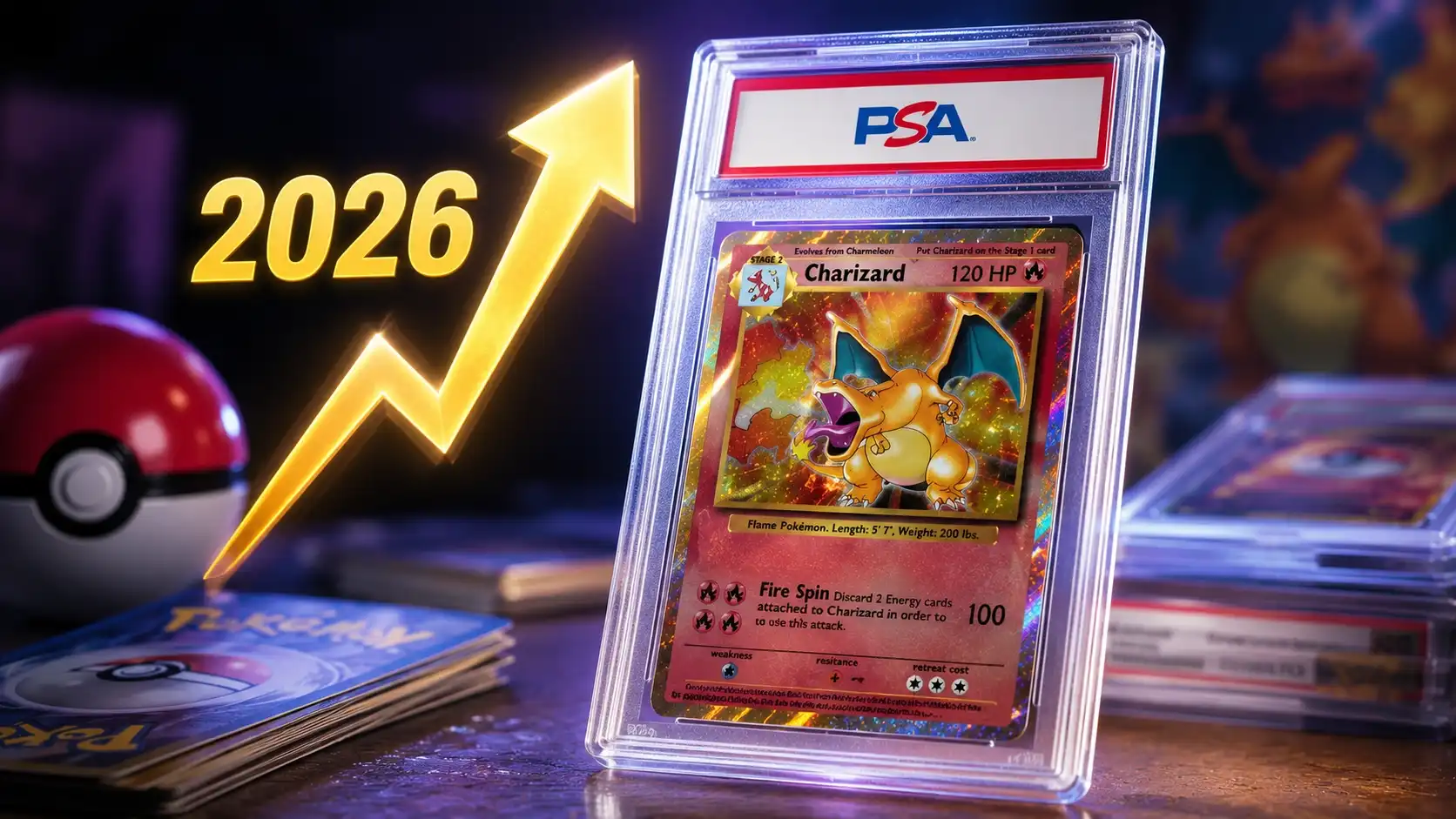

I still remember the first time I cracked open a slabbed Pokémon card return. That unmistakable click of acrylic, the PSA label catching the light, the small rush of either vindication or disappointment depending on the number staring back.
Pokémon PSA grading in 2026 is more accessible, more competitive, and more consequential than at any point in the hobby’s 30-year history, and it has never been more misunderstood.
Too many collectors are shipping in cards that will never earn back the grading fee. Too few are submitting cards that could turn a $60 raw copy into a $600 slab. With the 30th anniversary of the Pokémon TCG arriving on September 16, 2026, demand for graded vintage is surging, PSA submission volumes are climbing, and the difference between smart grading decisions and expensive mistakes is growing wider.
This guide covers everything you need to know about Pokémon PSA grading in 2026: what it costs, which cards earn real premiums, which should never see a slab, and how the 30th anniversary is reshaping the entire graded market.
| METRIC | DATA |
|---|---|
| Cheapest PSA Service (2026) | $18.99/card, Bulk Tier (20-card minimum, PSA membership required) |
| Standard Service | $50/card, up to $999 declared value | 20-30 business days |
| Express Service | $75/card, up to $2,499 declared value | 10-15 business days |
| Super Express / Walk-Through | $150-$600/card, high-value cards, same-day turnaround at shows |
| PSA Market Share (Pokémon) | ~68%, PSA dominates Pokémon grading by volume and liquidity |
| 1st Ed. Base Set Charizard, PSA 10 | ~$550,000, only 121 known PSA 10 copies out of 2,300+ submissions |
| 1st Ed. Base Set Charizard, PSA 9 | ~$15,000-$30,000, illustrates the enormous PSA 9-to-10 premium gap |
| Most Expensive Pokémon Card (2026) | Pikachu Illustrator PSA 10, $16,492,000 (Goldin Auctions, February 2026) |
| Vintage Card Price Growth (2026) | 30-50% year-over-year, driven by the Pokémon TCG 30th anniversary |
| Projected Graded Card CAGR to 2035 | 15-25% compound annual growth rate for quality graded Pokémon cards |
How Much Does PSA Grading Cost in 2026?
PSA grading costs around $18.99 to $600+ per card in 2026. Most modern Pokémon cards use Bulk, while valuable cards usually need Standard or higher tiers.
| SERVICE TIER | COST/CARD | MAX DECLARED VALUE | TURNAROUND | BEST FOR |
|---|---|---|---|---|
| Bulk / Economy | $18.99-$25 | $499 | 45-65 days | Modern cards $30-$80 raw |
| Standard / Regular | $50 | $999 | 20-30 days | Mid-tier cards $80-$300 raw |
| Express | $75 | $2,499 | 10-15 days | Chase SIRs, vintage holos |
| Super Express | $150-$200 | $9,999 | 5-10 days | High-value vintage singles |
| Walk-Through (shows) | $300-$600 | $10,000+ | Same-day | Trophy cards, 1st Ed grails |
Do not ignore PSA’s declared value limit. It affects insurance coverage if your card is lost or damaged. A $2,000+ raw Shadowless Charizard should not go under a $499 Bulk tier just to save time or money.
Also count shipping, insurance, return shipping, and selling fees. If grading costs $25, shipping is $8, and eBay takes around 13%, the graded card must sell for $53+ more than raw value just to break even.
Which Pokémon Cards Are Actually Worth Grading in 2026?
In 2026, Pokémon cards worth grading are usually raw Near Mint cards valued at $50+, low-pop PSA 10 cards, high-demand Pokémon like Charizard, Pikachu, Mewtwo, and Umbreon, or cards from closed print runs.
Vintage cards offer the best upside, especially WOTC holos, Shadowless cards, 1st Edition Jungle/Fossil, Neo-era Shinings, Gold Stars, and older ex-era cards. PSA 9 or 10 can still be profitable because supply is limited.
Modern cards are riskier. Grade strong SIRs and alt arts worth $150+ raw. Cards between $50–$149 are borderline. Anything under $50, bulk cards, commons, and most recent full arts are usually not worth grading.
Japanese promos and exclusives are also strong grading targets because supply is lower and demand is global.
Simple rule: modern cards usually need PSA 10 to profit. Vintage cards can still make money at PSA 9. Always check sold listings and use this formula before submitting:
Raw value + grading cost + shipping < expected graded sale price after fees.
What Grade Do You Need to Make Pokémon Grading Profitable?
For modern cards, you almost always need a PSA 10 Gem Mint to see meaningful returns, a PSA 9 on most recent sets barely covers the grading fee after selling costs. For vintage WOTC-era cards, PSA 9 can still be very profitable because scarcity is real at every grade level.
The fundamental break-even formula for any grading decision:
Raw price + grading cost + two-way shipping < Expected PSA 10 sale price × 0.85 (after platform fees)
If a modern Illustration Rare is worth $45 raw, costs $25 to grade, and $8 in round-trip shipping, you need the PSA 10 to sell for at least $91 to break even. If the market shows that same card trading at PSA 10 for $85, you will lose money every time. Check sold listings before submitting, not before opening packs.
| CARD CATEGORY | GRADE PREMIUM OVER RAW | NOTES |
|---|---|---|
| Vintage 1st Ed holo, PSA 10 | 5x-15x raw card value | Tiny PSA 10 population ensures lasting premium; Charizard PSA 10 ~$550K vs PSA 9 ~$22.5K |
| Vintage 1st Ed holo, PSA 9 | 2x-5x raw card value | Still profitable for vintage; scarcity is real even at PSA 9 level |
| Modern SIR / alt art, PSA 10 | 2x-3x raw card value | Population grows fast; submit only cards $150+ raw to justify cost |
| Modern SIR / alt art, PSA 9 | 1.1x-1.5x raw card value | Rarely clears break-even after fees; only submit if raw card is pristine |
| Modern bulk / common / uncommon, Any | Little to no premium | Grading cost cannot be recovered. Do not submit. |
PSA vs CGC vs BGS: Which Grader Should You Use for Pokémon in 2026?
Use PSA for maximum liquidity and the highest secondary market prices, it commands a 5-15% premium over CGC on most Pokémon cards. Use CGC if you want lower bulk grading costs for modern cards. Use BGS if you collect cards where sub-grades matter to you. For most Pokémon collectors, PSA is the default and the right call.
PSA holds approximately 68% of the graded Pokémon card market. That dominance translates directly into better liquidity: PSA 10 slabs sell faster and for more money than equivalent CGC 10 or BGS 10 grades on almost every card in the market. The gap has compressed significantly since 2020, the PSA 10 premium over CGC 10 for modern cards has come down from 30%+ to around 5-10%, but PSA still commands a meaningful advantage, especially on vintage.
| GRADER | MARKET SHARE | STARTING COST | PREMIUM VS. CGC 10 (MODERN) | BEST USE CASE |
|---|---|---|---|---|
| PSA | ~68% | $18.99 (Bulk tier) | , (benchmark) | Maximum liquidity, vintage, all collector tiers |
| CGC | ~22% | ~$12/card (Bulk) | 5-10% less than PSA | Budget grading, modern cards with narrow margins |
| BGS (Beckett) | ~10% | Comparable to PSA | Variable; less Pokémon-specific data | Collectors who value sub-grades (centering, corners, etc.) |
How Is The Pokémon TCG 30th Anniversary Changing The Grading Market?
The Pokémon TCG 30th anniversary is driving fresh demand for graded vintage cards. As collectors look ahead to the 30th Celebration set, PSA 10 copies from Base Set, Jungle, Fossil, and Neo-era cards are getting the most attention.
The biggest winners are low-population, high-demand cards tied to Pokémon’s early history. If you own clean Near Mint vintage cards, 2026 could be a strong time to consider grading before anniversary hype peaks.
When Should You NOT Send Your Pokémon Cards to PSA?
Do not grade a Pokémon card if the raw Near Mint value is under $50, the card has visible damage, or the PSA 10 population is already too high. In most cases, grading fees, shipping, and selling fees will wipe out any profit.
Avoid grading:
- Modern cards with 5,000+ PSA 10 copies
- Unlimited Base Set commons and uncommons
- Heavily played or damaged cards
- Recently rotated competitive cards
- Any card you have not checked against recent sold listings
Before submitting, always compare raw value, PSA 10 sold prices, population count, and total grading cost. If the numbers do not clearly work, do not grade it.
The 2026 Pokémon PSA Grading Verdict: Should You Slab It?
| CARD TYPE | TARGET GRADE | VERDICT | REASON |
|---|---|---|---|
| 1st Ed. Base Set holos (Charizard, Blastoise, Venusaur, Raichu) | PSA 9-10 | YES | 5-15x raw premium; tiny, fixed PSA 10 population; appreciation accelerating in anniversary year |
| Shadowless Base Set holos | PSA 9-10 | YES | Rarer variant than Unlimited; smaller population; strong collector demand |
| Neo Era (Shining, Gold Stars, Lugia, Ho-Oh) | PSA 9-10 | YES | Fast-rising segment; fixed supply; generational nostalgia now hitting peak disposable income |
| Japanese exclusives and Pokémon Center promos | PSA 9-10 | YES | 30-100%+ gains in last 12 months; global demand for domestic-only supply |
| Ex Era (Gold Stars, delta species, 2003-2007) | PSA 9-10 | YES | Underappreciated; 20+ year cards with small PSA 10 populations; nostalgia wave incoming |
| Modern SIR / alt art ($150+ raw Near Mint) | PSA 10 only | YES | Run the break-even formula first; at this price point, PSA 10 typically delivers 2.5x+ return |
| Modern SIR / alt art ($50-$149 raw) | PSA 10 only | ️ MAYBE | Borderline, depends on Pop Report and gradeability. Do the math. Many fail break-even. |
| Modern Illustration Rares (under $50 raw) | Any | NO | Grading cost exceeds likely premium in nearly every case |
| Unlimited Base Set commons/uncommons | Any | NEVER | High population, no meaningful premium, no investment return |
| Damaged or played cards (visible wear, creases, scratches) | Any | NEVER | PSA 7 and below rarely recoup grading cost even on vintage holos |
Grade Smart, Not Fast
Pokémon PSA grading in 2026 is not about guessing. It rewards collectors who check population reports, compare recent sold prices, and understand the real grading cost before submitting.
Vintage cards are benefiting from strong anniversary demand, but modern cards need more caution. If the raw value is low, the PSA 10 population is high, or the sold comps are weak, grading can quickly become a losing move.
Before sending any card to PSA, check the PSA Pop Report, eBay sold listings, COMC prices, and your break-even number. Clean vintage cards and Japanese exclusives may still offer strong upside, but research comes first.
Have you graded any Pokémon cards this year? Share what came back PSA 10, and what missed the mark.
External reference: For official or source context, see PSA trading card grading services.