
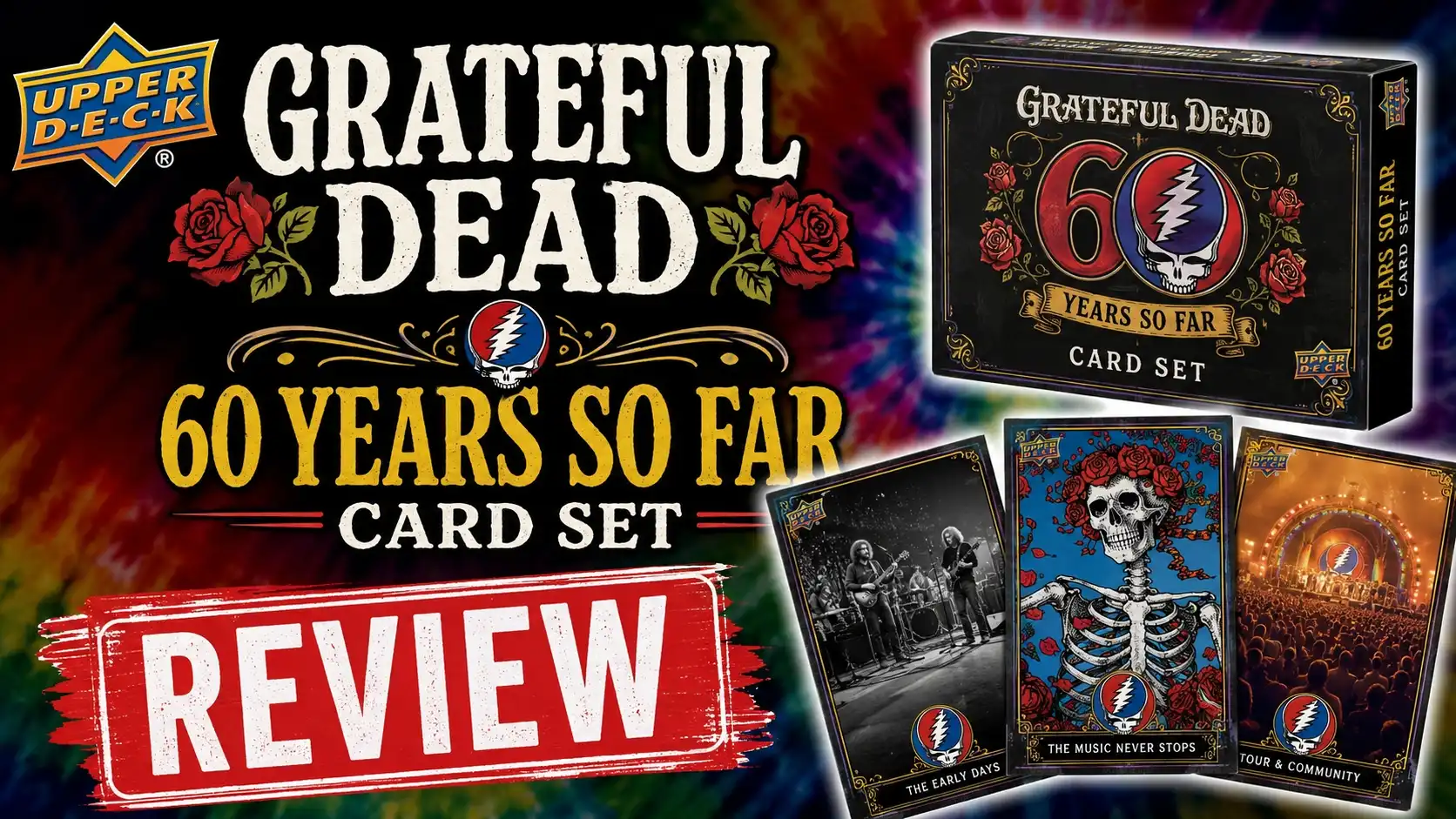

The moment Upper Deck announced its Grateful Dead collaboration in February 2026, my collector brain lit up like a wall of Fender Twins at the Fillmore West. Upper Deck Grateful Dead cards, just say that out loud. It sounds like a fever dream from a Dead show setlist, and honestly, it kind of is.
The set is called “60 Years So Far… A Visual Trip,” and that name alone tells you what Upper Deck is going for: a psychedelic, visually immersive celebration of one of rock’s most iconic bands and six decades of music, mythology, and devoted fans who never really stopped showing up.
I’ve watched music cards evolve from novelty afterthoughts into some of the most exciting pulls in the hobby. The best music releases succeed when they feel authentic, when they speak the band’s visual language instead of slapping a face on a generic template.
This one? This one feels like it was made by people who actually know what the skull means, what the lightning bolt means, and why Deadheads collect show posters the same way card collectors chase 1/1s. Let me break down exactly what Upper Deck delivered.
What Exactly Is the Upper Deck × Grateful Dead “60 Years So Far” Set?
“60 Years So Far… A Visual Trip” is Upper Deck’s 60th anniversary tribute to the Grateful Dead, a band that formed in San Francisco in 1965 and never really stopped moving.
The set builds its 50-card base around three content pillars: band iconography, classic characters, and show posters. That’s a smart, deliberate framework. It means you’re getting the visual symbols Deadheads tattooed on their bodies, the skull, the dancing bears, the lightning bolt, right alongside the psychedelic poster art that has commanded serious money in the broader memorabilia market for years.
The 60th anniversary timing isn’t arbitrary either. While Jerry Garcia passed in 1995, the Grateful Dead’s cultural presence never cooled.
Dead & Company sold out stadiums into the mid-2020s, Bobby Weir and Phil Lesh continued performing, and the band’s extended musical family kept the touring tradition alive. The fanbase didn’t age out, it grew.
Upper Deck read the room correctly. The demand was already there.
What Do You Get in a Box of Upper Deck Grateful Dead Cards?
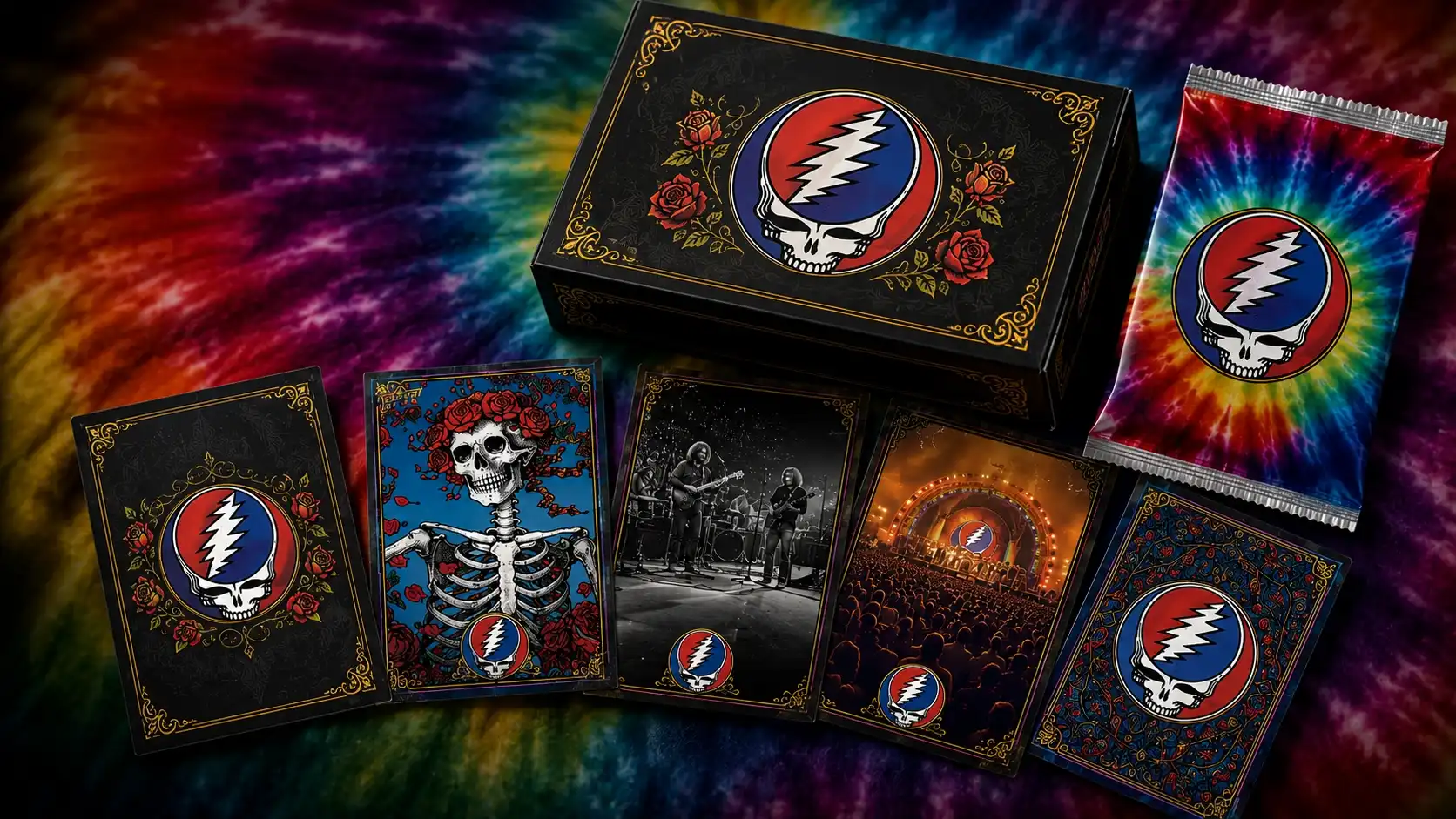
Every box contains a complete 50-card base set plus five additional hit cards, and those five hits are where the box either pays off or sends you reaching for another.
Here’s what the full box breakdown looks like:
- Base set: 50 cards covering iconography, classic characters, and show posters
- Hit cards: 5 additional cards per box
- Hit types: Serial-numbered parallels, themed inserts, or an autograph
The five-hit structure is Upper Deck’s guarantee that no box is purely a base experience. You’re not walking away with 50 cards and nothing else.
The built-in expectation of serial-numbered pulls on every box keeps the value floor from completely collapsing on the secondary market, which matters for collectors who buy sealed product as an investment rather than just for the rip.
The 50-card base set itself is a strong size choice. Compact enough that building a master set is achievable, not a years-long grind, but substantial enough to cover the breadth of Grateful Dead iconography without feeling rushed. When a base set only has 50 slots, every single card has to carry its visual weight.
No filler. No “fifth alternate photo of the same image.” Upper Deck had to be intentional, and from what the set reveals, they were. Also, you may love these Upper Deck Batman cards.
What Are All the Parallels in the Upper Deck Grateful Dead Set?
The parallel rainbow in “60 Years So Far” runs six tiers, from guaranteed per-box Yellow pulls all the way to the singular 1/1 High Potency Purple.
| Parallel | Print Run | Per Box |
|---|---|---|
| Yellow | Open (unspecified) | 3 guaranteed |
| Green | /199 | Variable |
| Blue | /149 | Variable |
| Orange | /65 | Variable |
| Pink | /13 | Variable |
| High Potency Purple | 1/1 | Ultra-rare |
The Yellow parallel is your volume pull, three per box means every collector gets a taste of the rainbow without hitting the jackpot. These will be the most common cards in the ecosystem, and secondary values on Yellow will depend almost entirely on which base card they land on. A Yellow of a marquee show poster image or the skull icon? Meaningful. A Yellow of a supporting visual? Moving on.
Where the set gets genuinely interesting is from Green (/199) down. The step from Green to Blue is a tighter gap (/199 to /149) than many Upper Deck releases, which signals intentional scarcity even at the mid-tier.
Orange at /65 is legitimately collectible. Pink at /13 is the kind of pull that stops a break in its tracks, there are only 13 copies of every card in that tier, full stop.
What Makes the High Potency Purple 1/1 the Ultimate Chase?
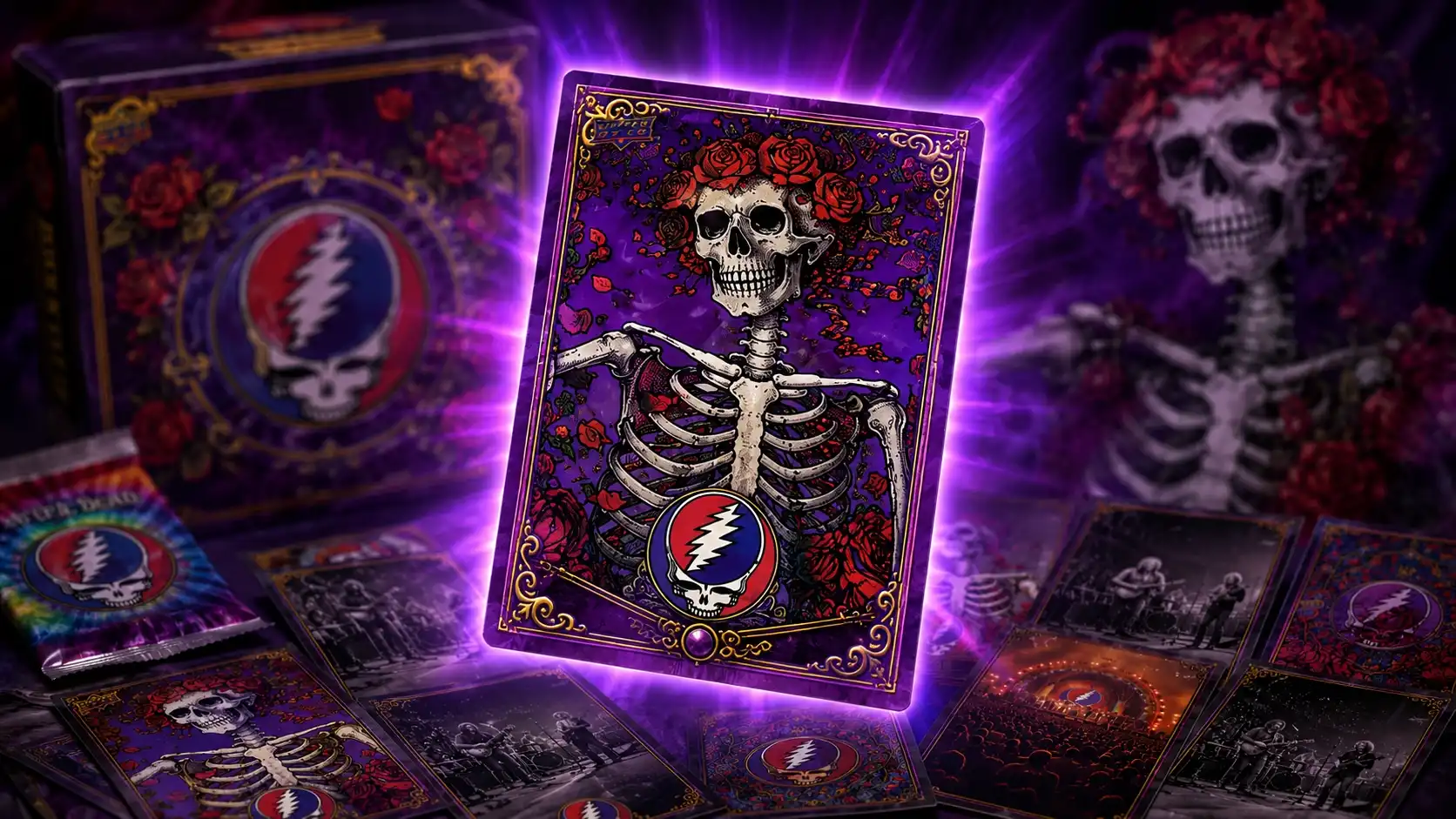
The High Potency Purple is a true 1/1, one copy of every base card in the set exists at this tier, making each one a completely unique, unrepeatable object in the hobby.
For a Deadhead who collects, this isn’t just a trading card. It’s a singular piece of the band’s legacy in a format that can be graded, authenticated, and displayed alongside the vintage poster collection.
A High Potency Purple 1/1 of a classic Fillmore show poster design or the iconic skull imagery? That’s the card that ends up behind glass, not in a binder.
The name earns separate credit. “High Potency Purple” is pure Dead branding, a reference to the color palettes and countercultural language woven into the band’s identity since Haight-Ashbury.
Upper Deck didn’t call it “Black” or “Superfractor.” They named it something that sounds like it came off a ’60s flyer from the Avalon Ballroom. That kind of attention to the band’s DNA doesn’t happen by accident, and it signals that whoever worked on this set actually cared about getting it right.
Is the Autograph Chase in This Set Worth Pursuing?
An autograph is possible, not guaranteed, within the five-hit configuration per box, which positions it as a real chase rather than a box-topper certainty.
The autograph checklist matters enormously here. For a 60th anniversary Grateful Dead release, the dream pull is a Bob Weir or Phil Lesh on-card signature. Mickey Hart and Bill Kreutzmann round out the surviving core.
Beyond the band itself, the Dead’s extended universe, including collaborators, affiliated artists, and key figures from the touring era, offers a rich checklist Upper Deck could explore across multiple series.
The investment math is worth understanding for serious collectors. The Grateful Dead fanbase is one of the most devoted in music history, and many Deadheads have never engaged with the card hobby at all.
They do, however, buy signed memorabilia. A PSA-graded autograph from a key band member on a visually striking show poster card is the type of crossover piece that attracts buyers from completely outside the traditional hobby ecosystem, which historically drives prices higher than comparable sports or entertainment releases.
Who Should Actually Buy This Set?
There are two collector profiles for Upper Deck Grateful Dead cards, and they don’t overlap much, but both have strong reasons to engage.
The Deadhead Collector: Someone who followed the touring circuit, owns the posters, still has the concert tapes, and hasn’t seriously engaged with the card hobby.
For them, “60 Years So Far” is memorabilia in a new format, visually familiar, emotionally resonant, and priced far below vintage original poster art. The barrier to entry here is low. The barrier to walking away is high.
The Music Card Investor: A collector who tracks the music card market the way others track rookie cards, monitoring PSA population reports, watching secondary sales, and positioning for appreciation.
Music cards have demonstrated consistent demand growth over the past five years, and a 60th anniversary release anchored by one of rock’s most iconic catalogs, with tight print runs across every parallel tier, is exactly the type of product that performs in that market.
If you fall into both categories, you already know where this goes. Welcome to the dangerous section of the hobby.
How Does This Compare to Other Music Card Sets?
Upper Deck Grateful Dead cards earn a place alongside the strongest music releases the hobby has produced in recent years.
The best music card sets work because they feel authentic to their subject. Elvis sets that lean into the Sun Records era and the Las Vegas years. Beatles releases that draw from the Abbey Road imagery.
KISS cards built around the full spectacle of the live show. When the visual language on the cards matches what fans already love about the artist, the crossover audience shows up, and they spend.
“60 Years So Far… A Visual Trip” clears that bar. The choice to structure the base around show posters specifically is the move that separates this release from a generic celebrity card product. Show poster collecting is its own serious market.
By bringing that imagery into a graded, numbered card format, Upper Deck is essentially opening a new door between two collector communities that have historically ignored each other. That’s a real opportunity, for the hobby and for values.
Is the Upper Deck Grateful Dead Set Worth It?
Yes, and specifically because it respects both audiences it’s built for.
For the hobbyist: the parallel structure gives you a clear, motivated hierarchy. Three guaranteed Yellow pulls per box, mid-tier numbered cards to chase, genuinely scarce Pink /13 pulls, and the ultimate 1/1 High Potency Purple sitting at the top of the rainbow. The autograph upside is real. The 50-card base is tight and collectible. The set is built correctly.
For the Deadhead: this is a visually stunning piece of 60th anniversary memorabilia that lives inside one of the most liquid collectible marketplaces on earth. A graded Pink parallel of a classic show poster image carries both cultural and financial value simultaneously, and that combination is rare in any collecting category.
“60 Years So Far… A Visual Trip” earns its name. Upper Deck came correct with this one, and it earns a permanent spot in any serious music card collection.
Have you pulled a High Potency Purple yet? Drop your box break results in the contract page; we want to see what the Dead brought you.