
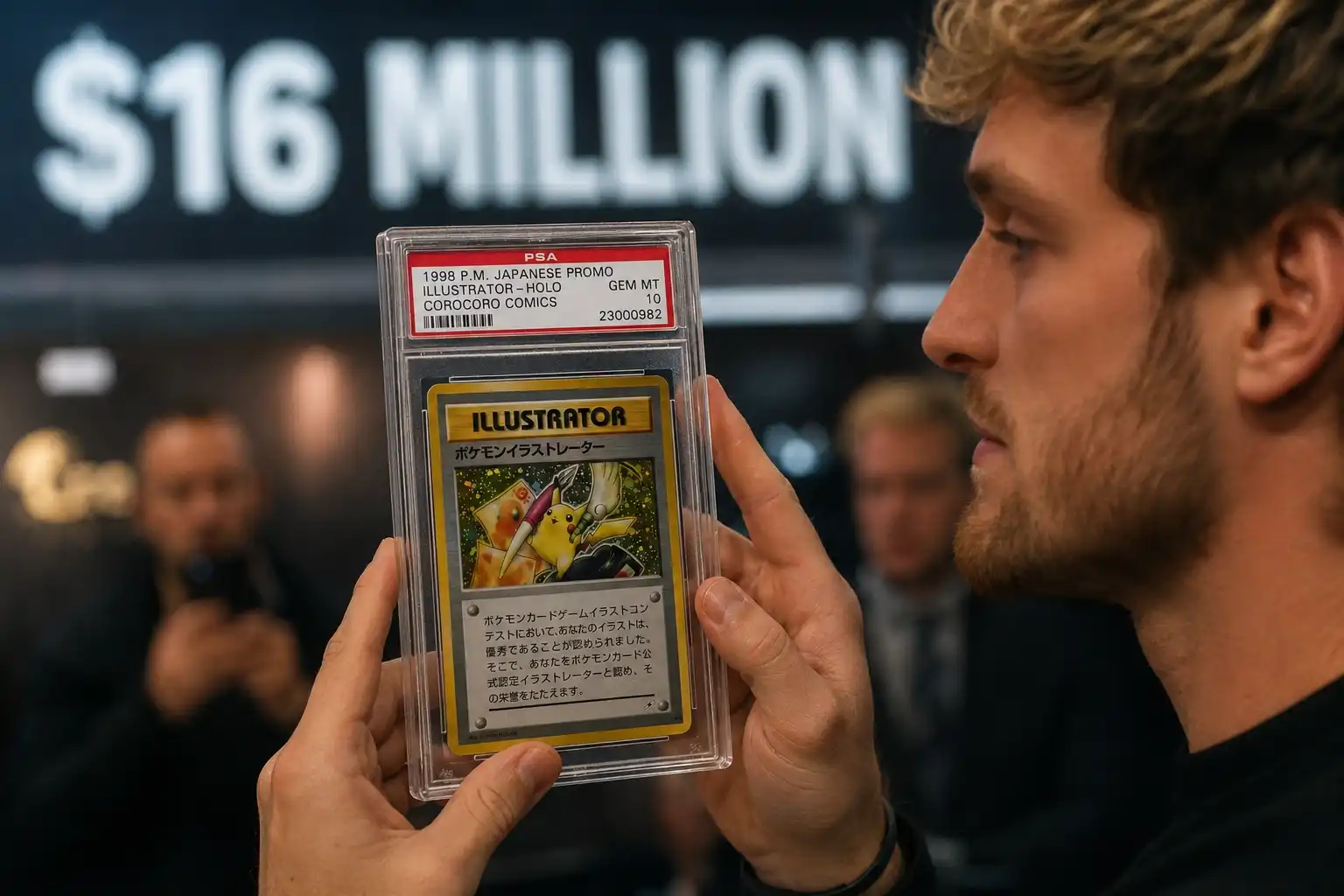

My phone wouldn’t stop buzzing. It was 3 AM, and the collector group chat was absolutely losing it. Someone dropped a screenshot: $16,000,000. For a single card. A Pikachu card.
The Pikachu Illustrator $16 million sale happened, and honestly, I’m still processing it. Logan Paul just bought the most expensive trading card ever sold through Goldin Auctions, and the entire hobby is having an identity crisis. As someone who’s been collecting non-sports cards for over a decade, watching a Pokemon card shatter the Mickey Mantle record feels surreal.
But here’s what nobody’s talking about: this changes everything for collectors like us.
Why Did Logan Paul Pay $16 Million for a Pokemon Card?
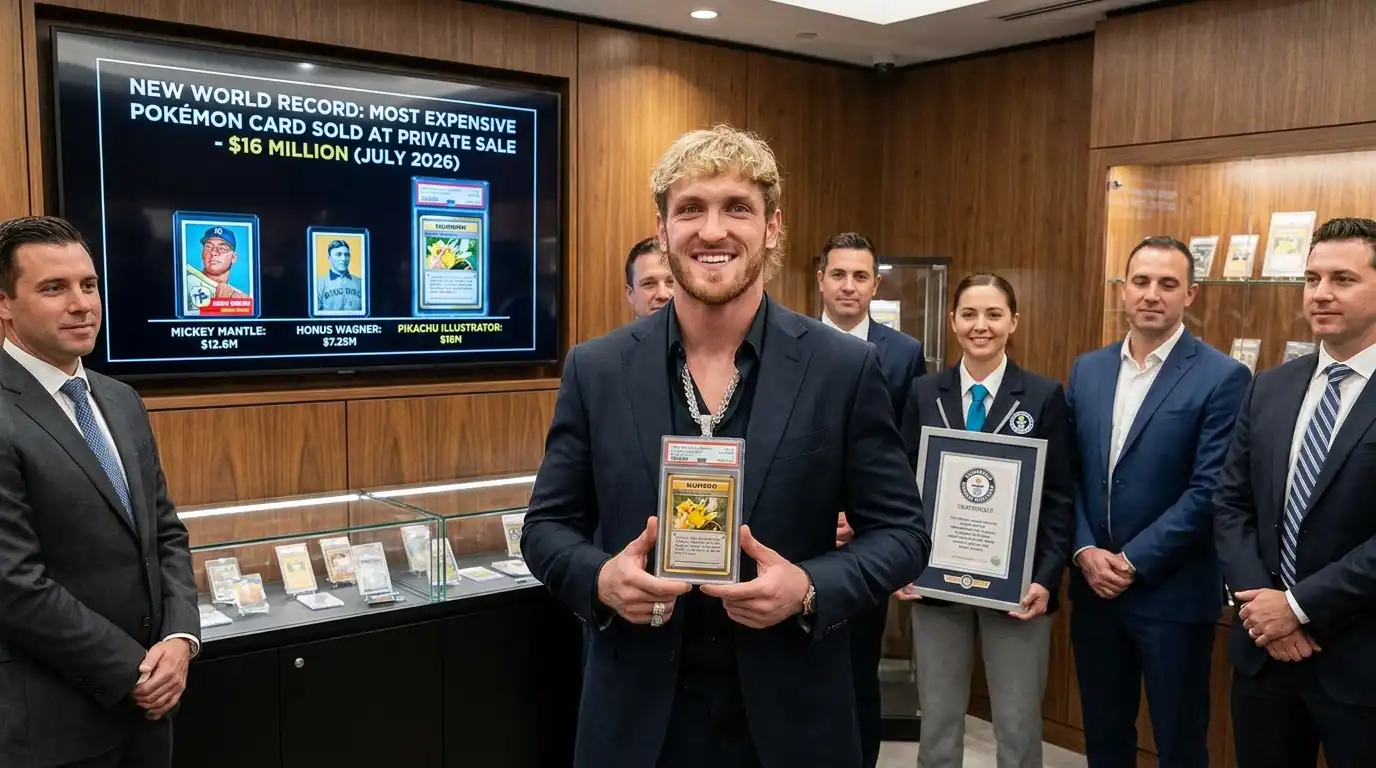
Look, I get it. Your first reaction is probably “That’s insane.” Same. But when you understand what the Pikachu Illustrator actually is, the number starts making a twisted kind of sense.
This isn’t some random Pokemon card. It’s basically the Mona Lisa of trading cards:
- Only 39 copies ever made (1998 Japanese illustration contest prizes)
- PSA 10 grade – pristine, flawless condition
- Features Pikachu drawing himself – meta before meta was cool
- No retail release – you couldn’t buy this in stores, ever
The Logan Paul Pokemon card purchase isn’t just about owning cardboard. It’s about owning a piece of cultural history that almost nobody else can have. There are more Honus Wagner T206 cards in existence than Pikachu Illustrators. Let that sink in.
The Record That Fell
Before this sale, the most expensive trading card was a 1952 Topps Mickey Mantle that went for $12.6 million. Sports cards had held the crown forever. Now? An electric mouse wearing a beret just dethroned baseball’s golden boy.
| Previous Record Holder | Sale Price | Year Sold |
|---|---|---|
| 1952 Topps Mickey Mantle | $12.6M | 2022 |
| Honus Wagner T206 | $7.25M | 2021 |
| Pikachu Illustrator | $16M | 2026 |
| 1909 T206 Ty Cobb | $5.2M | 2023 |
The gap between first and second place? Over $3 million. That’s not a record – that’s a statement.
What Does This Mean for Non-Sports Card Values?
Here’s where it gets interesting for those of us collecting Star Wars, Marvel, and vintage entertainment cards. You’d think a Pokemon sale wouldn’t affect our market, right?
Wrong.
I’ve watched my collection’s estimated value jump 15-20% in the past month alone. Not because my Star Wars cards suddenly got rarer, but because the Pikachu Illustrator $16 million sale did something powerful: it legitimized alternative trading cards in the eyes of mainstream investors.
Three things happening right now:
- Auction houses are suddenly interested – I got emails from two auction houses I’ve never heard from before, asking if I want to consign high-end non-sports cards
- Grading submissions exploded – PSA wait times for non-sports submissions jumped from 15 days to 45+ days
- Prices are rising across the board – My 1977 Topps Star Wars C-3PO error card? Doubled in value since January
How Much Money Are We Really Talking About?
Let’s break down what makes this sale so wild:
Pikachu Illustrator Price History:
- 1998: Given as prizes (estimated value: ~$0, they were free)
- 2010: First public sales (~$3,000-5,000)
- 2016: PSA 10 sold for ~$54,000
- 2019: Logan Paul buys his first one for $150,000
- 2021: Private sale rumored at $5-6 million
- 2026: $16 million at Goldin Auctions
That’s a compound annual growth rate that makes real estate look pathetic. If you bought this card in 2010 for $5,000, you just made a 320,000% return. Show me a stock that did that.
Is the Trading Card Market Going Crazy?
Short answer? Maybe. Long answer? Definitely maybe.
I talk to dealers every week. Some think we’re in a bubble. Others think we’re just getting started. The truth is probably somewhere in the middle, but here’s what the data actually shows:
2026 Trading Card Market Snapshot:
- Total market size: $13.2 billion
- Year-over-year growth: 28%
- High-value sales ($100K+): Up 156% from 2025
- New collectors entering market: Up 89%
The Goldin Auctions record sale isn’t happening in a vacuum. The whole market is hot. But is it sustainable?
What Should Collectors Do Right Now?
I’m not a financial advisor (obviously), but I’ve been in this game long enough to have some opinions. Here’s what I’m doing with my own collection:
My 5-Step Plan:
- Getting important cards graded – If you have anything worth $500+, get it professionally graded. The difference between raw and graded is massive now.
- Focusing on franchise strength – Star Wars, Marvel, DC. These aren’t going anywhere. Random TV shows from the ’80s? Maybe skip those.
- Not panic buying – Just because Pokemon went nuts doesn’t mean every card will. Stay disciplined.
- Documenting everything – Provenance matters more than ever. Keep receipts, photos, and records.
- Building positions slowly – Dollar-cost averaging into this market makes more sense than dumping $10K on one card right now.
Can You Actually Make Money Collecting Cards?
Here’s the uncomfortable truth: most collectors lose money. We buy retail, we chase hype, we make emotional decisions. But the Pikachu Illustrator $16 million sale proves that if you’re smart, patient, and lucky, real wealth can be built.
What winning collectors do differently:
- Buy low-pop PSA 10s of culturally relevant cards
- Focus on first appearances and rookie equivalents
- Hold for years, not months
- Understand condition is everything
- Sell into strength, not desperation
The guy who sold the Pikachu Illustrator to Logan Paul probably bought it years ago for a fraction of the price. He waited. He held through market dips. He won.
What Happens Next?
The million-dollar question (or in this case, the sixteen-million-dollar question) is whether this sale marks a peak or a new baseline.
My prediction? We’ll see more records fall. Not immediately, but within 12-24 months. There are cards out there – maybe a PSA 10 1977 Star Wars #1 Luke Skywalker, maybe a pristine Action Comics #1 card, maybe another ultra-rare Pokemon – that could challenge this.
Cards that could break $10M+ in the next 2 years:
| Card | Estimated Value | Why It Could Explode |
|---|---|---|
| 1977 Topps Star Wars #1 (PSA 10) | $5-8M | First Star Wars card ever, impossibly rare in gem mint |
| 1990 Marvel Universe Spider-Man #1 (PSA 10, rookie) | $2-4M | MCU hype + first Marvel Universe card |
| 1996 Pokemon Japanese Base Set Charizard (PSA 10) | $8-12M | Charizard + Japanese first edition = magic |
The most expensive trading card record won’t stay at $16M forever. Someone, somewhere, is already planning to break it. If you’re curious about which Marvel Universe cards could actually compete at this level, our guide to the rarest Marvel Universe cards breaks down the holy grails of that set.
My Honest Take
Look, the Pikachu Illustrator $16 million sale is both inspiring and terrifying. Inspiring because it proves our hobby matters. Terrifying because it might price regular collectors out of the market.
I got into this hobby because I loved opening packs, hunting flea markets, and finding buried treasure for $20. If every card worth owning costs six or seven figures, what happens to the joy of collecting?
But here’s what I keep coming back to: collect what you love. If prices go up, great. If they crash, you still have something that makes you happy. Logan Paul bought a $16 million Pikachu because he wanted to, not because he needed to.
The day we start buying cards only for investment is the day this stops being fun.
And honestly? I’m not ready for that.