

The pack wrapper was holographic. I’d never seen anything like it in 1993. Most trading card packs came in plain wax wrappers or basic foil. This SkyBox DC Cosmic pack shimmered like someone had wrapped a rainbow in plastic.
I was thirteen, standing in a Walgreens, holding what I didn’t realize was the future of premium trading card packaging. The pack cost $1.50, triple what Marvel Universe packs cost. But the wrapper promised something different: “Cosmic Cards featuring DC’s greatest heroes.”
I bought two packs. Ripped them in the parking lot. The first card showed Superman flying through space, painted in hyper-realistic detail with a cosmic background that looked more like fine art than a trading card. The cardstock was thicker than normal. The finish was glossy.
Everything felt premium.
The 1993 SkyBox DC Cosmic Cards represented a pivotal moment in DC trading card history, the first premium DC product with painted artwork, chromium technology, and insert chase cards that established the template for modern superhero card releases.
What Are the 1993 DC Cosmic Cards?
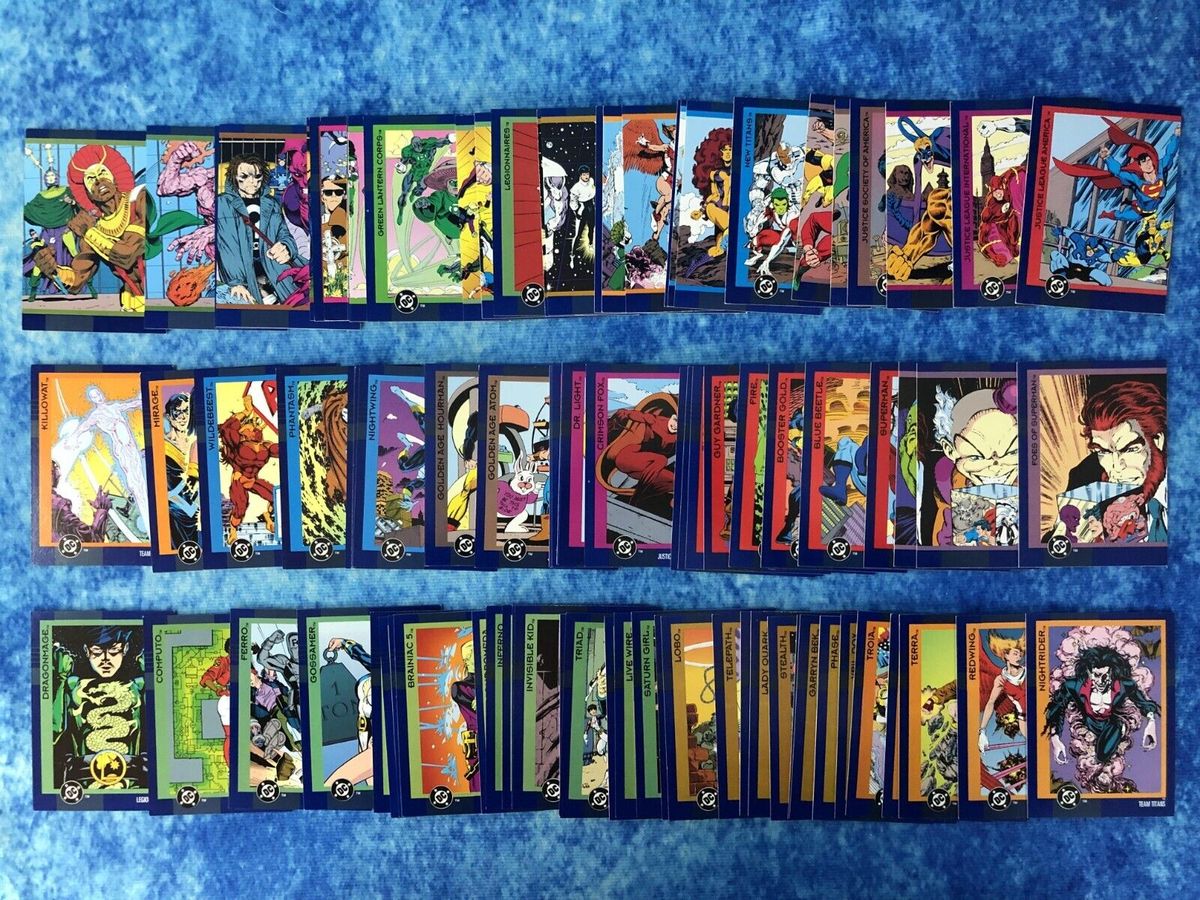
The 1993 DC Cosmic Cards are a 150-card base set produced by SkyBox featuring painted artwork of DC Comics characters with cosmic and space themes, plus chromium parallel cards and hologram chase inserts. The set elevated DC card production quality beyond the simple comic reprints of previous releases.
SkyBox secured the DC license in 1993 and immediately aimed for premium positioning. Where earlier DC sets simply reprinted comic panels, Cosmic Cards commissioned original painted artwork depicting DC heroes in space settings, cosmic battles, and universe-spanning adventures.
Base set structure: 150 base cards, painted artwork of major DC characters 10 Spectra (chromium) parallel cards, limited foil versions 9 hologram chase cards, DC heroes in holographic 3D format Promo cards, retailer exclusives and convention giveaways Packs cost $1.50 and contained 8 cards. Boxes contained 36 packs. The price point positioned Cosmic Cards as premium product competing with SkyBox’s Marvel Masterpieces line.
For collectors familiar with how premium Marvel sets evolved in the early 1990s, DC Cosmic Cards followed a similar trajectory, moving from basic reprints to original commissioned artwork.
Why Was This Set Revolutionary for DC Cards?
This set was revolutionary for DC cards because it introduced painted artwork, chromium technology, and hologram inserts to the DC collecting market, proving DC properties could support premium products and establishing design standards that influenced DC card releases for the next decade.
Before Cosmic Cards, DC trading cards were afterthoughts. Companies reprinted comic panels, slapped them on cardstock, and sold them cheaply. No original art. No premium materials. No collector focus.
Cosmic Cards changed everything:
- Original Painted Artwork: Artists painted heroes specifically for cards, not reprints Cosmic Theme, Unified visual identity across all 150 cards Chromium Parallels, Foil technology creating chase content
- Hologram Inserts: 3D holographic DC heroes randomly inserted Premium Packaging, Holographic wrappers signaling quality The set proved DC collectors would pay premium prices for premium products. This opened the door for future DC releases with autographs, sketch cards, and modern insert structures.
What Makes the Spectra Chromium Cards Valuable?
The Spectra chromium cards are valuable because only 10 cards from the 150-card base set received the chromium foil treatment, creating instant scarcity, and the foil technology was cutting-edge in 1993, making these cards visually stunning and highly sought by collectors.
Spectra cards featured the same artwork as base cards but printed on chromium stock that created rainbow prismatic effects when tilted. The technology was expensive in 1993, limiting SkyBox to producing Spectra versions for only 10 cards: Key Spectra cards:
- Superman: The flagship character, highest demand
- Batman: Peak 1990s Batman popularity
- Wonder Woman: Major trinity character
- Flash: Silver Age nostalgia
- Green Lantern: Cosmic theme fit perfectly
Individual Spectra cards sold for $20-$50 in 1993. Today, clean raw copies sell for $30-$80 depending on character. PSA 10 Spectra cards command $150-$300.
The scarcity was real. With only 10 Spectra cards across 36-pack boxes, pulling a specific character required serious pack-ripping volume or secondary market purchases.
How Do the Hologram Chase Cards Work?
The hologram chase cards feature 3D lenticular holographic images of DC heroes that shift and animate when tilted, inserted randomly at approximately 1:4 packs. Nine different heroes received hologram treatment, making a complete hologram set moderately difficult but achievable for dedicated collectors.
The nine hologram cards: 1. Superman in flight 2. Batman emerging from shadows 3. Wonder Woman with lasso 4. Flash running 5. Green Lantern with power ring 6. Aquaman underwater 7. Hawkman flying 8. Martian Manhunter shifting forms 9.
Lobo (the breakout character of 1990s DC) Each hologram showed basic animation, Superman appeared to fly toward you, Batman’s cape billowed, Flash’s legs moved in running motion. The technology was primitive by modern standards but revolutionary in 1993.
Insertion odds of 1:4 packs meant a 36-pack box yielded roughly 9 holograms, enough to complete the set with some duplicates for trading. This balanced accessibility with chase excitement.
Complete 9-card hologram sets sell for $40-$80 today depending on condition. Individual holograms sell for $5-$15 each.
What Role Did the Cosmic Theme Play?
The cosmic theme unified the set’s visual identity by framing all DC heroes in space settings, cosmic battles, and universe-spanning adventures, which distinguished the product from standard superhero card releases and provided artists with dramatic backdrops for painted artwork.
Every card featured space elements: star fields, cosmic energy, planetary backgrounds, nebulae, and galaxy imagery. This created visual consistency across 150 cards that might otherwise feel disjointed.
The theme worked especially well for cosmic DC characters:
- Green Lantern Corps patrolling space sectors
- Martian Manhunter from Mars
- Hawkman and Thanagarian heritage
- Darkseid and Apokolips
- Lobo as space bounty hunter It worked less well for street-level characters like Batman, but artists compensated by placing Batman against cosmic Gotham skylines or space-dock settings that stretched believability while maintaining theme consistency.
The unified aesthetic made collecting more engaging. You weren’t just accumulating random DC character cards. You were building a cosmic DC universe gallery.
How Does This Set Compare to 1966 Batman Cards?
The 1993 DC Cosmic Cards differ from 1966 Batman cards by featuring painted original artwork rather than TV show photography, emphasizing DC’s full character roster rather than single-property focus, and targeting older collectors with premium pricing versus mass-market distribution to children.
| Aspect | 1966 Batman | 1993 Cosmic |
|---|---|---|
| Source | TV show photos | Original paintings |
| Focus | Batman only | Full DC universe |
| Price | $0.10/pack | $1.50/pack |
| Target | Children | Older collectors |
| Technology | Basic printing | Chromium, holograms |
| Longevity | Nostalgia-driven | Quality-driven |
Both sets represent pivotal moments in DC card history. 1966 established that Batman cards could sell. 1993 proved DC cards could be premium collectibles worthy of adult collector budgets.
What Condition Issues Affect These Cards?
The primary condition issues affecting 1993 DC Cosmic Cards include chromium card surface scratching, hologram print lines from manufacturing, and base card edge chipping from pack insertion. The premium materials that made these cards special also made them vulnerable to condition problems.
Common issues: Chromium Surface Scratches, Spectra cards scratch easily during pack insertion and handling. Even mint-from-pack Spectra cards often show light surface marks under magnification.
- Hologram Print Lines, Manufacturing defects created horizontal lines across some holograms.
- These don’t affect functionality but lower grades.
- Edge Chipping, The thicker cardstock chips more easily than standard cards. White edge showing is common.
- Centering, 1993 cutting equipment produced off-center cards. Perfectly centered examples are scarce.
- Glossy Surface Fingerprints, The glossy finish shows fingerprints and smudges easily. Clean surfaces are tough to maintain.
High grades are tougher than expected given the set’s age. PSA 9s are solid cards. PSA 10s are genuinely rare. Population reports show brutal scarcity at gem-mint levels.
How Do You Collect This Set Today?
You collect the 1993 DC Cosmic Cards today by purchasing complete base sets from eBay or hobby dealers for $50-$100, buying hologram sets separately for $40-$80, and targeting Spectra cards individually based on character preference and budget. Complete master sets including all parallels run $300-$600.
Collection strategies:
- Strategy 1: Base Set Only ($50-$100) Buy a complete 150-card base set in near-mint raw condition. This captures the core collecting experience without chasing expensive Spectra or hologram variants.
- Strategy 2: Base + Holograms ($100-$200) Complete base set plus all nine hologram chase cards. Achievable and satisfying without breaking the bank.
- Strategy 3: Character Focus Chase all versions (base, Spectra, hologram) of favorite characters. A complete Superman or Batman run across all formats creates focused subcollections.
- Strategy 4: Graded Master Set ($500-$1,500) All 150 base cards, all 10 Spectra cards, all 9 holograms, ideally graded PSA 8 or better. This is the completionist path. I own a partial base set, about 75 cards including the Superman and Batman Spectra cards and 4 holograms. I bought them at a card show in 2002 for $35 total. They sit in a binder next to my 1992 Marvel Masterpieces cards, reminding me when painted superhero cards were the cutting edge.
What’s the Market for These Cards in 2026?
The market for 1993 DC Cosmic Cards in 2026 is stable but modest, with base cards selling for $0.25-$1, Spectra cards selling for $30-$80, and complete sets trading steadily in the $50-$200 range depending on inclusions. The set maintains collector interest without achieving explosive growth.
Market reality: Base Cards, Plentiful supply, low individual value, complete sets affordable Spectra Cards, Limited supply creates sustained demand, character drives pricing Holograms, Novelty value persists, complete sets easy to assemble Graded Cards, PSA 9-10 examples command premiums but population is small.
The set benefits from 1990s nostalgia but suffers from competition with modern DC products featuring autographs, relics, and sketch cards. Collectors allocating $200 to DC cards often choose modern hits over vintage painted artwork.
Still, the set has legs. Thirty-three years later, people still buy, collect, and appreciate it. That longevity suggests genuine collectibility rather than passing fad.
Why Do 1990s Painted Card Sets Still Matter?
1990s painted card sets still matter because they represent the artistic peak of pre-digital trading card production, showcase commissioned artwork that exists nowhere else, and capture a specific aesthetic that modern digital products can’t replicate. The painted cards are artifacts of a transitional era.
Before 1990s sets like Cosmic Cards and Marvel Masterpieces, trading cards reprinted existing comic panels. After 2000, digital art and photo manipulation dominated. The 1990s occupied a sweet spot where companies commissioned original oil paintings specifically for cards.
Those paintings are unique. The Joe Jusko Punisher from Marvel Masterpieces? Painted once, for that card. The DC Cosmic Batman? Original artwork that exists as a physical painting somewhere. These cards are reproductions of unique art pieces.
Modern cards feature digital illustrations or film stills. Both are fine, but neither matches the romantic appeal of knowing an artist sat with oils and canvas, painted Superman flying through space, and that painting became a trading card.
For collectors who value craftsmanship and analog artistry, 1990s painted sets are treasures. For younger collectors raised on digital content, they’re historical curiosities. Both perspectives are valid.
Cosmic Cards Were Ahead of Their Time
The 1993 SkyBox DC Cosmic Cards arrived at a weird moment in trading card history. The market was oversaturated. Companies were flooding shelves with products. The bubble was inflating toward its mid-1990s collapse.
But Cosmic Cards did something right. They proved DC could support premium products. They showcased beautiful painted artwork. They introduced chromium and hologram technology to DC collecting. They created a template that influenced DC card releases for years.
The set never achieved Marvel Masterpieces legendary status. It never became a must-own vintage product. But it carved out its niche, a solid, attractive, affordable DC set with genuine artistic merit.
My Superman Spectra card still catches light when I tilt it. The chromium shimmer hasn’t faded.
The artwork still looks great. And every time I see it, I remember standing in that Walgreens parking lot in 1993, ripping that holographic pack wrapper, discovering premium trading cards for the first time.
That’s the value right there. Not the money. The memory.
For comprehensive coverage of DC trading cards across all eras and how Cosmic Cards fits into the broader DC collecting timeline, explore Guide to DC Comics Trading Cards and Collectibles.