
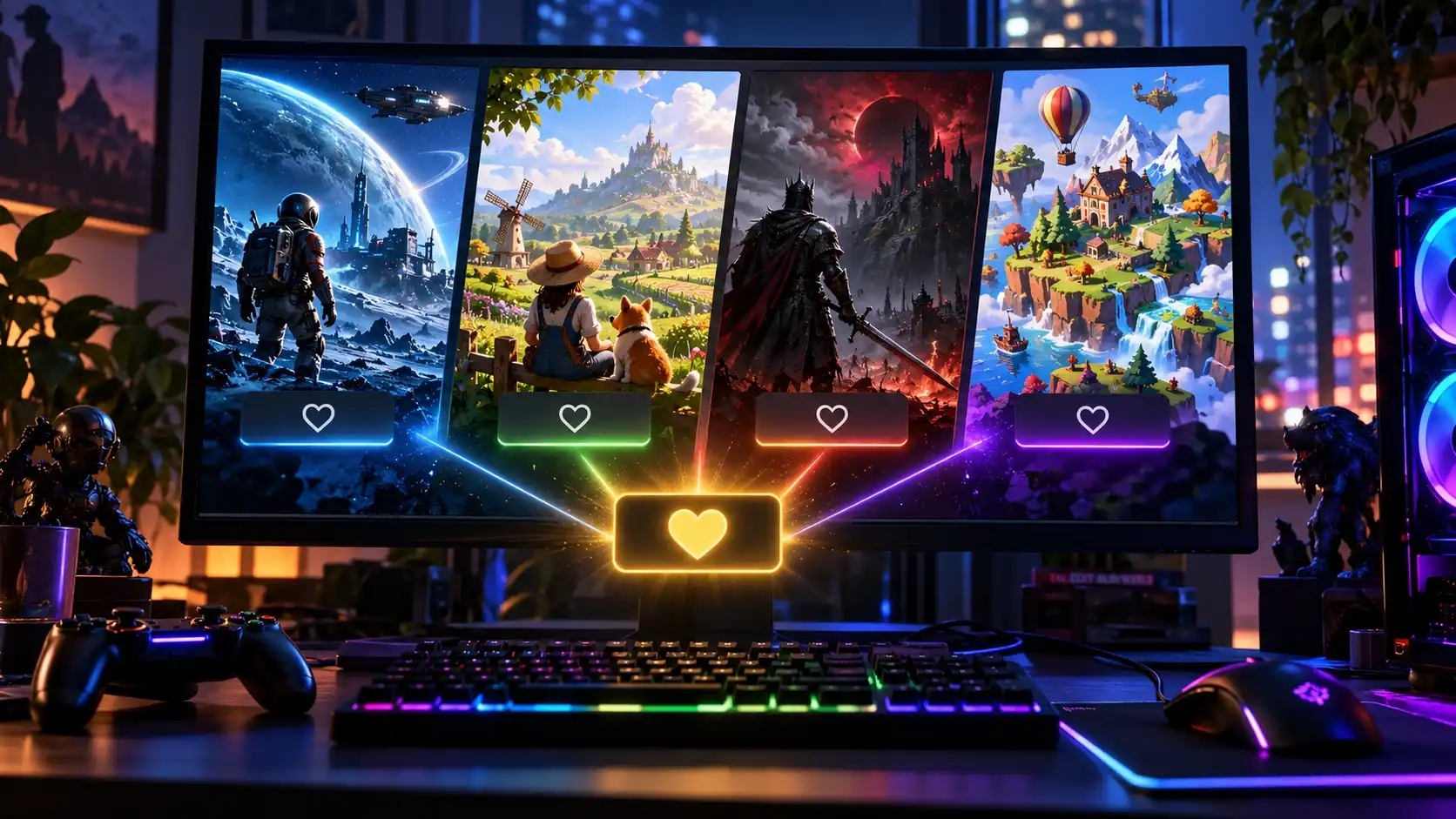

Between August 11 and 13, four Early Access indies land almost on top of each other, and they’re all fishing in the same pond, the crowd that loves to craft, build, explore, and (mostly) do it with friends. The catch is that you’ve only got so much time and so much money, and Early Access asks you to commit before a game is finished. So which of these four is worth your wishlist first?
Quick honesty check before we dive in: “survival” is a loose umbrella here. These range from a 2D factory-builder to a spell-crafting roguelite, so they’re not clones. But they overlap hard on the same “I like systems and co-op” audience, which is exactly why launching the same week is such a gamble for each of them. Here’s the full lineup, what each actually is, and who should buy which.
The Lineup at a Glance
| Game | Launch | Price | What it really is | Players |
|---|---|---|---|---|
| **Sandustry** | Aug 13 | TBA | 2D factory-automation sandbox | Solo |
| **Stonewards** | Aug 11 | TBA | Co-op dwarf mining + horde defense | 1–4 co-op |
| **Luminary** | Aug 11 | $19.99 | Chill open-zone action RPG | 1–3 co-op |
| **Echoes of Mystralia** | Aug 11 | $19.99 | Spell-crafting ARPG roguelite | Solo |
Three of the four hit on the exact same day. Only Sandustry gets a little breathing room on the 13th. Now let’s break each one down.
Sandustry: The Factory-Builder for Automation Addicts
If you love watching a tangle of conveyor belts slowly become a beautiful machine, Sandustry is your pick. Developed by Lantto Games and published by Hooded Horse, it’s a 2D factory-automation game set in a fully destructible pixel world where, as the tagline puts it, every pixel is a resource. PC Gamer’s shorthand nails it: the automation of Factorio in the 2D world of Terraria.
You dig into a procedurally generated planet, automate increasingly complex production chains, and delve deep to uncover an ancient civilization’s secrets. It’s less about fending off monsters and more about optimization and discovery.
- Best for: automation, base-building, and “just one more production line” players
- Standout signal: its free demo is sitting at an *Overwhelmingly Positive* 97% across more than 1,280 reviews, the strongest demo rating of the four
- Nice bonus: it’s on Steam, GOG, and the Microsoft Store, hits PC Game Pass day one, and even has a native Linux build
- Honest note: the developers have said the price may rise as more content is added during Early Access, so buying early likely locks in a lower price
Stonewards: The Co-op Dwarf Defense
For a rowdy night with up to three friends, Stonewards is the most social of the bunch. Made by Banana Tiger Studio, it’s a 1–4 player co-op first-person roguelite where you lead a crew of stubborn dwarves: mine procedural tunnels for resources between waves, forge upgrades, and hold the line when the monsters march on the kingdom you’re defending. “Dig. Forge. Defend.” is the whole pitch, and it wears its influences, Minecraft, Dungeon Defenders, and Deep Rock Galactic, openly.
- Best for: co-op groups who want mining, loot runs, and horde defense in one loop
- Standout signal: it built a following through the June 2026 Steam Next Fest before pulling its demo to focus on the launch build
- Honest note: this is the one that leans hardest on having friends, and it’s stepping into the long shadow of Deep Rock Galactic, so it has the toughest competition to justify itself against
Luminary: The Chill Co-op RPG
If you want a relaxed fantasy adventure to share without the usual friction, Luminary is the cozy option. Built by the two-person team at Refractive Entertainment, it’s a fantasy “ARPG-lite”, solo or drop-in co-op for up to three players, with shared progression so nobody has to pass the controller. The creative director has openly said the idea came from playing Breath of the Wild with family, and previewers have compared its combat to Fable.
You explore handcrafted open zones, climb, swim, glide, hunt monsters, chase treasure, and rebuild your town, all with forgiving combat aimed at newcomers and veterans alike. Notably, it deliberately skips survival busywork, no forced hunger meters or time-wasting systems.
- Best for: friends who want a laid-back, welcoming co-op RPG rather than a punishing grind
- Standout signal: 50,000+ wishlists and a 90% *Very Positive* demo before launch
- Price: $19.99, with a 1.0 release targeted roughly a year out
- Honest note: early players flag some rough edges, awkward menus, camera struggles during fast climbing, inconsistent hit detection, the usual Early Access wrinkles
Echoes of Mystralia: The Spell-Crafting Wonder
The most anticipated of the four by a mile, Echoes of Mystralia is the one to watch if you love build-crafting. From Montreal’s Borealys Games, the studio behind the award-winning Mages of Mystralia (2017), it’s an action-heavy spell-crafting ARPG roguelite. You play a Watcher named Mazarim, protecting the Cycle of Memories from a reality-consuming Rift.
The hook is the crafting system: you collect Memories and build spells from elements like fire, ice, and lightning, where the *position* of each component changes the spell’s behavior, allowing for millions of combinations. It’s often mentioned alongside Noita and Magic Survival, but with more intentional, deliberate crafting rather than chaos.
- Best for: solo players who love theorycrafting, roguelite runs, and deep customization
- Standout signal: 175,000+ wishlists, comfortably the biggest pre-launch audience of this group
- Launch content: 110 Memories, 12 spell forms, 3 regions, and 3 Guardians, with save data carrying over from the demo
- Price: $19.99, with a Mystralia Bundle pairing it with Mages of Mystralia for 10% off
Which One Should You Actually Buy First?
It comes down to who you’re playing with and what itch you’re scratching. Here’s the shortcut:
- You play solo and love systems → Echoes of Mystralia (spell theorycrafting) or Sandustry (factory optimization)
- You’ve got a co-op crew → Stonewards (rowdy horde defense) or Luminary (relaxed shared adventure)
- You want the safest bet on polish → Echoes of Mystralia and Sandustry, both riding enormous demo goodwill
- You want the cheapest confirmed price → Luminary and Echoes at $19.99 each; Sandustry and Stonewards hadn’t locked public prices at the time of writing
If I had to spend on just one this week, the smart money is on Echoes of Mystralia, 175,000+ wishlists and a proven studio is a hard combination to ignore. But if your group chat is already planning a co-op night, Stonewards or Luminary will get more hours out of your friends.
Here’s the pre-launch hype gap in one look:
Reported Steam wishlists before launch

Echoes of Mystralia ████████████████████ 175,000+
Luminary ██████ 50,000+
Sandustry (leaned on a 97% demo, no public total)
Stonewards (Next Fest following, no public total)
Read that as interest, not quality, wishlists measure anticipation, and Sandustry’s demo rating suggests it punches well above whatever its wishlist count is.
Should You Buy Any of Them in Early Access at All?
Only if you’re comfortable playing an unfinished game and shaping it with feedback, that’s the whole deal with Early Access. All four are launching incomplete by design, with content and balance changes planned over months. A few honest ground rules before you spend:
- Prices can climb. Sandustry’s team has openly said it may raise the price as content grows, which is common across Early Access, buying early often means paying less.
- Roadmaps vary. Some studios (Echoes, Sandustry) have detailed post-launch plans; others want to gather feedback before committing to a public roadmap.
- Demos are your friend. Sandustry and Echoes both had strong free demos, and demo saves even carry into Echoes’ full version, try before you buy wherever you can.
- Co-op games need co-op partners. Stonewards and Luminary are far more fun with friends; buying them to play solo may leave you underwhelmed.
None of these are red flags, they’re just the reality of backing a game mid-development. Two of the four (Echoes and Sandustry) look like the lowest-risk bets thanks to overwhelming demo receptions; the other two are more about matching the right game to the right group.
Why a Card Site Is Watching a Crowded Early Access Week
Because a launch pile-up like this is a perfect snapshot of how Steam discovery actually works, and that’s a machine we watch closely. Four small teams betting on the same week, leaning on demos and wishlists to break through, is the same grassroots path that turns unlikely titles into hits, whether it’s a spell-crafting roguelite or a bare-bones oddity like Trading Card Inspector, the $7 Steam sleeper.
There’s a collecting parallel here too. The crafting, gathering, and “build the perfect setup” loops driving these games are the exact instincts behind the wave of video game trading cards and the broader gaming-collectibles crossover, the joy of assembling something piece by piece. And the cozy-management energy that makes a factory-builder like Sandustry click is the same energy that turned TCG Card Shop Simulator into a surprise Steam hit.
Watching which of these four converts launch-week buzz into a lasting community is one of the better early reads on where fan energy, and eventually collectibles, will flow next.
Final Thoughts
My honest take: this week is a great problem to have if you love indie games, and a genuine headache if your budget is tight. Four capable teams shipped into the same 48-hour window, and the sad math of Early Access is that some of them will get buried simply because attention is finite, not because they’re worse.
If you buy nothing else, keep an eye on Echoes of Mystralia; the wishlist numbers and studio pedigree make it the likeliest breakout. But don’t sleep on Sandustry’s demo goodwill, and if you’ve got a co-op crew, Stonewards or Luminary will earn their $20 in laughs alone. My advice: play the demos where they exist, be honest about whether you have people to play with, and pick the one game you’ll actually sink twenty hours into, rather than grabbing all four and finishing none.
Frequently Asked Questions
What are the four Early Access games launching this week?
Sandustry (a 2D factory-automation sandbox), Stonewards (a 1–4 player co-op dwarf mining and defense roguelite), Luminary (a chill co-op action RPG), and Echoes of Mystralia (a solo spell-crafting ARPG roguelite). Stonewards, Luminary, and Echoes all launch August 11, while Sandustry follows on August 13.
How much do they cost?
Luminary and Echoes of Mystralia are both confirmed at $19.99. Sandustry and Stonewards hadn’t announced public launch prices at the time of writing, and Sandustry’s developers have noted the price may rise later in Early Access as more content is added.
Which of these games has the most hype?
Echoes of Mystralia, by a wide margin, it’s surpassed 175,000 Steam wishlists, helped by being a follow-up to the award-winning Mages of Mystralia. Luminary is second with 50,000+ wishlists, while Sandustry’s biggest signal is an Overwhelmingly Positive (97%) demo.
Which ones are co-op or multiplayer?
Stonewards (1–4 players) and Luminary (1–3 players) are the co-op picks, both playable solo or with friends. Sandustry and Echoes of Mystralia are single-player experiences focused on automation and spell-crafting, respectively.
Are these games finished?
No, all four are Early Access, meaning they’re playable but still in active development. Expect ongoing content additions, balance changes, and occasional rough edges, and only buy in if you’re comfortable supporting a game as it evolves.
Which should I get if I mostly play solo?
Echoes of Mystralia if you love deep build-crafting and roguelite runs, or Sandustry if you’d rather optimize sprawling factories. Both have strong demos you can try first, and neither requires friends to enjoy.
Current listing: Steam Early Access games on Steam.